Showing posts with label Cut_Flower. Show all posts

Thursday, 12 December 2019

RED BORONIA

Boronia is a genus of about 160 species of flowering plants in the citrus family Rutaceae, most are endemic in Australia with a few species in New Caledonia, which were previously placed in the genus Boronella. They occur in all Australian states but the genus is under review and a number of species are yet to be described or the description published. Boronias are similar to familiar plants in the genera Zieria, Eriostemon and Correa but can be distinguished from them by the number of petals or stamens.

Some species have a distinctive fragrance and are popular garden plants. Plants in the genus Boronia are nearly always shrubs although a very small number occur as herbs or as small trees. The leaves are usually arranged in opposite pairs and may be simple leaves or compound leaves with up to nineteen or more leaflets, in either a pinnate or bipinnate arrangement. The flowers are arranged in groups in the leaf axils or on the ends of the branches and have both male and female parts. There are usually four separate sepals, usually four separate petals and generally eight stamens. (In Zieria there are only four stamens, Eriostemon species have five petals and in Correa the petals are joined to form a bell-shaped tube.) There are four carpels with their styles fused and there are two ovules in each carpel.

Boronias are found in all states and mainland territories of Australia and generally grow in open forests or woodlands, only rarely in rainforests or arid areas. Boronias, especially B. megastigma, are known for their perfumed flowers. Unfortunately, they are generally somewhat difficult to grow in cultivation. All species require excellent drainage and part shade. Shown here is red boronia (Boronia heterophylla), which features bell-shaped blossoms that are a striking magenta pink and have a delicate perfume that adds to its appeal as a cut flower. It grows to about 1.5 m in height by half a metre wide. It originates in Western Australia but has adapted well to east coast gardens as well. ‘Ice Charlotte’ is a white flowered form of this species that has similar requirements.

This post is part of the Floral Friday Fotos meme.

Thursday, 14 November 2019

SWEET PEA

The sweet pea (Lathyrus odoratus) is a flowering plant in the genus Lathyrus in the family Fabaceae (legumes), native to Sicily, Cyprus, southern Italy and the Aegean Islands. It is an annual climbing plant, growing to a height of 1–2 metres, where suitable support is available.

The leaves are pinnate with two leaflets and a terminal tendril, which twines around supporting plants and structures, helping the sweet pea to climb. In the wild plant the flowers are purple, 2–3.5 centimetres broad; they are larger and very variable in colour in the many cultivars. The annual species, L. odoratus, may be confused with the everlasting pea, L. latifolius, a perennial.

This post is part of the Floral Friday Fotos meme.

Thursday, 12 September 2019

SHASTA DAISIES

Leucanthemum × superbum (or Shasta daisy) is a commonly grown flowering herbaceous perennial plant with the classic daisy appearance of white petals (ray florets) around a yellow disc, similar to the oxeye daisy Leucanthemum vulgare Lam. but larger. Shasta daisies are characterised by a distinct odour which some find unpleasant.

This flower originated as a hybrid produced in 1890 by the American horticulturist Luther Burbank from a number of daisies. First, he crossed Leucanthemum vulgare with Leucanthemum maximum (Ramond) DC.; this double hybrid was itself crossed with Leucanthemum lacustre (Brot.) Samp. The resulting Leucanthemum triple hybrid was crossed with Nipponanthemum nipponicum (Franch. ex Maxim.) Kitam., creating an intergeneric cross of species from three continents.

It was named after Mount Shasta, because its petals were the colour of the snow. Some members of the genus are considered noxious weeds, but the Shasta daisy remains a favourite garden plant and ground-cover. Many cultivars are suitable for cut flowers, such as 'Becky', 'Esther Read', 'Silberprinzesschen' (Silver Princess), 'Snow Lady', 'Tinkerbell', 'Wirral Pride', 'Wirral Supreme'. The cultivar 'T.E. Killin' has gained the Royal Horticultural Society's Award of Garden Merit. The illustrated variety is 'Snowdrift', which we have growing in our garden.

This post is part of the Floral Friday Fotos meme.

Thursday, 27 June 2019

JONQUILS

Narcissus jonquilla (Jonquil, Rush daffodil) is a bulbous flowering plant, a species of Narcissus (daffodil) that is native to southwestern Europe and northern Africa, but has naturalised throughout Europe and the United States. It bears long, narrow, rush-like leaves (hence the name "jonquil", Spanish junquillo, from the Latin juncus = "rush"). It is in the Amaryllidaceae family of plants.

In Spring it bears heads of up to 5 scented yellow or white flowers. It is a parent of numerous varieties within Division 7 of the horticultural classification. Division 7 in the Royal Horticultural Society classification of Narcissus includes N. jonquilla and N. apodanthus hybrids and cultivars that show clear characteristics of those two species. N. jonquilla has been cultivated since the 18th century in France as the strongest of the Narcissus species used in Narcissus Oil, a component of many modern perfumes.

Like other members of their family, narcissi produce a number of different alkaloids, which provide some protection for the plant, but may be poisonous if accidentally ingested. This property has been exploited for medicinal use in traditional healing and has resulted in the production of galantamine for the treatment of Alzheimer's dementia.

This post is part of the Floral Friday Fotos meme.

Thursday, 13 June 2019

MOTHER & CHILD ROSE

Rosa "Mother and Child" is a hybrid from Rankin’s Roses released in 2015. The elegant strong stems of "Mother and Child" peak into highly fragrant clusters of dark pink flowers, with up to 10 flowers per stem. Set off by hardy, dark green foliage, the beautiful blooms of "Mother and Child" will flower profusely and will stay disease free (very resistant to black spot and mildew in gardens). The rose grows approximately 1.1m high x 0.6m wide. Rankin's "Mother and Child" sales will follow the tradition in supporting research into MND (Motor Neurone Disease) to find a cure for this terrible disease.

This post is part of the Floral Friday Fotos meme.

Thursday, 9 May 2019

TWEEDIA

Oxypetalum coeruleum is a species of flowering plant, native to South America from southern Brazil to Uruguay, in the Apocynaceae family. The synonymous name Tweedia caerulea is also used. Growing to 100 cm, it is a straggling evergreen perennial with heart shaped, gray-green, downy leaves.

It is grown for its clear pale blue, star-shaped flowers, which are long lasting and cut well. The summer flowers age to purple and are followed by 30 cm long, boat-shaped seed pods. The seeds have downy parachute-like tufts (cypsela). The cultivar 'Alba' has white flowers, while 'Rosea' has pink flowers.

Oxypetalum coeruleum requires full sun in a well-drained soil that is dry. Propagation is via seed. With a minimum temperature range of 3–5 °C, it can be grown outdoors in a frost-free, sheltered environment. Alternatively it can be grown as an annual. This plant has gained the Royal Horticultural Society's Award of Garden Merit.

This post is part of the Floral Friday Fotos meme.

Thursday, 21 February 2019

CROWEA

Crowea exalata, or Small Crowea, is a flowering plant in the family Rutaceae, which is native to the states of Queensland, New South Wales and Victoria in Australia. It is a small shrub growing to 1 metre tall. It is named after James Crowe, an 18th-19th century surgeon and botanist. The specific name exalata means without wings, referring to the lack of ridges on the stems - this is not a definitive characteristic.

This species flowers during most months of the year, resting only in extremes of heat and cold, and with flushes in autumn and spring. Pointed buds open to five-petalled starry flowers 2 cm across, in clear tints of rose purple. They are of a solid waxy substance, and make a vivid display for the size of the plant. Before falling they close again to look like buds of deeper pink. Propagation by cuttings is easy using tip growth (which is very soft in character), at a half-ripe stage.

Nurseries dealing in native plants usually stock this small shrub and it should be planted in light, lime-free soil. A position with some shade is desirable - otherwise the soil should be shaded in some way from hot sun. This may be done by surrounding the plant with 5-10 cm of leaves, bush litter or compost. Rocks make an attractive setting, and in fact this is a beautiful rockery subject. Pruning should be done to maintain bushy growth, or a straggly plant with bare stems may develop. The end of winter is a good time to do this - or any time when sprigs of cut flowers are wanted, as these are dainty and long-lasting in water.

This post is part of the Floral Friday Fotos meme.

Thursday, 31 January 2019

CROWEA

Crowea exalata, or Small Crowea, is a flowering plant in the family Rutaceae, which is native to the states of Queensland, New South Wales and Victoria in Australia. It is a small shrub growing to 1 metre tall. It is named after James Crowe, an 18th-19th century surgeon and botanist. The specific name exalata means without wings, referring to the lack of ridges on the stems - this is not a definitive characteristic.

This species flowers during most months of the year, resting only in extremes of heat and cold, and with flushes in autumn and spring. Pointed buds open to five-petalled starry flowers 2 cm across, in clear tints of rose purple. They are of a solid waxy substance, and make a vivid display for the size of the plant. Before falling they close again to look like buds of deeper pink. Propagation by cuttings is easy using tip growth (which is very soft in character), at a half-ripe stage.

Nurseries dealing in native plants usually stock this small shrub and it should be planted in light, lime-free soil. A position with some shade is desirable - otherwise the soil should be shaded in some way from hot sun. This may be done by surrounding the plant with 5-10 cm of leaves, bush litter or compost. Rocks make an attractive setting, and in fact this is a beautiful rockery subject. Pruning should be done to maintain bushy growth, or a straggly plant with bare stems may develop. The end of winter is a good time to do this - or any time when sprigs of cut flowers are wanted, as these are dainty and long-lasting in water.

This post is part of the Floral Friday Fotos meme.

Thursday, 29 November 2018

ROSE TIME

The roses are in full bloom at the moment in Melbourne and the mild, wet weather we have been having is ensuring they are flowering profusely.

This post is part of the Floral Friday Fotos meme.

Thursday, 15 November 2018

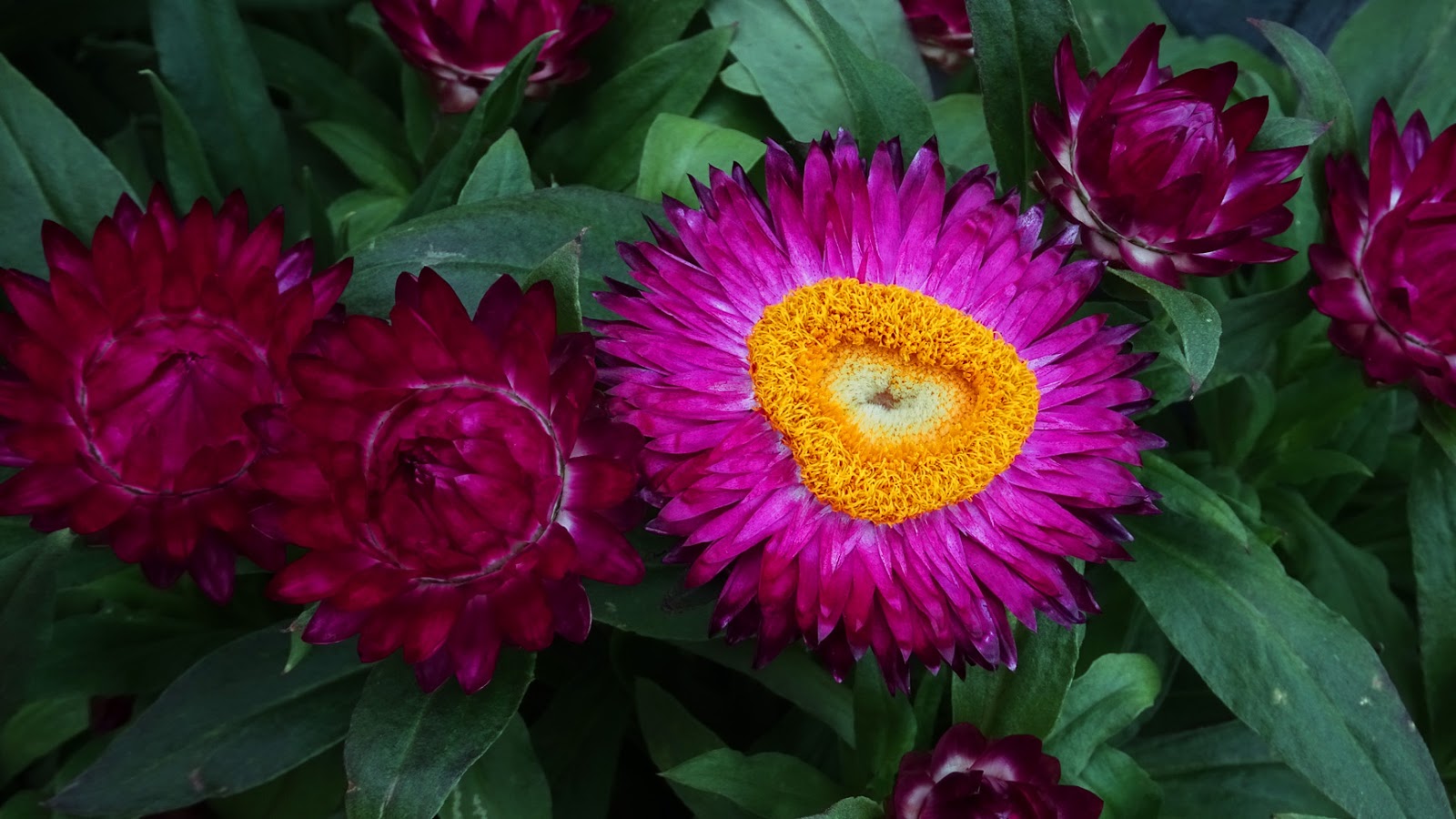
BRACTEANTHA

Bracteantha bracteata commonly known as the golden everlasting or strawflower, is a flowering plant in the family Asteraceae native to Australia. Described by Étienne Pierre Ventenat in 1803, it was known as Helichrysum bracteatum for many years before being transferred to a new genus Xerochrysum in 1990. It grows as a woody or herbaceous perennial or annual shrub up to a metre tall with green or grey leafy foliage.

Golden yellow or white flower heads are produced from spring to autumn; their distinctive feature is the papery bracts that resemble petals. The species is widespread, growing in a variety of habitats across the country, from rainforest margins to deserts and subalpine areas.

The golden everlasting serves as food for various larvae of lepidopterans (butterflies and moths), and adult butterflies, hoverflies, native bees, small beetles, and grasshoppers visit the flower heads. The golden everlasting has proven very adaptable to cultivation. It was propagated and developed in Germany in the 1850s, and annual cultivars in a host of colour forms from white to bronze to purple flowers became available. Many of these are still sold in mixed seed packs. In Australia, many cultivars are perennial shrubs, which have become popular garden plants. Sturdier, long-stemmed forms are used commercially in the cut flower industry.

This post is part of the Floral Friday Fotos meme.


Thursday, 25 October 2018

LILAC BOUQUET

Syringa vulgaris (lilac or common lilac) is a species of flowering plant in the olive family Oleaceae, native to the Balkan Peninsula, where it grows on rocky hills. This species is widely cultivated as an ornamental and has been naturalised in other parts of Europe (including the United Kingdom, France, Germany, and Italy), as well as much of North America. It is not regarded as an aggressive species, found in the wild in widely scattered sites, usually in the vicinity of past or present human habitations.

Most garden plants of S. vulgaris are cultivars, the majority of which do not exceed 4–5 m tall. Between 1876 and 1927, the nurseryman Victor Lemoine of Nancy introduced over 153 named cultivars, many of which are considered classics and still in commerce today. Lemoine's "French lilacs" extended the limited colour range to include deeper, more saturated hues, and they also introduced double-flowered "sports", with the stamens replaced by extra petals. Illustrated here is the hybrid 'Agincourt Beauty' that grows in our garden.

This post is part of the Floral Friday Fotos meme.

Thursday, 18 October 2018

CARNATION 'MEMORIES'

Dianthus caryophyllus, the carnation or clove pink, is a species of Dianthus. It is probably native to the Mediterranean region but its exact range is unknown due to extensive cultivation for the last 2,000 years. It is an herbaceous perennial plant growing to 80 cm tall. The leaves are glaucous greyish green to blue-green, slender, up to 15 cm long.

The flowers are produced singly or up to five together in a cyme; they are 3–5 cm diameter, and sweetly scented; the original natural flower colour is bright pinkish-purple, but cultivars of other colours, including red, white, yellow and green, have been developed. Some fragrance-less carnation cultivars are often used as boutonnieres for men.

Dianthus 'Memories'  shown here is a modern version of the old-time favourite carnation variety 'Mrs Sinkins' introduced in 1863. It is an evergreen perennial with masses of highly scented, pure white flowers. Blooming in late Spring through Summer (with regular deadheading), the frilled blossoms rise on short, stout stems. Easy to grow, these carnations are perfect for a rock garden, a border or in containers. This hybrid belongs to the ScentFirst® series of carnations from Whetman Pinks.

Alzheimer’s Australia and its current president, Ita Buttrose worked with Carolyn Whetman in the UK, towards the release of the plant in order to raise awareness, and fund research for Alzheimer's disease. Ita is a passionate ambassador for Alzheimer’s Australia and extremely knowledgable on the subject. With scent being a powerful trigger of memory, the selection of this fragrant flowering plant to support this cause is very apt.

This post is part of the Floral Friday Fotos meme.


Thursday, 6 September 2018

SPANISH BLUEBELL

Hyacinthoides hispanica (syn. Endymion hispanicus or Scilla hispanica), the Spanish bluebell, is a spring-flowering bulbous perennial native to the Iberian Peninsula. It is one of around 11 species in the genus Hyacinthoides, others including the common bluebell (Hyacinthoides non-scripta) in northwestern Europe, and the Italian bluebell (Hyacinthoides italica) further east in the Mediterranean region.

It is distinguished from the common bluebell by its paler, larger blue flowers, more erect flower stem (raceme), broader leaves, blue anthers (where the common bluebell has creamy-white ones) and little or no scent compared to the strong fragrant scent of the northern species. The Spanish bluebell is also cultivated as a garden plant, and several named cultivars exist with flowers in various shades of white, pink and blue.

I've processed the photo in Photoshop using a variety of filters to give it a slightly painterly look.

This post is part of the Floral Friday Fotos meme.

Thursday, 16 August 2018

WATTLE

Acacia baileyana or Cootamundra wattle, is a shrub or tree in the genus Acacia, in the Fabaceae family. The scientific name of the species honours the botanist Frederick Manson Bailey. It is indigenous to a small area of southern New South Wales in Australia, but it has been widely planted in other Australian states and territories. In Melbourne, it is a very commonly encountered street tree. In many areas of Victoria, this wattle has become naturalised and is regarded as a weed, out-competing indigenous Victorian species. Wattles have been extensively introduced into New Zealand.

Almost all wattles have cream to golden flowers. The small, lightly fragrant, flowers are arranged in spherical to cylindrical inflorescences, with only the stamens prominent. These trees start to bloom in early Winter and different varieties of wattle will continue to flower until Spring. A. baileyana is used in Europe in the cut flower industry, where it is called "mimosa". It is also used as food for bees in the production of honey.

This plant is adaptable and easy to grow. It has gained the Royal Horticultural Society's Award of Garden Merit. Unfortunately it has an ability to naturalise (i.e. escape) into surrounding bushland. Also, it hybridises with some other wattles, notably the rare and endangered Sydney Basin species Acacia pubescens. The fine foliage of the original Cootamundra wattle is grey-green, but a blue-purple foliaged form, known as 'Purpurea' is very popular.

This post is part of the Floral Friday Fotos meme.


Thursday, 21 June 2018

BIRTHDAY ROSES

They are from the North, but roses they are nevertheless, offered in Winter, and their message is clear: Red for love, pink for joy and white for secrecy...

This post is part of the Floral Friday Fotos meme.

Thursday, 10 May 2018

AT THE FLORIST SHOP

In Autumn there is no dearth of flowers at our local florist shop, with seasonal golds and oranges aplenty. 

This post is part of the Floral Friday Fotos meme.
Thursday, 3 May 2018

ROSES

As Autumn advances in Melbourne we are seeing the last of the roses in gardens, however, at the florist shops roses as still making quite the show!

This post is part of the Floral Friday Fotos meme.

Wednesday, 11 April 2018

ROSA, 'PINK INTUITION'

Rosa 'Pink Intuition' is a sport of 'Red Intuition', which was voted International Cut Rose of the Year 2000. Like its sister rose, 'Pink Intuition' is prized for the perfection of its large, perfect, classical Hybrid Tea-shaped flowers, all massed with petals. Tall graceful buds open into blooms, a whirling palette of pinks – bright, rich, magentas slashed with delicate and buoyant pastels – stripes of pinks on pink.

Flowering continually from Spring to late Autumn, stems are laden with bunches of bright, unfading blooms. Long flower stems are ideal for cutting, having an exceptionally long vase life. Flowers do not droop. Blessed with a vigorous growth habit, Pink Intuition thrives in full sun, relishes regular feeding and mulching. Pink Intuition may be planted all the year round. Grows to approximately 150cms high.

This post is part of the Floral Friday Fotos meme.

Thursday, 1 March 2018

ROSA 'FIREFIGHTER'

Bred by Joseph Orard prior to 1998 and introduced to Australia in 2009 is Rosa 'Firefighter', a glorious rose with tall single stems of the most highly fragrant dark red rose which is suitable to work with in floral art and yet easy to grow in the open garden will be a joy to all rose gardeners. An added bonus is that it has few thorns. The name of this rose, 'Firefighter' honours the work our firefighters do here in Australia and as it states on the plant label: “This rose is so named as to remember those men and women who risk their lives daily to protect ours”.

The generally sunny, dry and hot conditions of the Australian garden are particularly well suited to planting roses and roses flourish in our gardens when you take measures to provide the following:

1) Watering: Roses are very deep rooted plants and require one good, deep soaking at least every 10 days in hot and dry conditions;

2) Feeding: Because roses flower throughout all but the Winter season, they should be regularly fertilised with quality (preferably organic) fertiliser which contains a balance of major nutrients (NPK) and trace elements. The fertiliser should be applied at least once a month – small amount often – with fortnightly applications of liquid seaweed over the foliage;

3) Pruning: During Winter, 70% of the rose plant should be pruned and all old wood removed back to the crown and the bush pruned to shape. During the flowering seasons, 25% of all flowering stems should be cut back after flowering to encourage strong re-growth.

4) Mulching: Particular attention to application of lucerne or pea straw directly around the root-zone of each rose will enhance the overall health of the rose and then the whole bed should be mulched to 75mm with any other mulch medium available.

This post is part of the Floral Friday Fotos meme.

Thursday, 8 February 2018

PENTAS

Pentas is a genus of flowering plants in the Rubiaceae family. The genus is found in tropical and southern Africa, the Comoros, Madagascar, and the Arabian Peninsula. The plants have hairy green leaves and clusters of flowers in shades of red, white, pink, and purple. Pentas are attractive to butterflies and hummingbirds. Some species are commonly cultivated and can be grown in pots and baskets. Species such as Pentas lanceolata can withstand full sunlight and need little to no care, growing even in locations that are dry and hot.

Growing into a shrub anywhere from about 50-80cm tall, pentas have dark green, pleated leaves, and bear numerous heads containing dozens of small, star-shaped flowers. The nectar-rich flowers are very attractive to bees and butterflies, so you will have the added bonus of enjoying watching these visitors to your garden. The flowers are also good for cutting, lasting a week or more in a vase. Pentas flower almost year round, and thrive in full sun or part shade. A thoroughly neglected pentas may look a bit shabby but it will come back beautifully after a hard prune.

The hybrid called Starcluster has huge flowers on tall, sturdy stems. They are fabulous in pots or in garden beds, and are available in red, lavender, white and rose. They are well branched and compact in habit, and have been bred to perform well in hot summer conditions.

This post is part of the Floral Friday Fotos meme.