Showing posts with label red. Show all posts

Thursday, 19 October 2023

WARATAH

Waratah (Telopea) is an Australian-endemic genus of five species of large shrubs or small trees, native to the southeastern parts of Australia (New South Wales, Victoria and Tasmania). The most well-known species in this genus is Telopea speciosissima, which has bright red flowers and is the NSW state emblem.

The waratah is a member of the plant family Proteaceae, a family of flowering plants distributed in the Southern Hemisphere. The key diagnostic feature of Proteaceae is the inflorescence, which is often very large, brightly coloured and showy, consisting of many small flowers densely packed into a compact head or spike.

Species of waratah boast such inflorescences ranging from 6–15 cm in diameter with a basal ring of coloured bracts. The leaves are spirally arranged, 10–20 cm long and 2–3 cm broad with entire or serrated margins. The name waratah comes from the Eora Aboriginal people, the original inhabitants of the Sydney area.

This post is part of the Floral Friday Fotos meme


Thursday, 15 September 2022

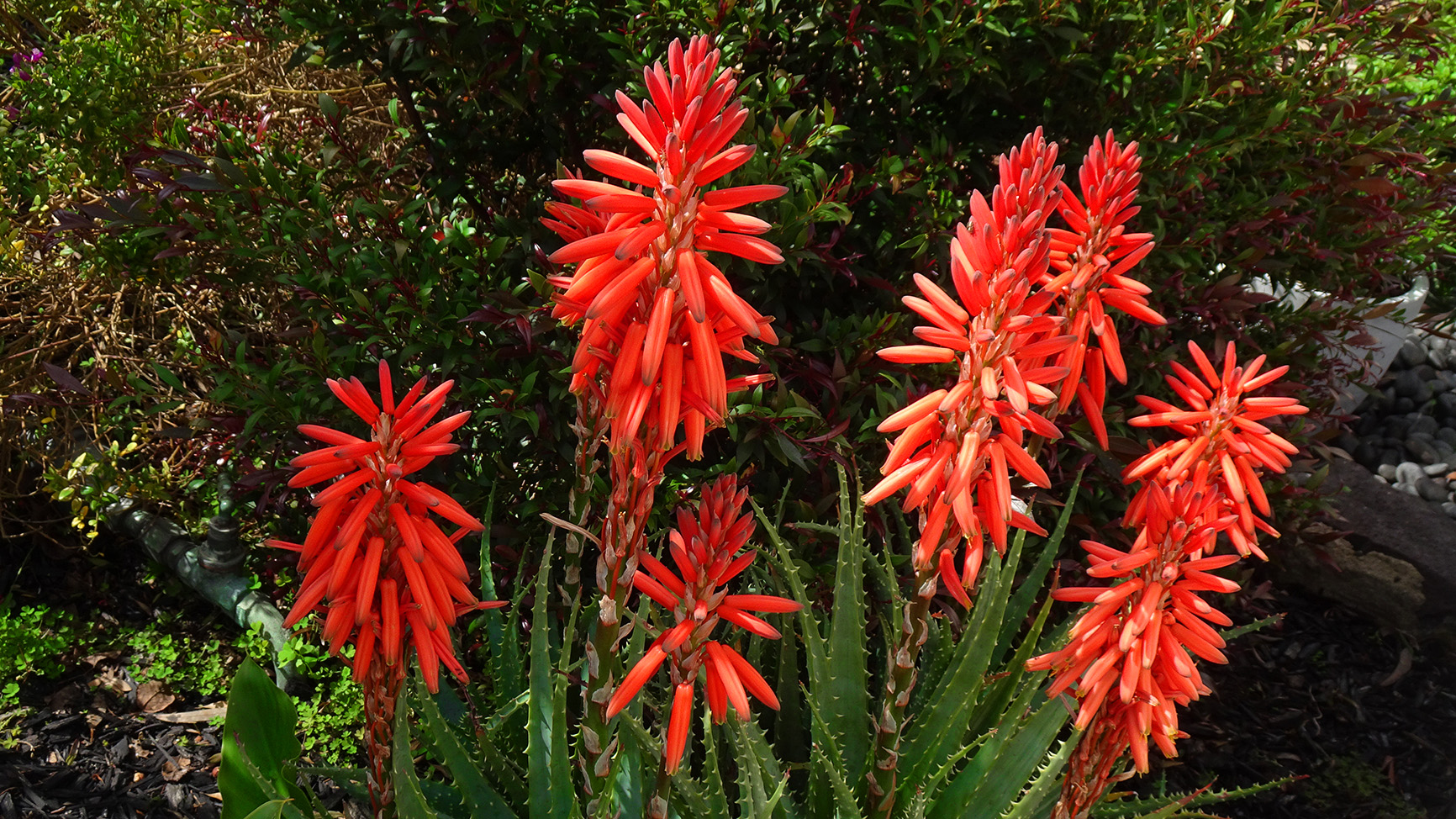
ALOE

Aloe arborescens, the krantz aloe or candelabra aloe, is a species of flowering succulent perennial plant that belongs to the genus Aloe, which it shares with the well known and studied Aloe vera. The specific epithet arborescens means "tree-like". Aloe arborescens is valued by gardeners for its succulent green leaves, large vibrantly-colored flowers, winter blooming, and attraction for birds, bees, and butterflies. 

This post is part of the Floral Friday Fotos meme.


Sunday, 7 August 2022

SUNDAY BEST #286 - RED DOOR

Welcome to the meme, "My Sunday Best", which is a photographic and creative meme that allows you to showcase your talents in imaging. Every Sunday, you can post here showing an image you have created using your camera, (and/or) image processing software, and/or painting and drawing in the conventional way and have scanned in.

The rules are simple:
1) Create your image and post it up on your blog;
2) Put the "My Sunday Best" logo image link somewhere on your post so people can click and come by here;
3) Leave a comment here once you have posted;
4) Visit other posters' blogs and be amazed with their creativity!

Please do not use this meme to advertise your goods or services. This is a creative meme and any inappropriate links or comments shall be removed immediately.

This photo is also part of the Weekend Reflections meme

You are invited to the Inlinkz link party!

Click here to enter
Last week, Wordless in the USA shared some lovely photos, the one below is my fave!


Sunday, 23 May 2021

SUNDAY BEST #223 - RED

Welcome to the meme, "My Sunday Best", which is a photographic and creative meme that allows you to showcase your talents in imaging. Every Sunday, you can post here showing an image you have created using your camera, (and/or) image processing software, and/or painting and drawing in the conventional way and have scanned in.

The rules are simple:
1) Create your image and post it up on your blog;
2) Put the "My Sunday Best" logo image link somewhere on your post so people can click and come by here;
3) Leave a comment here once you have posted;
4) Visit other posters' blogs and be amazed with their creativity!

Please do not use this meme to advertise your goods or services. This is a creative meme and any inappropriate links or comments shall be removed immediately.

The theme is of your own choosing, so post on any subject you desire.
This post is also part of the 
Photo Sunday meme.

You are invited to the Inlinkz link party!

Click here to enter
Last week, Image-in-ing in the USA showcased some of her photos on the theme of flight. Please visit her blog for more details.


Sunday, 28 March 2021

SUNDAY BEST #215 - PYRACANTHA

Welcome to the meme, "My Sunday Best", which is a photographic and creative meme that allows you to showcase your talents in imaging.

Every Sunday, you can post here showing an image you have created using your camera, (and/or) image processing software, and/or painting and drawing in the conventional way and have scanned in.

The rules are simple:
1) Create your image and post it up on your blog;
2) Put the "My Sunday Best" logo image link somewhere on your post so people can click and come by here;
3) Leave a comment here once you have posted;
4) Visit other posters' blogs and be amazed with their creativity!

Please do not use this meme to advertise your goods or services. This is a creative meme and any inappropriate links or comments shall be removed immediately.

The theme is of your own choosing, so post on any subject you desire.
Pyracantha coccinea
berries.

You are invited to the Inlinkz link party!

Click here to enter
Last week, Taken for Granted from the USA posted a photo that demonstrated pareidolia very nicely! 


Thursday, 24 December 2020

POINSETTIA FOR CHRISTMAS

The poinsettia (Euphorbia pulcherrima) is a culturally and commercially important plant species of the diverse spurge family that is indigenous to Mexico and Central America. It is particularly well known for its red and green foliage and is widely used in Christmas floral displays. It derives its common English name from Joel Roberts Poinsett, the first United States Minister to Mexico, who introduced the plant into the United States in 1825.

This post is part of the Floral Friday Fotos meme.


Thursday, 16 July 2020

JAPONICA

Chaenomeles japonica is a species of Japanese Quince in the Rosaceae family. It is a thorny deciduous shrub that is commonly cultivated. It is shorter than another commonly cultivated species C. speciosa, growing to only about 1 m in height. The fruit is called Kusa-boke (草木瓜) in Japanese.

Chaenomeles japonica is also popularly grown in bonsai. It is best known for its colourful spring flowers of red, white or pink. It produces apple-shaped fruit that are a golden-yellow colour containing red-brown seeds. The fruit is edible, but hard and astringent-tasting, unless bletted. The fruit is occasionally used in jelly and pie making as an inferior substitute for its cousin, the true quince, Cydonia oblonga.

This post is part of the Floral Friday Fotos meme.

Thursday, 23 April 2020

BOTTLEBRUSH

Callistemon is a genus of 34 species of shrubs in the family Myrtaceae, all of which are endemic to Australia. Callistemon species are commonly referred to as bottlebrushes because of their cylindrical, brush like flowers resembling a traditional brush used to clean the interior of bottles. They are found in the more temperate regions of Australia, mostly along the east coast and south-west, and typically favour moist conditions so when planted in gardens thrive on regular watering. However, at least some of the species are drought-resistant. There are varieties with white, yellow, pink or red flowers.

Bottlebrushes are often planted on nature strips along Melbourne streets and are also a favourite garden tree. Around Christmas and all through the summer the showy flowers make quite a spectacular display and provide nectar for insects and native birds. This variety illustrated is Callistemon 'Wildfire' - a rounded shrub to 2m high by 2m wide with slightly pendulous branches. It has showy red clusters of brushy flowers.

This is part of the Floral Friday Fotos meme.


Thursday, 6 February 2020

BORONIA

Boronia is a genus of about 160 species of flowering plants in the citrus family Rutaceae, most are endemic in Australia with a few species in New Caledonia, which were previously placed in the genus Boronella. They occur in all Australian states but the genus is under review and a number of species are yet to be described or the description published. Boronias are similar to familiar plants in the genera Zieria, Eriostemon and Correa but can be distinguished from them by the number of petals or stamens. Some species have a distinctive fragrance and are popular garden plants.

Plants in the genus Boronia are nearly always shrubs although a very small number occur as herbs or as small trees. The leaves are usually arranged in opposite pairs and may be simple leaves or compound leaves with up to nineteen or more leaflets, in either a pinnate or bipinnate arrangement. The flowers are arranged in groups in the leaf axils or on the ends of the branches and have both male and female parts. There are usually four separate sepals, usually four separate petals and generally eight stamens. (In Zieria there are only four stamens, Eriostemon species have five petals and in Correa the petals are joined to form a bell-shaped tube.) There are four carpels with their styles fused and there are two ovules in each carpel.

Boronias are found in all states and mainland territories of Australia and generally grow in open forests or woodlands, only rarely in rainforests or arid areas. Boronias, especially B. megastigma, are known for their perfumed flowers. Unfortunately, they are generally somewhat difficult to grow in cultivation. All species require excellent drainage and part shade. Shown here is red boronia (Boronia heterophylla), which features bell-shaped blossoms that are a striking magenta pink and have a delicate perfume that adds to its appeal as a cut flower. It grows to about 1.5 m in height by half a metre wide. It originates in Western Australia but has adapted well to east coast gardens as well. ‘Ice Charlotte’ is a white flowered form of this species that has similar requirements.

This post is part of the Floral Friday Fotos meme.

Sunday, 29 December 2019

MY SUNDAY BEST MEME #150 - VINTAGE CAR

Welcome to the meme, "My Sunday Best", which is a photographic and creative meme that allows you to showcase your talents in imaging. Every Sunday, you can post here showing an image you have created using your camera, (and/or) image processing software, and/or painting and drawing in the conventional way and have scanned in.

The rules are simple:
1) Create your image and post it up on your blog;
2) Put the "My Sunday Best" logo image link somewhere on your post so people can click and come by here;
3) Leave a comment here once you have posted;
4) Visit other posters' blogs and be amazed with their creativity!

Please do not use this meme to advertise your goods or services. This is a creative meme and any inappropriate links or comments shall be removed immediately!

The theme is of your own choosing, so post on any subject you desire.
The Holden FB is a car that was produced by Holden in Australia from 1960 to 1961. Introduced on 14 January 1960, the FB series replaced the Holden FC range. The FB range consisted of four-door sedans in two trim levels, five-door station wagons in two trim levels, a two-door coupe utility and a two-door panel van. The Holden Business Sedan, which had been marketed as part of the FC range, was not carried over to the FB series.

The FB was promoted as being longer, lower, more spacious and more powerful than the FC model although in reality it was only slightly so on each count. Overall length was 5.5 inches (140 mm) greater whilst the wheelbase remained the same. The engine remained the same at 3" the last model to have this bore, engine capacity remained at 132 cubic inches and the compression ratio was raised. However the resulting extra 4 brake horsepower (3.0 kW) of power did not compensate for the extra weight of the FB and performance was thus inferior to that of its predecessor.

This post is also part of the Photo Sunday meme.

Last week 'Taken for Granted' posted a photo featuring the Festive Season, which was my favourite photo of the week. Go to his blog for many more great shots.

Thursday, 19 December 2019

FIREWHEELS

Stenocarpus sinuatus, known as the Firewheel Tree is an Australian rainforest tree in the Proteaceae family. The range of natural distribution is in various rainforest types from the Nambucca River (30° S) in New South Wales to the Atherton Tableland (17° S) in tropical Queensland. However, Stenocarpus sinuatus is widely planted as an ornamental tree in other parts of Australia and in different parts of the world. Other common names include White Beefwood, Queensland Firewheel Tree, Tulip Flower and White Silky Oak

It is a medium to large tree, up to 40 metres tall and 75 cm in trunk diameter. The bark is greyish brown, not smooth and irregular. The base of the cylindrical trunk is flanged. Leaves alternate and variable in shape, simple or pinnatifid, the leaf margins wavy, 12 to 20 cm long. Leaf venation is clearly seen above and below the leaf. Leaves are characteristic and easily identified as part of the Proteaceae family.

The ornamental flowers are bright red in umbels, in a circular formation, hence the name Firewheel Tree. Flowers form mostly between February to March. The fruit is a follicle, in a boat shape, 5 to 10 cm long. Inside are many thin seeds 12 mm long. Fruit matures from January to July. Regeneration from fresh seed occurs speedily. Cuttings also strike well. The flower (as "Wheel Flower") is the subject of some of Australian artist, Margaret Preston's most popular flower prints.

This post is part of the Floral Friday Fotos meme.

Margaret Preston, ca 1929: Firewheel tree

Thursday, 11 July 2019

GUM TREE IN FLOWER

Eucalyptus leucoxylon, commonly known as the Yellow Gum, (South Australian) Blue Gum or White Ironbark, is a small to medium-sized tree with rough bark on the lower 1-2 metres of the trunk, above this, the bark becomes smooth with a white, yellow or bluish-grey surface. Adult leaves are stalked, lanceolate to broad-lanceolate, to 13 x 2.5 cm, concolorous, dull, green. Flowers in white, pink or red appear during winter.

This post is part of the Floral Friday meme.

Thursday, 6 June 2019

EASTER CACTUS

Hatiora gaertneri is a species of epiphytic cactus within the family Cactaceae. Together with the hybrid with H. rosea, Hatiora ×graeseri, it is known as Easter cactus or Whitsun cactus and is a widely cultivated ornamental plant. H. gaertneri is found in southeastern Brazil, in Paraná and Santa Catarina, at altitudes of 350–1,300 m. As with other species of the genus, H. gaertneri grows on trees (epiphytic) or less often rocks (lithophytic) in tropical rain forests. 

With maturity, it develops into a branching pendant leafless shrub with a woody base. The stems are made up of segments, most of which are flattened and which are the photosynthetic organs (cladodes) of the plant. Structures characteristic of cacti, called areoles, form in these notches. Flowers form from areoles at the ends of the stems. These are scarlet in colour, 4–5 cm long, radially symmetrical (actinomorphic), opening to a funnel shape with a maximum diameter of about 4–7.5 cm. Red oblong fruits form after the flowers are fertilised.

Under the name Easter cactus or Whitsun cactus, Hatiora gaertneri is widely cultivated as an ornamental plant for its scarlet flowers. Its common names reflect the period in which it flowers in the Northern Hemisphere, namely late Spring. It has been artificially crossed with a pink-flowered species, Hatiora rosea, to form the hybrid H. × graeseri, cultivars of which have flowers in a wider range of colours. The Easter cactus is considered more difficult to grow than the Christmas or Thanksgiving cactus (Schlumbergera).

Recommendations for care include:
Temperature - Summer temperatures around 25 °C are suggested, with lower temperatures down to 7–13 °C in the winter (November to January in the Northern Hemisphere) to initiate good bud formation.
Light - As epiphytic forest plants, they are not exposed to strong sunlight. Half-shade is recommended; plants can be placed outside in the summer.
Watering - The Easter cactus is said to respond badly to over- or under-watering, e.g. by losing stem segments; continuously moist soil is recommended.
Propagation - Stem segments may be removed in late Spring and the cut surface allowed to dry out before being placed in slightly moist soil.

This post is part of the Floral Friday Fotos meme.

Thursday, 2 May 2019

EASTER CACTUS

Hatiora gaertneri is a species of epiphytic cactus which belongs to the tribe Rhipsalideae within the subfamily Cactoideae of the Cactaceae family. Together with the hybrid with H. rosea, Hatiora × graeseri, it is known as the Easter Cactus or Whitsun Cactus and is a widely cultivated ornamental plant. H. gaertneri is found in southeastern Brazil, in Paraná and Santa Catarina, at altitudes of 350–1,300 m.

As with other species of the genus, H. gaertneri grows on trees (epiphytic) or less often rocks (lithophytic) in tropical rain forests. With maturity, it develops into a branching pendant leafless shrub with a woody base. The stems are made up of segments, most of which are flattened and which are the photosynthetic organs (cladodes) of the plant. Younger segments are dullish green, 4–7 cm long and 2–2.5 cm wide, with small notches on the margins. Structures characteristic of cacti, called areoles, form in these notches. Flowers form from areoles at the ends of the stems. These are scarlet in colour, 4–5 cm long, radially symmetrical (actinomorphic), opening to a funnel shape with a maximum diameter of about 4–7.5 cm. Red oblong fruits form after the flowers are fertilised.

The Easter Cactus is considered more difficult to grow than the Christmas or Thanksgiving Cactus (Schlumbergera). Recommendations for care include:
Temperature: Summer temperatures around 25 °C are suggested, with lower temperatures down to 7–13 °C in the winter (November to January in the Northern Hemisphere) to initiate good bud formation.
Light: As epiphytic forest plants, they are not exposed to strong sunlight. Half-shade is recommended; plants can be placed outside in the summer.
Watering: The Easter Cactus is said to respond badly to over- or under-watering, e.g. by losing stem segments; continuously moist soil is recommended.
Propagation: Stem segments may be removed in late Spring and the cut surface allowed to dry out before being placed in slightly moist soil.

This post is part of the Floral Friday Fotos meme.

Thursday, 18 April 2019

CUPHEA

Cuphea is a genus containing about 260 species of annual and perennial flowering plants  in the Lythraceae family, native to warm temperate to tropical regions of the Americas. The species range from low-growing herbaceous plants to semi-woody shrubs up to 2 m tall. Commonly they are known as cupheas, or, in the case of some species, as cigar plants. The generic name is derived from the Greek word κυφος (kyphos), meaning "bent," "curved," or "humped."

Several Cuphea species are popular ornamental plants or honey plants. C. ignea 'David Verity' and C. micropetalia are popular plants to attract hummingbirds. Cuphea vienco, seen here, is a charming, free-flowering plant with small, smooth green leaves smothered with frilly, vibrant red and purple flowers. Suitable for pots and mixed containers. Bird attracting. The plant copes well in dry conditions. Suitable for full sun or part shade positions. Grows up to 60cm high.

This post is part of the Floral Friday Fotos meme.

Sunday, 31 March 2019

MY SUNDAY BEST MEME #112 - CHALLENGE: ROCK

Welcome to the meme, "My Sunday Best", which is a photographic and creative meme that allows you to showcase your talents in imaging. Every Sunday, you can post here showing an image you have created using your camera, (and/or) image processing software, and/or painting and drawing in the conventional way and have scanned in.

The rules are simple:
1) Create your image according to the "CHALLENGE" theme, and post it up on your blog;
2) Put the "My Sunday Best" logo image link somewhere on your post so people can click and come by here;
3) Leave a comment here once you have posted;
4) Visit other posters' blogs and be amazed with their creativity!

Please do not use this meme to advertise your goods or services. This is a creative meme and any inappropriate links or comments shall be removed immediately!

NEXT WEEK'S CHALLENGE THEME IS: CITY LIFE
Uluru, also known as Ayers Rock, is a large sandstone rock formation in the southern part of the Northern Territory, central Australia. It lies 335 km south west of the nearest large town, Alice Springs, 450 km by road. Kata Tjuta and Uluru are the two major features of the Uluṟu-Kata Tjuṯa National Park. Uluru is sacred to the Anangu, the Aboriginal people of the area. The area around the formation is home to a plethora of springs, waterholes, rock caves and ancient paintings. Uluru is listed as a World Heritage Site.

Uluru is an inselberg, literally "island mountain". An inselberg is a prominent isolated residual knob or hill that rises abruptly from and is surrounded by extensive and relatively flat erosion lowlands in a hot, dry region. Uluru is also often referred to as a monolith, although this is a somewhat ambiguous term that is generally avoided by geologists. The remarkable feature of Uluru is its homogeneity and lack of jointing and parting at bedding surfaces, leading to the lack of development of scree slopes and soil. These characteristics led to its survival, while the surrounding rocks were eroded.

It seems last week the theme "Lozenge" proved to be too difficult for people so there were no entries of note! Hopefully next week, "City Life" will prove to be an easier topic...