Showing posts with label Rutaceae. Show all posts

Thursday, 6 February 2020

BORONIA

Boronia is a genus of about 160 species of flowering plants in the citrus family Rutaceae, most are endemic in Australia with a few species in New Caledonia, which were previously placed in the genus Boronella. They occur in all Australian states but the genus is under review and a number of species are yet to be described or the description published. Boronias are similar to familiar plants in the genera Zieria, Eriostemon and Correa but can be distinguished from them by the number of petals or stamens. Some species have a distinctive fragrance and are popular garden plants.

Plants in the genus Boronia are nearly always shrubs although a very small number occur as herbs or as small trees. The leaves are usually arranged in opposite pairs and may be simple leaves or compound leaves with up to nineteen or more leaflets, in either a pinnate or bipinnate arrangement. The flowers are arranged in groups in the leaf axils or on the ends of the branches and have both male and female parts. There are usually four separate sepals, usually four separate petals and generally eight stamens. (In Zieria there are only four stamens, Eriostemon species have five petals and in Correa the petals are joined to form a bell-shaped tube.) There are four carpels with their styles fused and there are two ovules in each carpel.

Boronias are found in all states and mainland territories of Australia and generally grow in open forests or woodlands, only rarely in rainforests or arid areas. Boronias, especially B. megastigma, are known for their perfumed flowers. Unfortunately, they are generally somewhat difficult to grow in cultivation. All species require excellent drainage and part shade. Shown here is red boronia (Boronia heterophylla), which features bell-shaped blossoms that are a striking magenta pink and have a delicate perfume that adds to its appeal as a cut flower. It grows to about 1.5 m in height by half a metre wide. It originates in Western Australia but has adapted well to east coast gardens as well. ‘Ice Charlotte’ is a white flowered form of this species that has similar requirements.

This post is part of the Floral Friday Fotos meme.

Thursday, 12 December 2019

RED BORONIA

Boronia is a genus of about 160 species of flowering plants in the citrus family Rutaceae, most are endemic in Australia with a few species in New Caledonia, which were previously placed in the genus Boronella. They occur in all Australian states but the genus is under review and a number of species are yet to be described or the description published. Boronias are similar to familiar plants in the genera Zieria, Eriostemon and Correa but can be distinguished from them by the number of petals or stamens.

Some species have a distinctive fragrance and are popular garden plants. Plants in the genus Boronia are nearly always shrubs although a very small number occur as herbs or as small trees. The leaves are usually arranged in opposite pairs and may be simple leaves or compound leaves with up to nineteen or more leaflets, in either a pinnate or bipinnate arrangement. The flowers are arranged in groups in the leaf axils or on the ends of the branches and have both male and female parts. There are usually four separate sepals, usually four separate petals and generally eight stamens. (In Zieria there are only four stamens, Eriostemon species have five petals and in Correa the petals are joined to form a bell-shaped tube.) There are four carpels with their styles fused and there are two ovules in each carpel.

Boronias are found in all states and mainland territories of Australia and generally grow in open forests or woodlands, only rarely in rainforests or arid areas. Boronias, especially B. megastigma, are known for their perfumed flowers. Unfortunately, they are generally somewhat difficult to grow in cultivation. All species require excellent drainage and part shade. Shown here is red boronia (Boronia heterophylla), which features bell-shaped blossoms that are a striking magenta pink and have a delicate perfume that adds to its appeal as a cut flower. It grows to about 1.5 m in height by half a metre wide. It originates in Western Australia but has adapted well to east coast gardens as well. ‘Ice Charlotte’ is a white flowered form of this species that has similar requirements.

This post is part of the Floral Friday Fotos meme.

Thursday, 31 January 2019

CROWEA

Crowea exalata, or Small Crowea, is a flowering plant in the family Rutaceae, which is native to the states of Queensland, New South Wales and Victoria in Australia. It is a small shrub growing to 1 metre tall. It is named after James Crowe, an 18th-19th century surgeon and botanist. The specific name exalata means without wings, referring to the lack of ridges on the stems - this is not a definitive characteristic.

This species flowers during most months of the year, resting only in extremes of heat and cold, and with flushes in autumn and spring. Pointed buds open to five-petalled starry flowers 2 cm across, in clear tints of rose purple. They are of a solid waxy substance, and make a vivid display for the size of the plant. Before falling they close again to look like buds of deeper pink. Propagation by cuttings is easy using tip growth (which is very soft in character), at a half-ripe stage.

Nurseries dealing in native plants usually stock this small shrub and it should be planted in light, lime-free soil. A position with some shade is desirable - otherwise the soil should be shaded in some way from hot sun. This may be done by surrounding the plant with 5-10 cm of leaves, bush litter or compost. Rocks make an attractive setting, and in fact this is a beautiful rockery subject. Pruning should be done to maintain bushy growth, or a straggly plant with bare stems may develop. The end of winter is a good time to do this - or any time when sprigs of cut flowers are wanted, as these are dainty and long-lasting in water.

This post is part of the Floral Friday Fotos meme.

Thursday, 19 April 2018

CROWEA

Crowea saligna, commonly known as willow-leaved crowea, is a plant in the rue family, Rutaceae and is endemic to eastern New South Wales in Australia. It is a small shrub with attractive, pink, star-shaped flowers and is commonly cultivated. Crowea saligna was first formally described in 1800 by Henry Charles Andrews. The description was published in "The Botanist's Repository for New, and Rare Plants." The specific epithet (saligna) is a Latin word meaning " of willow".

The shrub usually grows to a height of about 1–1.5 metres with conspicuously angled branches. The leaves are 30–60 millimetres long, 3–13 millimetres wide and are narrow elliptic to lance-shaped. They are also dark green, shiny, dotted with oil glands and there is a distinct mid-vein. The flowers develop in the axils of leaves on a stalk 5-13 millimetres  long. There are 5 short, broad sepals and 5 overlapping petals forming a "star" shape. The petals are pink, sometimes white and are 12-18 millimetres long. The stamens are hairy and enclose the centre of the flower. The flowers appear from January to June and the fruits that follow are dry and have 5 compartments which open to release 2 seeds each.

Willow-leaved crowea occurs in Sydney between Woy Woy and Yerrinbool and on the adjacent Blue Mountains. It grows in sheltered locations on sandstone. It is widely cultivated due to its attractive flowers that appear when most other species are dormant. It prefers a well drained position in sun or semi shade. It grows best in moist soils but will tolerate extended dry periods once established. Illustrated below is the large-flowered form.

This post is part of the Floral Friday Fotos meme.


Thursday, 21 September 2017

WAX FLOWER

Philotheca myoporoides, commonly known as long-leaf wax flower, is a shrub in the family Rutaceae. The species is endemic to south-eastern Australia. It is usually up to 2 metres high and produces white flowers in spring and autumn. The species was first formally described in 1824 by Swiss botanist Augustin Pyramus de Candolle who gave it the name Eriostemon myoporoides. It was transferred to the genus Philotheca in 1998.

Five subspecies are currently recognised in the Australian Plant Census:
P. myoporoides subsp. acuta
P. myoporoides subsp. brevipedunculata
P. myoporoides subsp. euroensis - occurs in the Garden Range near Euroa, Victoria
P. myoporoides subsp. myoporoides
P. myoporoides subsp. petraeus - occurs on Mount Stewart in East Gippsland, Victoria

In recent years a number of subspecies have been raised to species status including Philotheca conduplicata, P. epilosa, P. glasshousiensis (syn. P. myoporoides subsp. leichhardti), P. obovatifolia and P. queenslandica.

Philotheca myoporoides occurs in dry forest and heathland in New South Wales. In Victoria, it is recorded in woodland in rocky, mountainous areas in association with Eucalyptus regnans. It is also found in Queensland. Caterpillars of the Orchard Butterfly feed on this species.

The species is well adapted to cultivation, and plants are commercially available at nurseries in Australia. The species prefers a well-drained position in light shade. Established plants tolerate both dry periods and moderate frost. Plants may be propagated from semi-mature cuttings, though some forms are slow to take root.

This post is part of the Floral Friday Fotos meme.


Thursday, 1 June 2017

LEMON BLOSSOM

The lemon, Citrus limon (L.) Osbeck, is a species of small evergreen tree in the flowering plant family Rutaceae, native to Asia. The tree's ellipsoidal yellow fruit is used for culinary and non-culinary purposes throughout the world, primarily for its juice, which has both culinary and cleaning uses. The pulp and rind (zest) are also used in cooking and baking. The juice of the lemon is about 5% to 6% citric acid, which gives a sour taste. The distinctive sour taste of lemon juice makes it a key ingredient in drinks and foods such as lemonade and lemon meringue pie.

This post is part of the Floral Friday Fotos meme.


Thursday, 11 May 2017

CHOISYA

Choisya is a small genus of aromatic evergreen shrubs in the rue family, Rutaceae. Members of the genus are commonly known as Mexican orange or mock orange due to the similarity of their flowers with those of the closely related orange, both in shape and scent. They are native to southern North America, from Arizona, New Mexico, Texas and south through most of Mexico. In the generic name Humboldt and Bonpland honoured Swiss botanist Jacques Denis Choisy (1799-1859).

The species grow to 1 to 3 m tall. The leaves are opposite, leathery, glossy, palmately compound with 3-13 leaflets, each leaflet 3–8 cm long and 0.5–3.5 cm broad. C. ternata (shown here) has three broad leaflets, while C. dumosa has up to 13 very narrow leaflets. The flowers are star-shaped, 3–5 cm diameter, with 4-7 white petals, 8-15 stamens and a green stigma; they are produced throughout the late spring and summer. The fruit is a leathery two to six sectioned capsule.

Choisya species are popular ornamental plants in areas with mild winters, grown primarily for their abundant and fragrant flowers. The foliage is also aromatic, smelling of rue when bruised or cut. The most commonly found cultivars in the horticultural trade are the species, C. ternata, the golden-leaved C. ternata 'Sundance', and the inter-specific hybrid C. 'Aztec Pearl' (C. arizonica x C. ternata). All three varieties have gained the Royal Horticultural Society's Award of Garden Merit. The flowers are also valued for honeybee forage, producing abundant nectar. This post is part of the Floral Friday Fotos meme, and also part of the Friday Greens meme.

This post is part of the Floral Friday Fotos meme.


Thursday, 16 February 2017

CROWEA SALIGNA

Crowea saligna, commonly known as willow-leaved crowea, is a plant in the rue family, Rutaceae and is endemic to eastern New South Wales in Australia. It is a small shrub with attractive, pink, star-shaped flowers and is commonly cultivated.

It is a small shrub usually growing to a height of about 1–1.5 metres with conspicuously angled branches. The leaves are 30–60 millimetres, 3–13 millimetres wide and are narrow elliptic to lance-shaped. They are also dark green, shiny, dotted with oil glands and there is a distinct mid-vein.

The flowers develop in the axils of leaves on a stalk 5-13 millimetres long. There are 5 short, broad sepals and 5 overlapping petals forming a "star" shape. The petals are pink, sometimes white and are 12-18 millimetres long. The stamens are hairy and enclose the centre of the flower. The flowers appear from January to June and the fruits that follow are dry and have 5 compartments which open to release 2 seeds each.

Crowea saligna was first formally described in 1800 by Henry Charles Andrews. The description was published in The Botanist's Repository for New, and Rare Plants.The specific epithet (saligna) is a Latin word meaning " of willow".

Willow-leaved crowea occurs in Sydney between Woy Woy and Yerrinbool and on the adjacent Blue Mountains. It grows in sheltered locations on sandstone. Crowea saligna is widely cultivated due to its attractive flowers that appear when most other species are dormant. It prefers a well drained position in sun or semi shade. It grows best in moist soils but will tolerate extended dry periods once established.

This post is part of the Floral Friday Fotos meme.


Thursday, 23 June 2016

RUE IN FLOWER

Ruta graveolens, commonly known as rue, common rue or herb-of-grace, is a species of Ruta in the family Rutaceae, grown as an ornamental plant and as an herb. It is native to the Balkan Peninsula.

It is now grown throughout the world in gardens, especially for its bluish leaves, and sometimes for its tolerance of hot and dry soil conditions. It is also cultivated as a medicinal herb, as a condiment, and to a lesser extent as an insect repellent.

For more information, see here "All About Rue":
 http://nicholasjv.blogspot.com.au/2016/03/all-about-rue.html

This post is part of the Floral Friday Fotos meme,
and also part of the Friday Greens meme.

Thursday, 16 June 2016

LEMON

The lemon (Citrus × limon) is a species of small evergreen tree native to Asia. The tree's ellipsoidal yellow fruit is used for culinary and non-culinary purposes throughout the world, primarily for its juice, which has both culinary and cleaning uses. The pulp and rind (zest) are also used in cooking and baking. The juice of the lemon is about 5% to 6% citric acid, which gives a sour taste. The distinctive sour taste of lemon juice makes it a key ingredient in drinks and foods such as lemonade and lemon meringue pie.

The origin of the lemon is unknown, though lemons are thought to have first grown in Assam (a region in northeast India), northern Burma or China. A study of the genetic origin of the lemon reported it to be hybrid between bitter orange (sour orange) and citron. Lemons entered Europe near southern Italy no later than the first century AD, during the time of Ancient Rome. However, they were not widely cultivated. They were later introduced to Persia and then to Iraq and Egypt around 700 AD.

The lemon was first recorded in literature in a 10th-century Arabic treatise on farming, and was also used as an ornamental plant in early Islamic gardens. It was distributed widely throughout the Arab world and the Mediterranean region between 1000 and 1150. The first substantial cultivation of lemons in Europe began in Genoa in the middle of the 15th century. The lemon was later introduced to the Americas in 1493 when Christopher Columbus brought lemon seeds to Hispaniola on his voyages. Spanish conquest throughout the New World helped spread lemon seeds. It was mainly used as an ornamental plant and for medicine.

In the 19th century, lemons were increasingly planted in Florida and California. In 1747, James Lind's experiments on seamen suffering from scurvy involved adding lemon juice to their diets, though vitamin C was not yet known. The origin of the word "lemon" may be Middle Eastern. The word draws from the Old French limon, then Italian limone, from the Arabic laymÅ«n or lÄ«mÅ«n, and from the Persian lÄ«mÅ«n, a generic term for citrus fruit, which is a cognate of Sanskrit (nimbÅ«, “lime”).

The 'Eureka' lemon shown here grows year-round and abundantly. This is the common supermarket lemon, also known as 'Four Seasons' (Quatre Saisons) because of its ability to produce fruit and flowers together throughout the year. This variety is also available as a plant to domestic customers. There is also a pink-fleshed Eureka lemon, which's outer skin is variegated from green and yellow stripes.

This post is part of the Floral Friday Fotos meme,
and also part of the Friday Greens meme.


Thursday, 19 May 2016

CORREA

Correa is a genus of flowering plants in the family Rutaceae, with bell-shaped flowers, native mainly to eastern Australia. There are about 11 species in the genus and 26 subspecies. Natural hybridisation between the species makes taxonomic relationships within this genus problematic. There are also hundreds of named cultivars, many of which have been registered with the Australian Cultivar Registration Authority (ACRA). The genus Correa is named after the Portuguese botanist José Correia da Serra (1750–1823), known as Abbé Correa.

This post is part of the Floral Friday Fotos meme.


Thursday, 4 June 2015

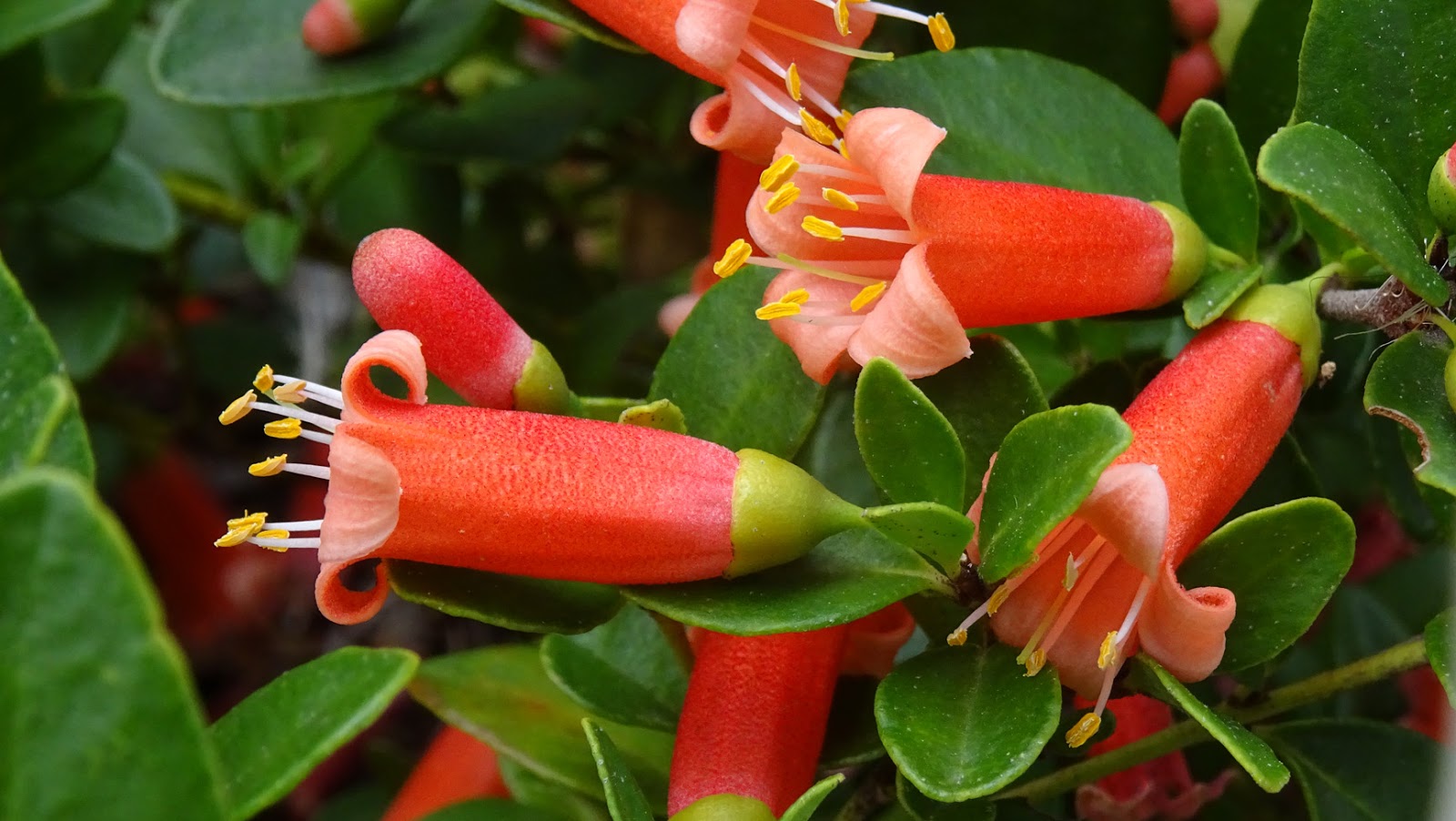
CORREA

Correa 'Ray's Tangerine' (Tangerine Australian Fuchsia) is slow growing compact evergreen shrub growing eventually to about 0.5-1 meter by only a bit wider, with closely paired shiny dark 2 cm long green leaves. The vibrant 4 cm long orange bell-shaped flowers are on display during the Autumn through Winter.

Grow in sun or partial shade, with good drainage. Tolerant of drought but best with regular water during dry periods. Hardy to about -7˚C. In the Appendix to the Encyclopaedia of Australian Plants authors Rodger Elliot and David Jones note that it is a hybrid between "Correa pulchella and a broad-bellied selection of C. reflexa var. scabridula from Carpenter Rocks, SA".

It is an Australian fuchsia that stays small and has bright, shiny, dark-green leaves and vibrant orange flowers that bloom in Autumn and Winter.  It grows well in containers or in-ground in gardens.

This post is part of the Floral Friday Fotos meme.


Thursday, 21 August 2014

WAX FLOWER

Philotheca is a genus of about 45 species, all of which occur only in Australia. The genus has been recently increased in number by the transfer of about 39 species from the genus Eriostemon. Transferred species include Philotheca myoporoides which was previously known as Eriostemon myoporoides.

Philotheca buxifolia, commonly known as Box-leaf Waxflower, is a shrub in the family Rutaceae. It produces white or pink flowers. The species occurs for the most part around Sydney, New South Wales, Australia, however, it has been introduced as a garden ornamental plant in many locations around Australia.

The plant thrives in a range of climates from sub-tropical to cool-temperate. It prefers well-drained soils in full sun or part shade. Dislikes root disturbance. Can be tip pruned to promote a bushy habit, however, if pruned too hard they can be slow to recover. Can be affected by scale. Profuse flowers make this a good feature plant. Also suited to containers or as a hedge.


This post is part of the Floral Friday Fotos meme.


Thursday, 14 August 2014

COLEONEMA OR DIOSMA?

Coleonema is a genus of flowering plants in the family Rutaceae. The eight known species are all from the western Cape Province of South Africa. In Australia, where they are cultivated as garden ornamentals, they are often incorrectly referred to as Diosma.

Coleonema pulchellum, commonly known as confetti bush, buchu, diosma or breath of heaven, is a shrub which is endemic to South Africa. It grows to between 0.8 and 1 metre high. Single pink flowers to about 8 mm in diameter appear between May and October in the species native range. The flowers are slightly fragrant, but the leaves when crushed emit a strong, pleasant, distinctive, almost pine-like odour.

The species was formally described in 1981 in the Journal of South African Botany. Prior to this, plants in cultivation had been erroneously identified as Coleonema pulchrum. The species is naturalised in Victoria, Australia.

This post is part of the Floral Friday Fotos meme.


Tuesday, 3 June 2014

CORREA PULCHELLA

Correa pulchella (salmon correa, Australian fuchsia) is a species of flowering plant in the family Rutaceae. Derivation of the name: "Correa" after José Francisco Correa de Serra (1750–1823), Portuguese botanist and "pulchella" meaning beautiful in Latin.

It is small evergreen shrub, endemic to South Australia. It grows to 0.3–1 m in height and 1–2 m in width. The leaves are linear-oblong to broadly ovate. The pendent, tubular flowers appear between April and September in the species' native range. These are pink-red, orange, or rarely white, and have yellow anthers.

Correa pulchella is regarded as one of the most attractive Correa species. It prefers dry summers with low humidity and well-drained alkaline soils. Propagation from seed is difficult, however semi-mature stem cuttings strike readily. It has gained the Royal Horticultural Society's Award of Garden Merit.

This post is part of the Nature Footsteps Floral Macros meme,
and also part of the Our World Tuesday meme,
and also part of the Ruby Tuesday meme.