Showing posts with label natives. Show all posts

Thursday, 19 April 2018

CROWEA

Crowea saligna, commonly known as willow-leaved crowea, is a plant in the rue family, Rutaceae and is endemic to eastern New South Wales in Australia. It is a small shrub with attractive, pink, star-shaped flowers and is commonly cultivated. Crowea saligna was first formally described in 1800 by Henry Charles Andrews. The description was published in "The Botanist's Repository for New, and Rare Plants." The specific epithet (saligna) is a Latin word meaning " of willow".

The shrub usually grows to a height of about 1–1.5 metres with conspicuously angled branches. The leaves are 30–60 millimetres long, 3–13 millimetres wide and are narrow elliptic to lance-shaped. They are also dark green, shiny, dotted with oil glands and there is a distinct mid-vein. The flowers develop in the axils of leaves on a stalk 5-13 millimetres  long. There are 5 short, broad sepals and 5 overlapping petals forming a "star" shape. The petals are pink, sometimes white and are 12-18 millimetres long. The stamens are hairy and enclose the centre of the flower. The flowers appear from January to June and the fruits that follow are dry and have 5 compartments which open to release 2 seeds each.

Willow-leaved crowea occurs in Sydney between Woy Woy and Yerrinbool and on the adjacent Blue Mountains. It grows in sheltered locations on sandstone. It is widely cultivated due to its attractive flowers that appear when most other species are dormant. It prefers a well drained position in sun or semi shade. It grows best in moist soils but will tolerate extended dry periods once established. Illustrated below is the large-flowered form.

This post is part of the Floral Friday Fotos meme.


Sunday, 15 April 2018

MY SUNDAY BEST MEME #63 - ORCHID

Welcome to the meme, "My Sunday Best", which is a photographic and creative meme that allows you to showcase your talents in imaging. Every Sunday, you can post here showing an image you have created using your camera, (and/or) image processing software, and/or painting and drawing in the conventional way and have scanned in.

The rules are simple:
1) Create your image and post it up on your blog;
2) Put the "My Sunday Best" logo image link somewhere on your post so people can click and come by here;
3) Leave a comment here once you have posted;
4) Visit other posters' blogs and be amazed with their creativity!

Please do not use this meme to advertise your goods or services. This is a creative meme and any inappropriate links or comments shall be removed immediately!
Dipodium roseum, commonly known as pink hyacinth orchid, in the family Orchidaceae is a leafless mycoheterotrophic orchid found in east and south-eastern Australia. The species was formally described in 1991. The type specimen was collected in Montrose in Victoria's Dandenong Ranges. The species was previously included in a wider circumscription of Dipodium punctatum.

For most of the year, plants are dormant and have no above-ground presence. Below the ground lie fleshy roots. Flower spikes ranging from 30 to 90 cm in height appear between December and April. These racemose inflorescences have 15 to 40 pink flowers with small darker spots. The sepals and petals are strongly recurved and the three-lobed labellum is pink with dark lines and a band of mauve hairs. A rare white-flowering form also exists.

Pollination of this species, as for all species in the genus, is by native bees and wasps. No leafless species of Dipodium has been sustained in cultivation due to the inability to replicate its association with mycorrhizal fungi in a horticultural context. I.e. it needs the wild underground fungi to nourish it as it has no leaves and cannot photosynthesise.

This post is part of the My Sunday Photo meme,
and also part of the Photo Sunday meme.

Thursday, 29 March 2018

BLUE WATER LILY

Nymphaea violacea, also known as blue lily, is a waterlily in the family Nymphaeaceae. Nymphaea violacea is found in Australia, particularly in the Kimberleys and in northern parts of Queensland and the Northern Territory. The flowers are violet, blue or white.

Nymphaea violacea is a floating perennial herb growing from a rhizome in the mud of the pond base. Leaves are broadly egg-shaped to circular with a split at the base to the point of the stalk attachment, 6-29 cm x 7-23 cm, dark green above, purplish or paler green beneath, smooth. The leaf margins are wavy but not toothed.

The waterlily is a bush tucker of the Aborigines in northern Australia. The tuber, stem, flowers and seeds are all edible.

This post is part of the Floral Friday Fotos meme.


Thursday, 18 January 2018

AUSTRALIAN BINDWEED

Convolvulus is a genus of about 200 to 250 species of flowering plants in the bindweed family Convolvulaceae, with a cosmopolitan distribution. Common names include bindweed and morning glory; both names shared with other closely related genera. They are annual or perennial herbaceous vines, bines and (a few species of) woody shrubs, growing to 0.3–3 m tall. The leaves are spirally arranged, and the flowers trumpet-shaped, mostly white or pink, but blue, violet, purple or yellow in some species. Many of the species are invasive species weeds; but others are cultivated for their attractive flowers, while some are globally threatened.

This is Convolvulus erubescens, commonly known as blushing bindweed, pinkflower bindweed or (in Britain and Ireland) Australian bindweed, is a perennial herb in the Convolvulaceae family that is native to Australia. It has trailing and twining stems and variable leaves, ovate to triangular or arrow-shaped, 25–55 mm long and 2–40 mm wide. It has rosy-pink or mauve, funnel-shaped flowers, 7–15 mm long, 8–20 mm in diameter, with a pale, greenish throat. It is found in coastal and subcoastal areas where it inhabits eucalypt forests, the margins of rainforests, grassy woodlands and grasslands.

This post is part of the Floral Friday Fotos meme.

Thursday, 21 September 2017

WAX FLOWER

Philotheca myoporoides, commonly known as long-leaf wax flower, is a shrub in the family Rutaceae. The species is endemic to south-eastern Australia. It is usually up to 2 metres high and produces white flowers in spring and autumn. The species was first formally described in 1824 by Swiss botanist Augustin Pyramus de Candolle who gave it the name Eriostemon myoporoides. It was transferred to the genus Philotheca in 1998.

Five subspecies are currently recognised in the Australian Plant Census:
P. myoporoides subsp. acuta
P. myoporoides subsp. brevipedunculata
P. myoporoides subsp. euroensis - occurs in the Garden Range near Euroa, Victoria
P. myoporoides subsp. myoporoides
P. myoporoides subsp. petraeus - occurs on Mount Stewart in East Gippsland, Victoria

In recent years a number of subspecies have been raised to species status including Philotheca conduplicata, P. epilosa, P. glasshousiensis (syn. P. myoporoides subsp. leichhardti), P. obovatifolia and P. queenslandica.

Philotheca myoporoides occurs in dry forest and heathland in New South Wales. In Victoria, it is recorded in woodland in rocky, mountainous areas in association with Eucalyptus regnans. It is also found in Queensland. Caterpillars of the Orchard Butterfly feed on this species.

The species is well adapted to cultivation, and plants are commercially available at nurseries in Australia. The species prefers a well-drained position in light shade. Established plants tolerate both dry periods and moderate frost. Plants may be propagated from semi-mature cuttings, though some forms are slow to take root.

This post is part of the Floral Friday Fotos meme.


Thursday, 29 June 2017

PURPLE BOTTLEBRUSH

Callistemon is a genus of shrubs in the family Myrtaceae, first described as a genus in 1814. The entire genus is endemic to Australia but widely cultivated in many other regions and naturalised in scattered locations. Their status as a separate taxon is in doubt, some authorities accepting that the difference between Callistemon and Melaleuca is not sufficient for them to be grouped in a separate genera.

Callistemon species have commonly been referred to as bottlebrushes because of their cylindrical, brush like flowers resembling a traditional bottle brush. They are mostly found in the more temperate regions of Australia, especially along the east coast and typically favour moist conditions so when planted in gardens thrive on regular watering. However, two species are found in Tasmania and several others in the south-west of Western Australia. At least some species are drought-resistant and some are used in ornamental landscaping elsewhere in the world.

Although one of the older Callistemon cultivars, Callistemon 'Violaceus' shown here is typical of some of the excellent, colourful bottlebrush cultivars and hybrids that have become available in recent years. Similar cultivars include 'Purple Splendour', 'Purple Cloud' and 'Mauve Mist'. All of these form dense, bushy shrubs 2-3 metres tall by a similar spread, producing yellow-tipped purple brushes in mid to late spring (October to November).

They are hardy shrubs which will withstand at least moderate frost and which flower best in a sunny position. Like most Callistemon cultivars, C.'Violaceus' produces viable seed which germinates easily. However, because of seedling variation, any plants produced from this seed will not be identical to the parent plant and cannot be called 'Violaceus'. Plants produced from cuttings (which usually strike readily) will produce genetically identical plants to the parent.

Many callistemons can tolerate less than perfect drainage but usually perform best in gardens with reasonable drainage and regular availability of water. Callistemons respond well to annual fertilising after flowering and are not as sensitive as some other Australian plants to phosphorus.

This post is part of the Floral Friday Fotos meme.


Thursday, 22 June 2017

HAKEA

Hakea laurina is a plant of Southwest Australia that is widely cultivated and admired. The species is often referred to as Kodjet, Pincushion Hakea, and Emu Bush. The specific epithet, derived from the Latin laurus, is given for the resemblance to the leaves of laurel. The habit of this plant is an upright shrub or tree, reaching a height between 2.5 and 6 metres. It does not possess a lignotuber. The habitat is often sandplains, sometimes occurring on sandy-clay, most recorded specimens are in the southern districts of its botanical province.

Flowers are initially pale or cream, perhaps hidden by the leaves in the early stages, and are contained by scale-like bracts before opening. These are deep pink to red on the globular centre, a clustered flowerhead at the leaf axils, pale styles emerge from these. This resembles a pin cushion. Nectar and a slight fragrance is produced from the flowerheads. In the language of flowers, Hakea laurina symbolises nobility and longevity.

The flowering period occurs between April and August. Leaves are simtline, coming to a sharp point at the tip. The leaves vary in size on the plant, they may be 6–29 mm wide and reach 180 mm in length. Foliage is dense and in alternate arrangement on the upright branchlets; in some forms this may be pendulous and reach the ground. Bark is grey and smooth. Fruit is retained on the plant, is ovoid, slightly beaked at the end, and a smooth surface on the valve.

The species occurs in the sandplains of the coastal Southwest of Australia, the northernmost range being Narrogin and extending east to Esperance. The plant, which is propagated from seeds, is used in cultivation in the Eastern states of Australia, and as a hedging or street plant in America and Italy. Adaptable to a number of soil types, the plant is also tolerant of frost. The uses of this spple and slightly blue green, they are flat, glabrous, have entire margins, and are obovate or lanceolate in ouecies include ornament and shading in public streets, wildlife habitat, windbreaks, and control of soil erosion.

This post is part of the Floral Friday Fotos meme.


Thursday, 4 May 2017

WHITE BOTTLEBRUSH

Callistemon is a genus of shrubs in the family Myrtaceae, first described as a genus in 1814. The entire genus is endemic to Australia but widely cultivated in many other regions and naturalised in scattered locations. Their status as a separate taxon is in doubt, some authorities accepting that the difference between callistemons and melaleucas is not sufficient for them to be grouped in a separate genus.

Callistemon species have commonly been referred to as bottlebrushes because of their cylindrical, brush like flowers resembling a traditional bottle brush. They are mostly found in the more temperate regions of Australia, especially along the east coast and typically favour moist conditions so when planted in gardens thrive on regular watering. However, two species are found in Tasmania and several others in the south-west of Western Australia. At least some species are drought-resistant and some are used in ornamental landscaping elsewhere in the world.

Melaleuca pallida, commonly known as lemon bottlebrush, is a plant in the myrtle family, Myrtaceae and is endemic to eastern Australia. (Some Australian state herbaria use the name Callistemon pallidus.) It is an upright shrub with thin, spreading branches, silvery new growth and pale yellow, sometimes pinkish bottlebrush flowers. Callistemon pallidus is a hardy plant, adaptable to many soils but needs full sun.

This post is part of the Floral Friday Fotos meme. 

Thursday, 16 February 2017

CROWEA SALIGNA

Crowea saligna, commonly known as willow-leaved crowea, is a plant in the rue family, Rutaceae and is endemic to eastern New South Wales in Australia. It is a small shrub with attractive, pink, star-shaped flowers and is commonly cultivated.

It is a small shrub usually growing to a height of about 1–1.5 metres with conspicuously angled branches. The leaves are 30–60 millimetres, 3–13 millimetres wide and are narrow elliptic to lance-shaped. They are also dark green, shiny, dotted with oil glands and there is a distinct mid-vein.

The flowers develop in the axils of leaves on a stalk 5-13 millimetres long. There are 5 short, broad sepals and 5 overlapping petals forming a "star" shape. The petals are pink, sometimes white and are 12-18 millimetres long. The stamens are hairy and enclose the centre of the flower. The flowers appear from January to June and the fruits that follow are dry and have 5 compartments which open to release 2 seeds each.

Crowea saligna was first formally described in 1800 by Henry Charles Andrews. The description was published in The Botanist's Repository for New, and Rare Plants.The specific epithet (saligna) is a Latin word meaning " of willow".

Willow-leaved crowea occurs in Sydney between Woy Woy and Yerrinbool and on the adjacent Blue Mountains. It grows in sheltered locations on sandstone. Crowea saligna is widely cultivated due to its attractive flowers that appear when most other species are dormant. It prefers a well drained position in sun or semi shade. It grows best in moist soils but will tolerate extended dry periods once established.

This post is part of the Floral Friday Fotos meme.


Thursday, 9 February 2017

LADY'S FINGERS ORCHID

Caladenia catenata, commonly known as white caladenia, white fingers and lady's fingers, is a plant in the orchid family Orchidaceae and is endemic to New South Wales, Queensland and Victoria. It is a ground orchid with a single hairy leaf and one or two white, sometimes pink flowers on a thin, sparsely-hairy stem. It is similar to Caladenia carnea but lacks the red and white bars on the labellum of that species.

There are one or two flowers borne on a slender, sparsely hairy spike 10–30 cm high. The sepals and petals are glistening white, rarely pink and are sparsely hairy on the lower part of their backs. The dorsal sepal is linear to oblong, erect or slightly curved forward and is 15–22 mm long. The lateral sepals and petals are about the same length as the dorsal sepal and spreading. The labellum is white or pinkish with a yellowy-orange tip. It is 8–10 mm long, 6–18 mm wide when flattened and has three lobes. The central lobe is triangle-shaped, longer than the lateral lobes, curves downward and has finger-like teeth on its edges. The lateral lobes are narrow and may have a few teeth near their tips. There are two rows of yellow or white, club-shaped calli on the centre of the mid-lobe but only as far forward as the front of the lateral lobes.

Flowering occurs from August to November, earlier in New South Wales than Victoria. This Caladenia is uncommon in Victoria where it grows in scattered populations in forest and woodland east of Melbourne. It is more common in New South Wales where it usually grows in sandy soil in coastal forest and shrubland. It is probably the most common Caladenia in the Sydney region.

This post is part of the Floral Friday Fotos meme.

Thursday, 15 December 2016

KANGAROO PAW

Anigozanthos is a small genus of Australian plants in the Bloodwort family Haemodoraceae. The 11 species and several subspecies are commonly known as kangaroo paw and catspaw depending on the shape of their flowers. A further species, previously identified as Anigozanthos fuliginosus and commonly known as the black kangaroo paw, has been transferred to its own monotypic genus and is now known as Macropidia fuliginosa.

The genus was first named by Jacques Labillardière in his work, Relation du Voyage à la Recherche de la Pérouse, issued in 1800. The French botanist collected and described the type species, Anigozanthus rufus, during the d'Entrecasteaux expedition's visit to Southwest Australia in 1792. In recent years a number of numerous hybrids and cultivars have been developed. Kangaroo paws are much in demand as house plants and as cut flowers.

These perennials are endemic to dry sandy, siliceous areas of southwest Australia, but they occur as well in a variety of other environments and soil types. They are grown commercially in Australia, the United States, Japan and Israel. The plant grows from short, underground, horizontal rhizomes. The length and the character of these may vary between the species: some are fleshy, others are fragile. The sap in the root system allows the plants to survive extreme dry spells. In summer, a number of species die back to the rhizome, growing back in autumn.

The tuberous flower buds are covered with coloured hairs, giving them a velvety aspect. These long furry hairs also determine the colour of the flower, which may range from almost black to yellow, orange and red. Some species are even dichromatic (as Anigozanthos manglesii). The tubular form of the flower bud resembles a kangaroo paw, hence its name. The flower tip spreads fanlike into six petals. Full-grown plants can have up to ten flowers at the end of each stalk.

This post is part of the Floral Friday Fotos meme,
and also part of the Friday Greens meme.


Thursday, 10 November 2016

ROSE CONE FLOWER

Isopogon formosus or Rose Cone Flower is a shrub that is endemic to areas near Albany and Esperance in Western Australia. It occurs naturally in heathland and woodland areas. It has an erect or bushy form and is usually between 1.5 and 2 metres high. The pink flowers appear from mid winter to early summer. Rounded "drumsticks" containing the seeds appear later, formed from the old flower parts.The plants leaves are divided, narrow, terete and about 5 cm long.

It was first described by Robert Brown in 1810. In 1891, German botanist Otto Kuntze published Revisio generum plantarum, his response to what he perceived as a lack of method in existing nomenclatural practice. Because Isopogon was based on Isopogon anemonifolius, and that species had already been placed by Richard Salisbury in the segregate genus Atylus in 1807, Kuntze revived the latter genus on the grounds of priority, and made the new combination Atylus formosus for this species. However, Kuntze's revisionary program was not accepted by the majority of botanists. Ultimately, the genus Isopogon was nomenclaturally conserved over Atylus by the International Botanical Congress of 1905.

Isopogon formosus requires excellent drainage and full sun. It will not tolerate long periods of dryness or heavy frost. It is usually propagated from seed which germinates readily without pretreatment. Cuttings are also successful using firm, current season's growth. Some limited work has been carried out by enthusiasts on the grafting of western species of Isopogon, onto eastern rootstocks to extend the range where the plants can be grown. This offers the best chance for successful cultivation in humid areas.

This post is part of the Floral Friday Fotos meme.


Thursday, 27 October 2016

GOLDEN EVERLASTING

Xerochrysum bracteatum, commonly known as the golden everlasting or strawflower, is a flowering plant in the family Asteraceae native to Australia. Described by Étienne Pierre Ventenat in 1803, it was known as Helichrysum bracteatum for many years before being transferred to a new genus Xerochrysum in 1990.

It grows as a woody or herbaceous perennial or annual shrub up to a metre tall with green or grey leafy foliage. Golden yellow or white flower heads are produced from spring to autumn; their distinctive feature is the papery bracts that resemble petals. The species is widespread, growing in a variety of habitats across the country, from rainforest margins to deserts and subalpine areas.

The golden everlasting serves as food for various larvae of lepidopterans (butterflies and moths), and adult butterflies, hoverflies, native bees, small beetles, and grasshoppers visit the flower heads. The golden everlasting has proven very adaptable to cultivation. It was propagated and developed in Germany in the 1850s, and annual cultivars in a host of colour forms from white to bronze to purple flowers became available. Many of these are still sold in mixed seed packs. In Australia, many cultivars are perennial shrubs, which have become popular garden plants. Sturdier, long-stemmed forms are used commercially in the cut flower industry.

This post is part of the Floral Friday Fotos meme,
and also part of the Friday Greens meme.


Thursday, 6 October 2016

HAWKESBURY DAISY

Brachyscome multifida is a perennial herb in the family Asteraceae. Common names include cut-leaved daisy, rocky daisy, and Hawkesbury daisy. The species is endemic to Australia. This species has an erect, matting growth habit growing to 45 cm in height. The foliage is fine and deeply divided. The flowerheads arise above the foliage on 4 to 40 cm long peduncles. The ray florets are mauve, pink or white and are 7 to 10 mm long. The main flowering season is early autumn to mid winter, but the daisy-like flowerheads may appear throughout the year.

Brachyscome multifida occurs on dry, shallow or rocky soils in sclerophyll forest or grassland in Victoria, New South Wales and Queensland. The species and its cultivars are popular in horticulture, and are used for mass plantings, in hanging baskets, in borders and spilling over retaining walls. They can be grown in a wide range of soils and tolerate dry conditions, but will benefit from supplementary watering. Plants are best situated in a position with full sun, although partial shade is tolerated. Although relatively frost tolerant, foliage may burn. The plants is readily propagated by cuttings which strike readily. Plants may also be propagated by layering or from seed, though germination rate is usually poor.

This post is part of the Floral Friday Fotos meme,
and also part of the Friday Greens meme.


Monday, 29 August 2016

SILVER WATTLE

Acacia dealbata (known as silver wattle, blue wattle or mimosa) is a species of Acacia, in the Fabaceae family, native to southeastern Australia in New South Wales, Victoria, Tasmania, and the Australian Capital Territory and widely introduced in Mediterranean, warm temperate, and highland tropical landscapes. These trees are widespread in Melbourne and they are in full bloom currently.

It is a fast-growing evergreen tree or shrub growing up to 30 m tall, typically a pioneer species after fire. The leaves are bipinnate, glaucous blue-green to silvery grey, 1–12 cm (occasionally to 17 cm) long and 1–11 cm broad, with 6–30 pairs of pinnae, each pinna divided into 10–68 pairs of leaflets; the leaflets are 0.7–6 mm long and 0.4–1 mm broad. The flowers are produced in large racemose inflorescences made up of numerous smaller globose bright yellow flowerheads of 13–42 individual flowers. The fruit is a flattened pod 2–11.5 cm long and 6–14 mm broad, containing several seeds. Trees generally do not live longer than 30 to 40 years, after which in the wild they are succeeded by other species where bushfires are excluded. In moist mountain areas, a white lichen can almost cover the bark, which may contribute to the descriptor "silver".

Acacia dealbata is widely cultivated as an ornamental plant in warm temperate regions of the world, and is naturalised in some areas. The timber is useful for furniture and indoor work, but has limited uses, mainly in craft furniture and turning. It has a honey colour, often with distinctive figures like birdseye and tiger stripes. It has a medium weight (540–720 kg/m³), and is similar to its close relative blackwood, but of lighter tone without the dark heartwood. The flowers and tip shoots are harvested for use as cut flowers, when it is known by florist trade as "mimosa". In Italy, Albania, Russia and Georgia the flowers are also frequently given to women on International Women's Day. The essence of the flowers, called 'cassie' or 'opopanax', is used in perfumes. The leaves are sometimes used in Indian chutney.

This post is part of the Monday Mellow Yellows meme,
and also part of the Blue Monday meme,
and also part of the Through my Lens meme,
and also part of the Seasons meme.


Thursday, 11 August 2016

AUSTRALIAN FLAME PEA

Chorizema cordatum, known as the heart-leaf flame pea or Australian flame pea, is a flowering plant of the Fabaceae (pea family), endemic to gravelly or loamy soils in eucalyptus forests, in the moist south western parts of Western Australia. It is a bushy, evergreen shrub.

The attractive and noticeable flowers appear in late winter or spring in long racemes. Either starting at the end of stems or from the leaf axils. Flowers are orange and red, 10 to 12 mm in diameter. The heart shaped (or narrower) leaves are 3 to 5 cm long with somewhat wavy edges.

It can be grown as a garden plant, and does well in other parts of the country, (such as Sydney on the other side of the Australian continent). However, a summer with lower humidity is better suited for this plant. Propagation from seed is easily achieved, and cuttings strike well. This plant has gained the Royal Horticultural Society's Award of Garden Merit.

This post is part of the Floral Friday Fotos meme,
and also part of the Orange you Glad It's Friday meme.


Thursday, 19 May 2016

CORREA

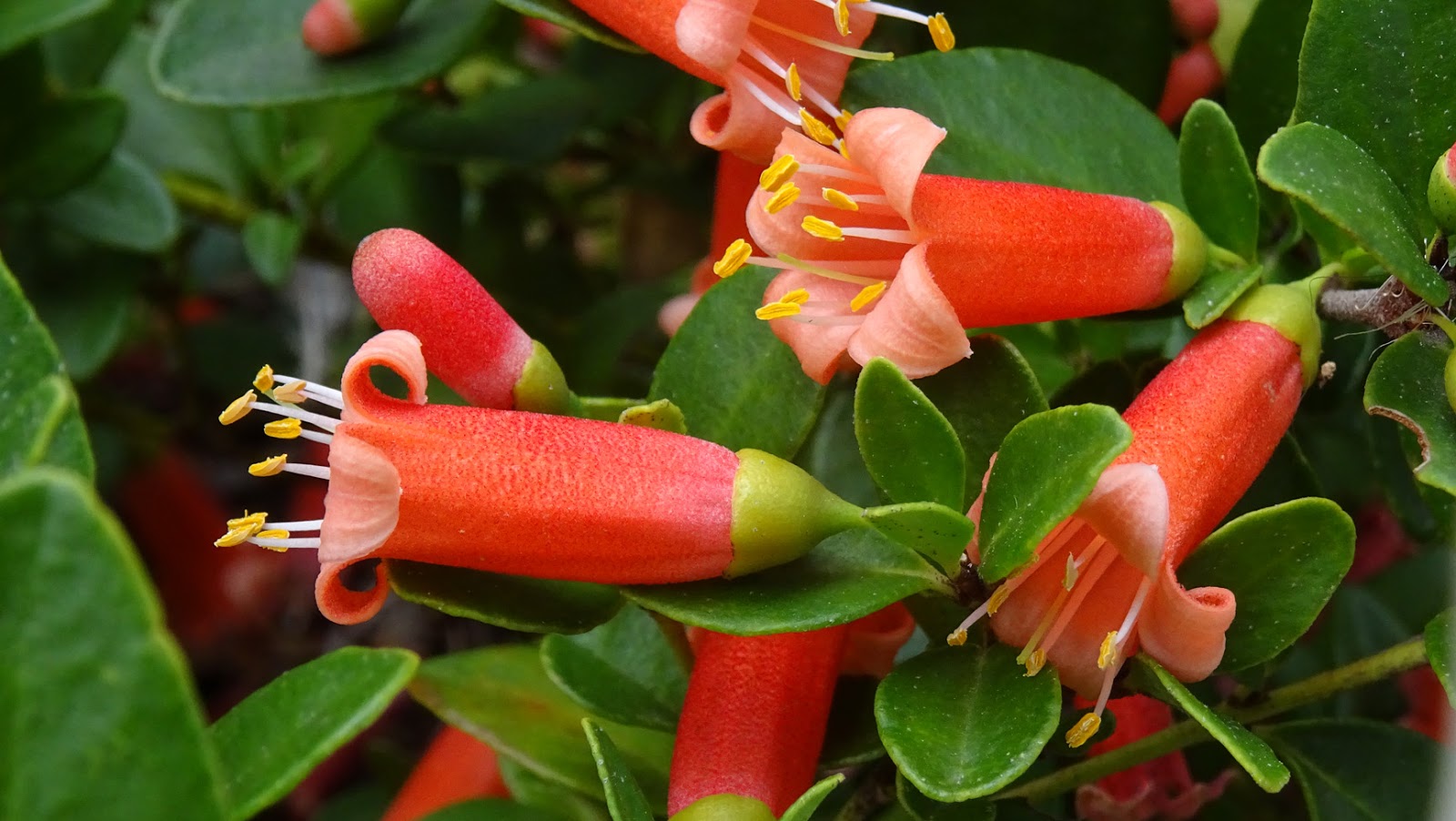
Correa is a genus of flowering plants in the family Rutaceae, with bell-shaped flowers, native mainly to eastern Australia. There are about 11 species in the genus and 26 subspecies. Natural hybridisation between the species makes taxonomic relationships within this genus problematic. There are also hundreds of named cultivars, many of which have been registered with the Australian Cultivar Registration Authority (ACRA). The genus Correa is named after the Portuguese botanist José Correia da Serra (1750–1823), known as Abbé Correa.

This post is part of the Floral Friday Fotos meme.


Friday, 22 April 2016

AUSTRALIAN BUSH

"Gum tree", is a common name for smooth-barked trees and shrubs in three closely related genera of Eucalypt:
Eucalyptus spp, which includes the majority of species of gum trees.
Corymbia spp, which includes the Ghost gums and Spotted gums.
Angophora spp, which includes the Sydney red gum.

Gum trees are highly characteristic native flora of Australia. There are more than 700 species of Eucalyptus and are mostly native of Australia, and a very small number are found in adjacent areas of New Guinea and Indonesia. Corymbia is a genus of about 113 species of tree that were classified as Eucalyptus species until the mid-1990s. Angophora is the smallest group of eucalypts with less than 20 species.

This post is part of the Skywatch Friday meme,
and also part of the Friday Greens meme.

Thursday, 11 February 2016

FAIRY FAN FLOWER

Scaevola aemula (Fairy Fan-flower or Common Fan-flower) is a small shrub in the family Goodeniaceae, native to southern Australia. It grows to 50 cm in height and produces white or blue flowers in spikes up to 24 cm long from August to March in its native range. These are followed by rounded, wrinkled berries to 4.5 mm in length. The species occurs in Western Australia, South Australia, Victoria and New South Wales.

This species is thought to be the most commonly cultivated of the genus Scaevola, and a large number of cultivars have been developed. Most of these are mat-forming to a height of 12 cm and spreading up to 1 metre in width. It prefers a sunny or partially shaded, well-drained position and tolerates salt spray and periods of drought. Pruning and pinching of tip growth may be carried out to shape the plant. Propagation is from cuttings or by layering.

This post is part of the Floral Friday Fotos meme.

Tuesday, 17 November 2015

GUM TREES

Eucalypts, commonly known as gum trees, form an integral part of the Australian identity with the bush. From the children's song "Kookaburra Sits in the Old Gum Tree" through to the distinctive smell of eucalypts to iconic paintings and photographs, eucalypts are an essential part of Australian culture, featuring in art, music and literature.

Eucalypts come in a great range of shapes and sizes – from tall trees to small shrubs. Eucalypts are a dominant part of the Australian flora. Eucalypts range across Australia – the only landscape they are completely absent from is the high alpine areas, though they are scarce in rainforests and in the arid interior of the continent, except where they find refuge along streams and in isolated ranges.

This post is part of the Our World Tuesday meme,
and also part of the Wordless Wednesday meme,
and also part of the Trees & Bushes meme.