Thursday, 2 February 2023
AGAPANTHUS
Thursday, 17 November 2022
PINCUSHION PROTEA
Thursday, 15 September 2022
ALOE
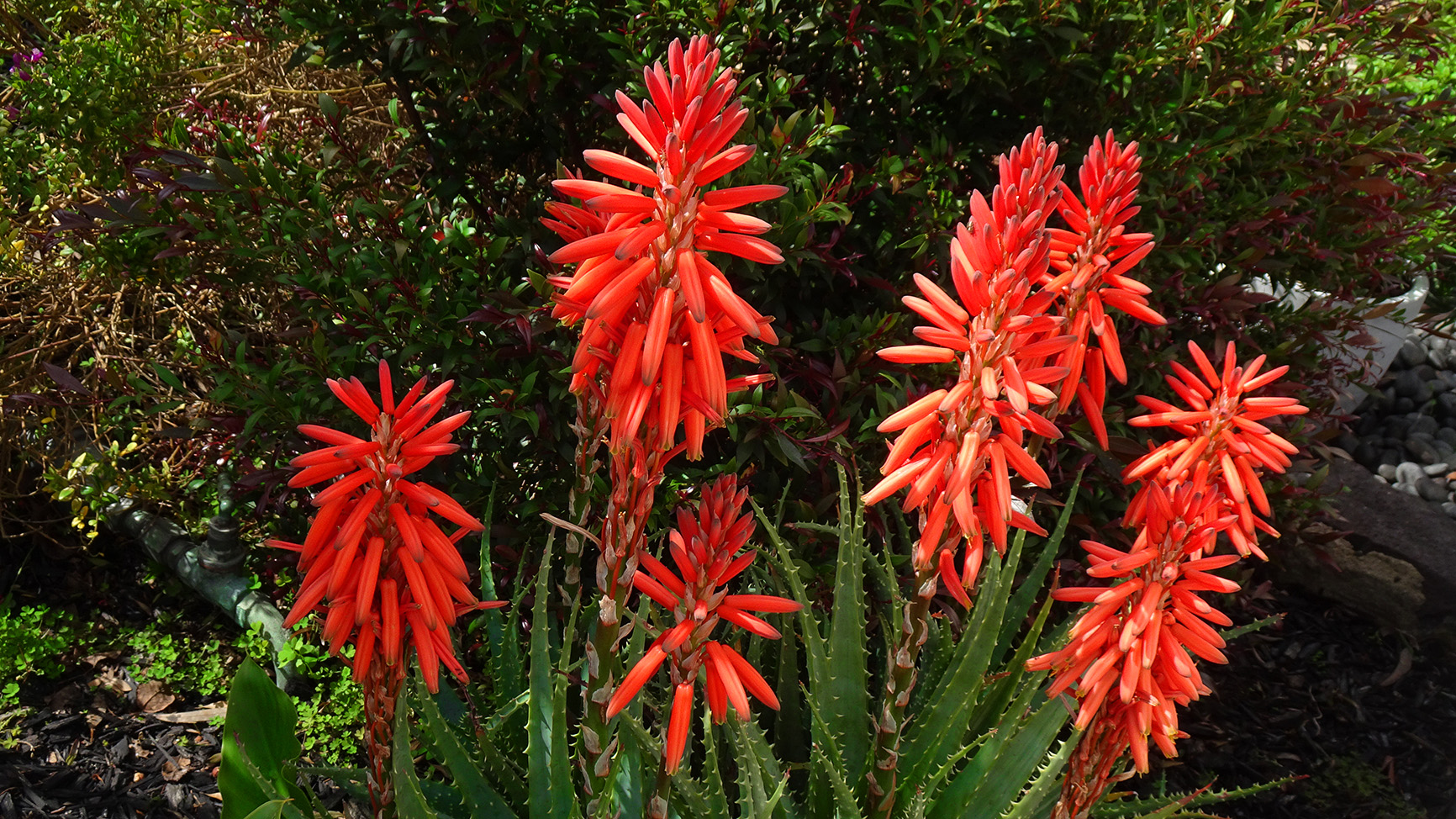
Aloe arborescens, the krantz aloe or candelabra aloe, is a species of flowering succulent perennial plant that belongs to the genus Aloe, which it shares with the well known and studied Aloe vera. The specific epithet arborescens means "tree-like". Aloe arborescens is valued by gardeners for its succulent green leaves, large vibrantly-colored flowers, winter blooming, and attraction for birds, bees, and butterflies.
This post is part of the Floral Friday Fotos meme.
Thursday, 4 August 2022
AFRICAN BUSH DAISY
Thursday, 8 July 2021
FELICIA
Felicia amelloides, the blue marguerite or blue daisy, is a species of flowering plant of the family Asteraceae, native to South Africa. F. amelloides is synonymous with, and formerly known as, F. aethiopica, Aster amelloides, Aster capensis, and Aster coelestis.
F. amelloides is an evergreen shrublet usually 30–60 cm tall by 50 cm wide, but sometimes up to 1 m tall, with densely branched and frequently dark red stems, and rough, hairy, ovate green leaves. Striking blue composite flowers with prominent yellow centres, about 30 mm in diameter, and borne on naked stalks up to 180 mm long.
This species is much cultivated, and in the temperate world is usually grown as a half-hardy annual in pots, window-boxes, hanging baskets, and other summer bedding schemes for parks and gardens. Drought- and wind-resistant, it requires a sheltered aspect in full sun, and does not tolerate frost.
This post is part of the Floral Friday Fotos meme
Thursday, 6 May 2021
POLYGALA
Thursday, 12 November 2020
PINCUSHION PROTEA
Leucospermum (Pincushion, Pincushion Protea or Leucospermum) is a genus of about 50 species of flowering plants in the family Proteaceae, native to Zimbabwe and South Africa, where they occupy a variety of habitats, including scrub, forest, and mountain slopes. They are evergreen shrubs (rarely small trees) growing to 0.5-5 m tall. The leaves are spirally arranged, tough and leathery, simple, linear to lanceolate, 2-12 cm long and 0.5-3 cm broad, with a serrated margin or serrated at the leaf apex only.
The flowers are produced in dense inflorescences, which have large numbers of prominent styles, which inspires the name. The genus is closely related in evolution and appearance to the Australian genus Banksia. Shown here is a Leucospermum patersonii hybrid. An excellent ornamental hardy shrub for most well-drained soils and full sun positions. It is a relatively fast growing landscape shrub for coastal or inland gardens. The two-tone orange-red flowers make a great long stemmed cut flower. Grown commercially.
This post is part of the Floral Friday Fotos meme.
Thursday, 9 April 2020
PROTEA
Thursday, 9 January 2020
AGAPANTHUS
Thursday, 28 November 2019
POMPOM TREE
Thursday, 8 August 2019
CAPE DAISY
Thursday, 14 March 2019
BEE & CRASSULA
Wednesday, 31 October 2018
QUAGGA
Thursday, 11 October 2018
FELICIA ANGUSTIFOLIA
Thursday, 4 October 2018
BUSH LILY
Wednesday, 1 August 2018
ALOES
Thursday, 26 July 2018
CINERARIAS
Thursday, 15 March 2018
BLOOD FLOWER
The Blood Lily is native throughout the winter rainfall region in Southern Africa - from the southern parts of Namibia, to South Africa in the Cape Peninsula, to the Keiskamma River in the Eastern Cape. It is an adaptable species, growing in a wide range of soils derived from sandstones, quartzites, granites, shales and limestones. It will survive annual rainfall ranging from 100–1,100 millimetres.
The large (up to 10 cm diameter) flowerheads of Haemanthus coccineus emerge between February and April in the Southern Hemisphere, with scarlet spathe valves on them like bright shaving brushes, making it a striking plant. The flowers are soon followed by translucent, fleshy berries. There are usually two very large leaves per bulb, and occasionally three, these leaves appearing only after flowering has occurred. We have it growing in our garden quite happily and it always attracts a lot of attention when it is in bloom.
This post is part of the Floral Friday Fotos meme.
Thursday, 7 December 2017
BIRD OF PARADISE FLOWER
The plant grows to 2 m tall, with large, strong leaves 25–70 cm long and 10–30 cm broad, produced on petioles up to 1 m long. The leaves are evergreen and arranged in two ranks, making a fan-shaped crown. The flowers stand above the foliage at the tips of long stalks. The hard, beak-like sheath from which the flower emerges is termed the spathe. This is placed perpendicular to the stem, which gives it the appearance of a bird's head and beak; it makes a durable perch for holding the sunbirds which pollinate the flowers. The flowers, which emerge one at a time from the spathe, consist of three brilliant orange sepals and three purplish-blue or white petals. Two of the blue or white petals are joined together to form an arrow-like nectary. When the sunbirds sit to drink the nectar, the petals open to cover their feet in pollen.
Strelitzia reginae is very popular as an ornamental plant. It was first introduced to Europe in 1773, when it was grown at the Royal Botanic Gardens, Kew. Since then, it has been widely introduced around the world, including the Americas and Australia, growing well in any area that is sunny and warm. In the United States, Florida and California are the main areas of cultivation, due to their warm climate. It is a common ornamental plant in Southern California, and has been chosen as the Official Flower of the City of Los Angeles. It has gained the Royal Horticultural Society's Award of Garden Merit.
It is propagated by division or from seeds, and is a low-maintenance plant that is easy to grow in the garden; it is fairly tolerant of soil conditions and needs little water once established. If cared for well, they will flower several times in a year. They will thrive in rich loamy soil, especially when they get plenty of water throughout the year. They do well in full sun to semi-shade and respond well to regular feeding with a controlled release fertiliser and compost. They are sensitive to cold and need to be sheltered from frost, as it can damage the flowers and leaves.
Strelitzia reginae is slow-growing and will not bloom until three to five years have passed since germination (though it can exceptionally flower at two years). It flowers only when properly established and division of the plant may affect flowering patterns. The flowers are, however, quite long-lasting once they appear. Peak flowering is in the winter and early spring. There is a yellow-flowered cultivar of this plant known as 'Mandela's Gold'.
This post is part of the Floral Friday Fotos meme.
Thursday, 30 November 2017
ORANGE PIGFACE
It is indigenous to southern Africa. Many Mesembryanthemum species are known as ice plants because of the glistening globular bladder cells covering their stems, fruit and leaves, so that "they sparkle like ice crystals". In South Africa, Mesembryanthemum is known as "vygies" (from Afrikaans "vy"), although this term refers to many plants in the Aizoaceae family. Many species formerly placed in Mesembryanthemum, such as Dorotheanthus bellidiformis, Carpobrotus spp. and Sceletium spp. have since been moved into other genera.
Ground cover plants don’t come much tougher or lower maintenance than this plant. In its native land, pigface is used to growing in dry, rocky and sandy conditions which makes it very tolerant to drought, salt and wind. Its succulent foliage will form a dense and spreading mat, growing to no more than 15cm high and around 40cm wide. It’s prized of course for the spectacularly vibrant flowers that form all over the plant in early spring – electric shades of orange, pink, yellow and a crystal white that contrast beautifully with the foliage.
Choose a dry, sunny spot with good drainage, such as amongst rock. They will tolerate partial shade but you may find they produce less flowers. They have a tendency to trail slightly, so plant them at the edge of retaining walls or pots where they can artfully spill over the side. Pigface is unlikely to have problems with pests or disease, just ensure that your drainage is good to prevent root rot.
This post is part of the Floral Friday Fotos meme,
and also part of the Orange you Glad It's Friday meme.