
A blog where I post a mixture of photos that I have taken and find amusing, interesting, artistic, surprising or strange.
Showing posts with label blue. Show all posts
Showing posts with label blue. Show all posts
Thursday, 18 May 2023


Thursday, 8 September 2022

Thursday, 1 September 2022
ISOTOME
Isotoma axillaris, commonly known as rock isotome or showy isotome, is a small herbaceous perennial in the family Campanulaceae. It usually has blue or mauve star-shaped flowers from September to May. It may also be called blue star, star flower, or laurentia.
This post is part of the Floral Friday Fotos meme.

Thursday, 24 March 2022
SPOTTED SUN ORCHID
Thelymitra ixioides, known as the Spotted Sun Orchid is a common plant in eastern and southern Australia, it is also found in New Zealand and New Caledonia. Leaves are thin or lanceolate, up to 20 cm long. A small plant of the Orchidaceae family, it has spotted flowers, forming from August to January. They are usually blue, but sometimes violet. It grows in eucalyptus woodland or heathland.
Thelymitra is derived from the Greek thely, female and mitra, a headdress, referring to the appearance of the plumed column (the fused stamens, styles and stigma). The specific name ixioides means similar to the genus Ixia. It is known as the "sun orchid" because the flowers of most species only open fully on warm, sunny days. There are about 80 species of terrestrial orchids in the genus Thelymitra.
As T. ixioides has fairly specialised cultural needs (like most terrestrial orchids) it is cultivated mainly by orchid enthusiasts. Generally the plants are grown in pots in a freely draining, sandy mix. They require good air circulation in a protected position of about 50% sun during the growing period from autumn to spring. During this growing period the plants must not be allowed to dry out. After the leaves have turned brown in late spring to early summer the pots are allowed to dry out completely. Repotting of tubers can be carried out in summer. This orchid is not considered to be at risk in the wild.
This post is part of the Floral Friday Fotos meme.

Thursday, 23 September 2021
SWAN RIVER DAISIES
Brachyscome iberidifolia (Swan River Daisy) is a delightful, easy to grow small shrub 15cm to 45cm and is native to Western and central Australia. Masses of purple, blue or white flowers from Spring to Autumn. Ideal for mass planting along borders, rockeries, as ground cover, in tubs or hanging baskets.
Brachyscome is a genus of around 70 species of mostly annual and perennial herbs and a few subshrubs in the daisy family Asteraceae. 65 of these are endemic to Australia, the remainder being found in New Zealand and New Guinea. They have typical "daisy" flower heads with showy ray florets in shades of white, pink, mauve, violet or blue, surrounding a usually narrow group of yellow disk florets.
The leaves are often dissected to varying degrees but may be linear or spathulate. In growth habit they vary between plants with a rosette of basal leaves and more-or-less leafless flower scape, and those with mostly cauline leaves and often prostrate stems.
This post is part of the Floral Friday Fotos meme.

Friday, 10 September 2021

Thursday, 11 February 2021
CHICORY
Common chicory, Cichorium intybus, is a somewhat woody, perennial herbaceous plant of the dandelion family, usually with bright blue flowers, rarely white or pink. Many varieties are cultivated for salad leaves, chicons (blanched buds), or roots (var. sativum), which are baked, ground, and used as a coffee substitute and additive. It is also grown as a forage crop for livestock.
It lives as a wild plant on roadsides in its native Europe, and is now common in North America, China, and Australia, where it has become widely naturalised and regarded as a weed. “Chicory” is also the common name in the United States for curly endive (Cichorium endivia); these two closely related species are often confused.
The chicory plant is one of the earliest cited in recorded literature, reaching back to ancient Egyptian times. Horace mentions it in reference to his own diet, which he describes as very simple: “Me pascunt olivae, me cichorea, me malvae” (As for me, olives, endives, and mallows provide sustenance). Medieval monks raised the plants. A common meal in Rome, “puntarelle”, is made with tender chicory sprouts.
Nowadays, chicory may be cultivated for its leaves, usually eaten raw as salad leaves.
This post is part of the Floral Friday Fotos meme

Thursday, 3 December 2020
CAMPANULA
Campanula is one of several genera in the family Campanulaceae with the common name bellflower. It takes both its common and its scientific name from its bell-shaped flowers —campanula is Latin for "little bell". The genus includes over 500 species and several subspecies, distributed across the temperate and subtropical regions of the Northern Hemisphere, with the highest diversity in the Mediterranean region east to the Caucasus.
Campanula persicifolia (peach-leaved bellflower, shown here) is a herbaceous perennial growing to 1 m. Its flowers are cup-shaped and can be either lilac-blue or white. Its foliage is narrow and glossy with a bright green appearance. It is common in the Alps and other mountain ranges in Europe. It grows at lower altitudes in the north, and higher up further south, passing 1,500 m in Provence.
Normally it flowers in June; a dry summer may reduce or inhibit its flowering. Despite this it can flower as late as September in a cold year. The natural habitat of this plant is broad-leaved forests, woodland margins, rocky outcrops in broad-leaved woods, meadows and banks.
This post is part of the Floral Friday Fotos meme

Thursday, 1 October 2020
AUSTRALIAN FLAX
Linum marginale, known by the common name of native flax or Australian flax, is a short lived perennial flowering herb, native to Australia. A slender, wispy, upright plant, growing to around 1 metre high, Native Flax is often overlooked when not in flower. It should not be confused with species of Wahlenbergia, which occurs in the same area and can appear similarly. Like most species of Linum, Linum marginale can be used to produce useful fibre, but is not grown on a commercial level for this purpose.
Native flax has small linear blue green leaves, often pushed quite close to the stem. To the untrained eye from a distance, in may appear to have no leaves. Unlike most other species of flax which have yellow flowers, Linum marginale beaks into sprays of large, electric blue flowers in spring and early summer. The flowers (around 3 cm across) have five petals and form at the top of each wiry stem of the plant. Flowers are replaced in summer by small, globular, papery capsules, about 3 mm across, containing a cluster of buff coloured, sesame-like seeds. Like many southern Australian flowers, the plant dies back in summer, but reshoots the following autumn when the rains return.
This post is part of the Floral Friday Fotos meme.

Friday, 7 August 2020
HEALESVILLE COUNTRYSIDE
Countryside
near Healesville in the Yarra Ranges Shire. The Shire of Yarra Ranges
is a local government area in Victoria, Australia, located in the outer
eastern and northeastern suburbs of Melbourne extending into the Yarra
Valley and Dandenong Ranges. It has an area of 2,469.9 square
kilometres, and at the 2011 census, it had a population of 144,541.It
was formed in 1994 by the merger of parts of the Shire of Sherbrooke,
Shire of Lillydale, Shire of Healesville and Shire of Upper Yarra. It
has rich farmland, vineyards and magnificent areas of native forest.
This post is part of the Skywatch Friday meme.

Sunday, 28 June 2020
MY SUNDAY BEST MEME #176 - ALIEN HOME
Welcome to the meme, "My Sunday Best", which is a photographic and creative meme that allows you to showcase your talents in imaging. Every Sunday, you can post here showing an image you have created using your camera, (and/or) image processing software, and/or painting and drawing in the conventional way and have scanned in.
The rules are simple:
1) Create your image and post it up on your blog;
2) Put the "My Sunday Best" logo image link somewhere on your post so people can click and come by here;
3) Leave a comment here once you have posted;
4) Visit other posters' blogs and be amazed with their creativity!
Please do not use this meme to advertise your goods or services. This is a creative meme and any inappropriate links or comments shall be removed immediately.
The theme is of your own choosing, so post on any subject you desire.

This is an image I created in a computer program called 'Mojoworld', which is a graphics program where one may create graphic constructions of planets according to parameters that are inputted, and then zoom in on views of the surface, visible in a 3D rendering. The planet here I've called Cyanea and the huge moon hovering in the horizon is Rosea.
Last week, Betty in New Zealand showed us some beautiful photos of her neck of the woods. I loved this photo. Please visit her blog for more beautiful images.

Friday, 27 March 2020

Tuesday, 17 March 2020
THE ALPS
The Alps are the highest and most extensive mountain range system that lies entirely in Europe, stretching approximately 1,200 kilometres across eight Alpine countries: Austria, France, Germany, Italy, Liechtenstein, Monaco, Slovenia, and Switzerland. The Caucasus Mountains are higher, and the Urals longer, but both lie partly in Asia.
The mountains were formed over tens of millions of years as the African and Eurasian tectonic plates collided. Extreme shortening caused by the event resulted in marine sedimentary rocks rising by thrusting and folding into high mountain peaks such as Mont Blanc and the Matterhorn. Mont Blanc spans the French–Italian border, and at 4,810 m is the highest mountain in the Alps. The Alpine region area contains about a hundred peaks higher than 4,000 m, known as the "four-thousanders".
The altitude and size of the range affects the climate in Europe; in the mountains precipitation levels vary greatly and climatic conditions consist of distinct zones. Wildlife such as ibex live in the higher peaks to elevations of 3,400 m, and plants such as Edelweiss grow in rocky areas in lower elevations as well as in higher elevations. Evidence of human habitation in the Alps goes back to the Paleolithic era.
This post is part of the Our World Tuesday meme,
and also part of the Travel Tuesday meme,
and also part of the Wordless Wednesday meme.

Sunday, 2 February 2020
MY SUNDAY BEST MEME #155 - JACARANDA
Welcome to the meme, "My Sunday Best", which is a photographic and creative meme that allows you to showcase your talents in imaging. Every Sunday, you can post here showing an image you have created using your camera, (and/or) image processing software, and/or painting and drawing in the conventional way and have scanned in.
The rules are simple: 1) Create your image and post it up on your blog;
2) Put the "My Sunday Best" logo image link somewhere on your post so people can click and come by here;
3) Leave a comment here once you have posted;
4) Visit other posters' blogs and be amazed with their creativity!
Please do not use this meme to advertise your goods or services. This is a creative meme and any inappropriate links or comments shall be removed immediately!
The rules are simple: 1) Create your image and post it up on your blog;
2) Put the "My Sunday Best" logo image link somewhere on your post so people can click and come by here;
3) Leave a comment here once you have posted;
4) Visit other posters' blogs and be amazed with their creativity!
Please do not use this meme to advertise your goods or services. This is a creative meme and any inappropriate links or comments shall be removed immediately!
The theme is of your own choosing, so post on any subject you desire.

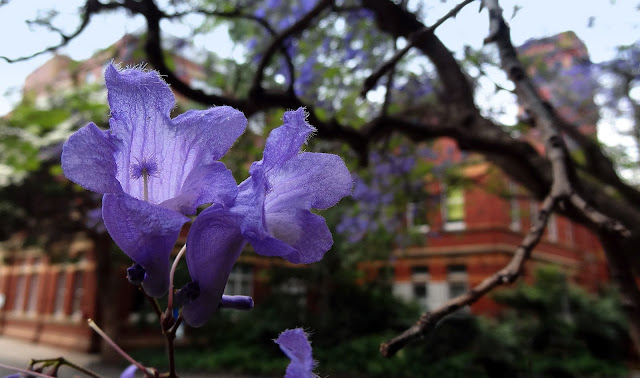
Jacaranda mimosifolia is a sub-tropical tree native to South America that has been widely planted elsewhere because of its beautiful and long-lasting blue flowers. It is also known as Jacaranda, Blue Jacaranda, Black Poui, or as the fern tree. Older sources give it the systematic name Jacaranda acutifolia, but it is nowadays more usually classified as Jacaranda mimosifolia. In scientific usage, the name "Jacaranda" refers to the genus Jacaranda, which has many other members, but in horticultural and everyday usage, it nearly always means the Blue Jacaranda.
Thursday, 9 January 2020
AGAPANTHUS
Agapanthus is the only genus in the subfamily Agapanthoideae of the flowering plant family Amaryllidaceae. The family is in the monocot order Asparagales. The name is derived from scientific Greek: αγάπη (agape) = love, άνθος (anthos) = flower. Some species of Agapanthus are commonly known as lily of the Nile (or African lily in the UK), although they are not lilies and all of the species are native to Southern Africa (South Africa, Lesotho, Swaziland, Mozambique) though some have become naturalised in scattered places around the world (Australia, Great Britain, Mexico, Ethiopia, Jamaica, etc.).
Species boundaries are not clear in the genus, and in spite of having been intensively studied, the number of species recognised by different authorities varies from 6 to 10. The type species for the genus is Agapanthus africanus shown here. A great many hybrids and cultivars have been produced and they are cultivated throughout warm areas of the world.
In Melbourne, these are planted widely in gardens, parks but also median strips of roads and nature strips. As they bloom around the time of Christmas, most Melburnians associate this flower with the Festive Season.
This post is part of the Floral Friday Fotos meme.

Thursday, 2 January 2020
LITHODORA
Lithodora diffusa ‘Grace Ward’ (also called blue lithospermum, USDA Zone: 5-9) in the Boraginaceae family is a choice ground-cover or rock garden plant, making an unforgettable display when grown well. Plants form a low, creeping mat of hairy dark-green leaves, studded with sapphire-blue star flowers from late spring through summer.
The Greek lithodora literally means "stone gifts", referring to their preferred rocky habitats. Plants must have a well-drained, acidic soil in order to thrive. Heavy clay soils are sure death. In colder regions this plant will benefit from a light covering of evergreen boughs as soon as the soil is frozen in late Autumn. Combines well with heaths and heathers, since plants have similar requirements. Evergreen where hardy. Not especially vigorous.
This post is part of the Floral Friday Fotos meme.

Friday, 29 November 2019
PRICKLY PEAR
Opuntia, commonly called prickly pear, is a genus in the cactus family, Cactaceae. Prickly pears are also known as tuna (fruit), sabra, nopal (paddle, plural nopales) from the Nahuatl word nōpalli for the pads, or nostle, from the Nahuatl word nōchtli for the fruit; or paddle cactus. The genus is named for the Ancient Greek city of Opus, where, according to Theophrastus, an edible plant grew and could be propagated by rooting its leaves. The most common culinary species is the Indian fig opuntia (O. ficus-indica).
This post is part of the Skywatch Friday meme.

Thursday, 7 November 2019
SPIDERWORT
Tradescantia virginiana is found in eastern North America, west to Missouri, south to northern South Carolina and Alabama, and north to Ontario, Vermont, and Michigan. Much of the northern range, however, may represent garden escapes rather than indigenous wild populations. It is an attractive garden plant and many showy hybrids bear striking, large blue flowers, such as this one illustrated, T. virginiana 'Zwanenburg Blue'.
Look closely at a bloom and you'll notice tiny hairs covering the stamens. Under normal circumstances, they're the same blue colour as the flower. However, as Steve Bender and Felder Rushing revealed in their classic, best-selling book, "Passalong Plants", in the presence of radiation the hairs turn pink. Thus, spiderwort is an essential part of any garden near nuclear plants! Your very own natural Geiger counter in your garden...
Spiderwort had many uses in First Nation’s culture as food and medicine. The seeds are edible when roasted and are ground into a powder (although they are somewhat bitter to taste). Leaves can be made into a tea or tossed into salads, soups, etc. The root can be collected all year round. The flowers can be tossed on top of a salad and eaten.
Dried, powdered flowers were once used as a snuff for nosebleeds. Externally, this plant can be used as a poultice to help heal wounds and haemorrhoids. Internally the leaves and roots are a valuable alternative medicine used by medical herbalists for their patients as an antidiarrhoeal, analgesic, anthelminthic, antiperiodic, astringent, diaphoretic, emetic, emmenagogue, expectorant, sedative, tonic, vermifuge, and vulnerary. Also, drinking spiderwort tea is supposed to be a good for increasing breast milk (galactagogue).
This post is part of the Floral Friday Fotos meme.

Thursday, 31 October 2019
CEANOTHUS
Ceanothus L. is a genus of about 50–60 species of shrubs or small trees in the family Rhamnaceae. Common names for members of this genus are California Lilac, Wild Lilac, and Soap Bush. Ceanothus comes from a Greek word meaning "spiny plant". The genus is confined to North America, with the centre of its distribution in California. Some species (e.g. C. americanus) are found in the eastern United States and southeast Canada, and others (e.g. C. coeruleus) extend as far south as Guatemala. Most are shrubs 0.5–3 m tall, but C. arboreus and C. thyrsiflorus, both from California, can be small trees up to 6–7 m tall.
The species illustrated here is Ceanothus thyrsiflorus (also known as blueblossom or blue blossom ceanothus), which is an evergreen shrub in the genus Ceanothus that is endemic to California. The term 'Californian lilac' is also applied to this and other varieties of Ceanothus, though it is not closely related to Syringa, the true lilac. In late spring and early summer, this bushy evergreen shrub is smothered in clusters of dark blue flowers among small, dark green, glossy leaves.
It looks great in the middle of a south or west-facing mixed border, or as a specimen at the edge of a terrace or path. It requires protection from cold, drying winds. Each year, after the plant has flowered, take out dead, diseased or damaged shoots and trim back the flowered shoots to the required shape. Apply a 5-7cm mulch of well-rotted organic matter around the base of the plant in spring.
This post is part of the Floral Friday Fotos meme.

Thursday, 17 October 2019
FORGET-ME-NOT
Myosotis (from the Greek: "mouse's ear", from the resemblance of the leaf) is a genus of flowering plants in the family Boraginaceae. In the northern hemisphere they are commonly called forget-me-nots or scorpion grasses. The common name "forget-me-not" was calqued from German, Vergissmeinnicht and first used in English in AD 1398 through King Henry IV. Similar names and variations are found in many languages. Myosotis alpestris is the state flower of Alaska.
Plants of this genus are commonly confused with Chatham Islands forget-me-nots which belong to a related genus, Myosotidium. Myosotis have pentamerous actinomorphic flowers with 5 sepals and petals. Flowers are typically 1 cm diameter (or less), flat, and blue, pink, white or yellow with yellow centres, growing on scorpioid cymes. They may be annual or perennial with alternate leaves. They typically flower in spring or soon after snow-melt in alpine eco-systems.
Their root systems are generally diffuse. Their seeds are found in small, tulip-shaped pods along the stem to the flower. The pods attach to clothing when brushed against and eventually fall off, leaving the small seed within the pod to germinate elsewhere. Seeds can be collected by putting a piece of paper under the stems and shaking the seed pods and some seeds will fall out. Myosotis scorpioides is also known as scorpion grass due to the spiralling curve of its inflorescence.
This post is part of the Floral Friday Fotos meme.

Subscribe to:
Posts (Atom)