Showing posts with label poisonous. Show all posts

Thursday, 23 December 2021

HELLEBORE

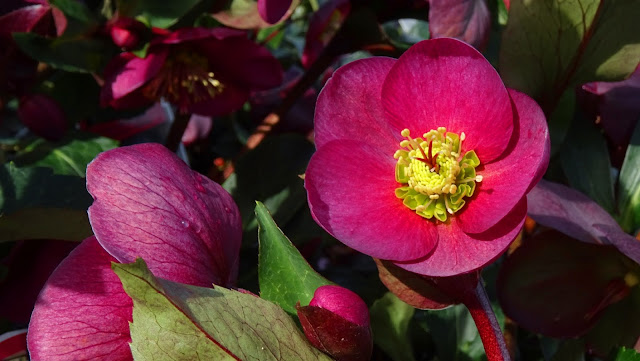
Helleborus niger, commonly called Christmas rose or black hellebore, is an evergreen perennial flowering plant in the buttercup family, Ranunculaceae. It is poisonous. Although the flowers resemble wild roses (and despite its common name), Christmas rose does not belong to the rose family (Rosaceae).

The plant is a traditional cottage garden favourite because it flowers in the depths of winter. Large-flowered cultivars are available, as are pink-flowered and double-flowered selections. It has been awarded an Award of Garden Merit (AGM). It can be difficult to grow well; acid soil is unsuitable, as are poor, dry conditions and full sun. Moist, humus-rich, alkaline soil in dappled shade is preferable. Leaf-mould can be dug in to improve heavy clay or light sandy soils; lime can be added to 'sweeten' acid soils.

The cultivar illustrated is Helleborus 'Anna's Red'. This beautiful variety has stunning deep flower colour. Deep magenta blooms which adorn the plant in winter and early spring, make this is one variety that is very popular. 'Anna's Red' is a vigorous grower with a tidy habit. Plant alongside our other varieties for maximum impact. Hellebores provide stunning results when mass planted in shady areas of the garden.

This post is part of the Floral Friday Fotos meme


Thursday, 22 August 2019

CYCLAMEN

Cyclamen persicum, the Persian cyclamen, in the family Primulaceae, is a species of flowering herbaceous perennial plant growing from a tuber, native to rocky hillsides, shrubland, and woodland up to 1,200 m above sea level, from south-central Turkey to Israel and Jordan. It also grows in Algeria and Tunisia and on the Greek islands of Rhodes, Karpathos, and Crete, where it may have been introduced by monks.

Cultivars of this species are the commonly seen florist's cyclamen. Wild plants have heart-shaped leaves, up to 14 cm usually green with lighter marbling on the upper surface. Flowers bloom from winter to spring (var. persicum) or in autumn (var. autumnale) and have 5 small sepals and 5 upswept petals, usually white to pale pink with a band of deep pink to magenta at the base. After pollination, the flower stem curls downwards slightly as the pod develops, but does not coil as in other cyclamens. Plants go dormant in summer.

Cyclamen persicum has a dark-brown tuberous root which is semi-poisonous. In some cultures, the tubers were used in making soap, as they generate a lather when mixed with water. The Bedouins of Mandate Palestine used to collect the root, and after grating it, would mix it with lime and sprinkle it over the surface of lakes or other large bodies of water known to contain fish. These poisonous mixtures would stun fish, which would then come to the surface and be collected by the fishermen. Such methods, as well as fishing with explosives, which came into use in the early 20th century, were banned by the British Mandate authorities.

This post is part of the Floral Friday Fotos meme.

Thursday, 4 October 2018

BUSH LILY

Clivia miniata (Natal lily, bush lily) is a species of flowering plant in the genus Clivia of the family Amaryllidaceae, native to damp woodland habitats in South Africa (Western Cape, Gauteng and KwaZulu-Natal provinces) as well as in Swaziland. It is also reportedly naturalised in Mexico.

It grows to a height of about 45 cm, and flowers are red, orange or yellow, with a faint, but very sweet perfume. It is sometimes known in cultivation as "Kaffir lily". However, this name is also confusingly applied to the genus Schizostylis, and in any case is best avoided as it is considered an offensive ethnic slur in South Africa.

With a minimum temperature of 10 °C, in temperate regions C. miniata is normally cultivated as a houseplant. It has gained the Royal Horticultural Society's Award of Garden Merit, along with the variety C. miniata var. citrina. It contains small amounts of lycorine, making it poisonous.

This post is part of the Floral Friday Fotos meme.

Thursday, 14 June 2018

BLACK NIGHTSHADE

European black nightshade (Solanum nigrum) or locally just 'black nightshade', duscle, garden nightshade, garden huckleberry, hound's berry, petty morel, wonder berry, small-fruited black nightshade, or popolo) is a species in the Solanum genus, native to Eurasia and introduced in the Americas, Australasia, and South Africa. Parts of this plant can be toxic to livestock and humans. Nonetheless, ripe berries and cooked leaves of edible strains are used as food in some locales, and plant parts are used as a traditional medicine. A tendency exists in literature to incorrectly refer to many of the other "black nightshade" species as "Solanum nigrum".

Solanum nigrum has been recorded from deposits of the Palaeolithic and Mesolithic era of ancient Britain and it is suggested by the botanist and ecologist Edward Salisbury that it was part of the native flora there before Neolithic agriculture emerged. The species was mentioned by Pliny the Elder in the first century AD and by the great herbalists, including Dioscorides. In 1753, Carl Linnaeus described six varieties of Solanum nigrum in 'Species Plantarum'.

Black nightshade is a common herb or short-lived perennial shrub, found in many wooded areas, as well as disturbed habitats. It reaches a height of 30 to 120 cm, leaves 4.0 to 7.5 cm long and 2 to 5 cm wide; ovate to heart-shaped, with wavy or large-toothed edges; both surfaces hairy or hairless; petiole 1 to 3 cm long with a winged upper portion. The flowers have petals greenish to whitish, recurved when aged and surround prominent bright yellow anthers. The berry is mostly 6 to 8 mm in diam., dull black or purple-black. In India, another strain is found with berries that turn red when ripe. Sometimes S. nigrum is confused for the more toxic deadly nightshade, Atropa belladonna, which is in a different Solanaceae genus altogether. A comparison of the fruit shows that the black nightshade berries grow in bunches, the deadly nightshade berries grow individually.

Solanine levels in S. nigrum can be toxic. Children have died from poisoning after eating unripe berries. However, the plant is rarely fatal, with ripe berries causing symptoms of mild abdominal pains, vomiting, and diarrhoea. Poisoning symptoms are typically delayed for 6 to 12 hours after ingestion. Initial symptoms of toxicity include fever, sweating, vomiting, abdominal pain, diarrhoea, confusion, and drowsiness. Death from ingesting large amounts of the plant results from cardiac arrhythmias and respiratory failure. Livestock have also been poisoned from nitrate toxicity by grazing the leaves of S. nigrum. All kinds of animals can be poisoned after ingesting nightshade, including cattle, sheep, poultry, and swine.

Nevertheless, S. nigrum has been widely used as a food since early times, and the fruit was recorded as a famine food in 15th-century China. Despite toxicity issues with some forms, the ripe berries and boiled leaves of edible strains are eaten. The thoroughly boiled leaves (although strong and slightly bitter flavoured) are used like spinach as horta (see here) and in fataya pies and quiches. The ripe black berries are described as sweet and salty, with hints of liquorice and melon. In South India, the leaves and berries are routinely consumed as food after cooking with tamarind, onion, and cumin seeds.

If you decide to pick and consume black nightshade, ensure you know that you are picking the right plant and also that you are preparing it correctly!

The plant has a long history of medicinal usage, dating back to ancient Greece. In the fourteenth century, the plant under the name of Petty Morel was being used for "canker" and with Horehound and wine taken for "dropsy". It was a traditional European medicine used as a strong sudorific, analgesic and sedative with powerful narcotic properties, but was considered a "somewhat dangerous remedy". Internal use has fallen out of favour in Western herbalism due to its variable chemistry and toxicity, but it is used topically as a treatment for herpes zoster. In the language of flowers, a sprig of flowering black nightshade signifies "truth".

This post is part of the Floral Friday Fotos meme.


Thursday, 26 April 2018

POTATO BUSH

Lycianthes rantonnetii (blue potato bush) is a species of flowering plant in the family Solanaceae. It is native to Brazil, Bolivia, Argentina and Paraguay. It is cultivated as ornamental plant the world over. The blue potato bush is one of about 150 species in the genus Lycianthes, which are found mostly in tropical regions of the Americas, and others located in the Asia-Pacific region.

Lycianthes is apparently closely related to the chili peppers (Capsicum). However, it was long confused with the nightshades (Solanum), and several little-known Solanum species presumably should be included with Lycianthes. The species is named for Barthélémy Victor Rantonnet, a 19th-century French horticulturalist.

This plant is noted for its superb display of richly coloured and lightly fragrant flowers over a long season, provided it is grown in full sun. Water and feed regularly for the best display. Cuttings will make good-sized bushes for the following summer. The small red autumn berries are poisonous when ingested.

This post is part of the Floral Friday Fotos meme.


Thursday, 20 October 2016

POISON HEMLOCK

Conium maculatum (hemlock or poison hemlock) is a highly poisonous biennial plant herbaceous flowering plant in the carrot family Apiaceae, native to Europe and North Africa. 

It is a herbaceous biennial plant that grows to 1.5–2.5 m, with a smooth, green, hollow stem, usually spotted or streaked with red or purple on the lower half of the stem. All parts of the plant are hairless (glabrous). The leaves are two- to four-pinnate, finely divided and lacy, overall triangular in shape, up to 50 cm long and 40 cm broad. The flowers are small, white, clustered in umbels up to 10–15 cm across. When crushed, the leaves and root emit a rank, unpleasant odour often compared to that of parsnips. It produces a large number of seeds that allow the plant to form thick stands in modified soils.


The toxicity of the plant has inspired many of its common names: In addition to the English poison hemlock, the Australian Carrot Fern, and the Irish devil's bread or devil's porridge, poison parsley, spotted corobane, and spotted hemlock are used.

Eight piperidinic alkaloids have been identified in C. maculatum. Two of them, gamma-coniceine and coniine, are generally the most abundant, and they account for most of the plant's acute and chronic toxicity. Due to high potency, the ingestion of seemingly small doses can easily result in respiratory collapse and death.

Coniine causes death by blocking the neuromuscular junction in a manner similar to curare; this results in an ascending muscular paralysis with eventual paralysis of the respiratory muscles which results in death due to lack of oxygen to the heart and brain. Death can be prevented by artificial ventilation until the effects have worn off 48–72 hours later. For an adult, the ingestion of more than 100 mg (0.1 gram) of coniine (about six to eight fresh leaves, or a smaller dose of the seeds or root) may be fatal.

In ancient Greece, hemlock was used to poison condemned prisoners. The most famous victim of hemlock poisoning is the philosopher Socrates. After being condemned to death for impiety and corrupting the young men of Athens, in 399 BC, Socrates was given a potent infusion of the hemlock plant. Plato described Socrates' death in 'Phaedo'.

This post is part of the Floral Friday Fotos meme,
and also part of the Friday Greens meme.


Thursday, 17 December 2015

PELICAN FLOWER

Aristolochia grandiflora (Pelican Flower) is a deciduous vine in the Aristolochiaceae family, with one of the world's largest flowers that emits an odour resembling rotting meat, attracting flies.

The large, solitary flowers are produced from cordiate leaf axils. Leaves can be up to 25 cm wide. Flowers are heart shaped: 10–20 cm wide and have tails that are up to 60 cm (24 in). The flower is green/white with purple/brown veins. The centre of the flower is darker coloured, which attracts pollinators along with a distinctive odour to its reproductive elements. The flower has three sections, utricle, tube and limb, characteristic to all Aristolochiaceae.

The plant is native to the Caribbean and Central America, and has been introduced to Florida in the United States as an attractor of butterflies. It is found in tropical forests near streams and gullies. A. grandiflora is pollinated by breeding flies attracted by the odour of the flower. Flies travel down the tubular part of the flower to the utricle where the reproductive organs are found. The tube is lined with trichomes that direct the fly down to the utricle and prevent the fly from moving out.

Reproduction occurs in three main phases. In the first phase, the fly carrying pollen from other flowers pollinates the carpel. During the second phase, the stamen matures releasing pollen on the fly. This phase lasts one day. While trapped inside the flower, the fly eats nectar produced along the walls of the utricle. The trichomes then are signalled to wither, allowing the fly to escape. The entire reproductive process lasts two days before flower senescences and abscises in the third phase.

A. grandiflora has been used for ornamental purposes, as a food source, and in traditional medicine. It is a food source for swallowtail butterfly larvae. These butterflies become unpalatable to predators when they consume the terpenes in this plant. The use of this plant poses a risk as it contains the toxin aristolochic acid which is carcinogenic. The USDA has banned all products containing this compound.  A. grandiflora contains many different alkaloids (bisbenzylisoquinolinic and 8-benzylberberinic), which aid in chemical defences against insects and plant microbes.

This post is part of the Floral Friday Fotos meme.