Showing posts with label Fabaceae. Show all posts

Thursday, 1 June 2023

QUEENSLAND SILVER WATTLE

Acacia podalyriifolia is a perennial tree which is fast-growing and widely cultivated. It is native to Australia but is also naturalised in Malaysia, Africa, India and South America. Its uses include environmental management and it is also used as an ornamental tree. It is very closely related to Acacia uncifera. It grows to about 5 m (16 feet) in height and about the same in total width. It blooms during winter. Common names for it are Mount Morgan wattle, Queensland silver wattle, Queensland wattle, pearl acacia, pearl wattle and silver wattle.

This post is part of the Floral Friday Fotos meme.


Thursday, 1 July 2021

PRICKLY WATTLE

Acacia paradoxa is a plant in the family Fabaceae. Its common names include kangaroo acacia, kangaroo thorn, prickly wattle, hedge wattle and paradox acacia.

The large shrub or tree up to 2 to 4 metres tall and has a similar width, it has ribbed branchlets that are often arched downward. It is dense with foliage; the leaves are actually enlarged petioles known as phyllodes. They are crinkly and the new ones are covered in hairs. The erect phyllodes are asymmetric and have a lanceolate shape and are around 30 millimetres in length and 7 mm wide. The bush is also full of long spines.

It usually flowers between August and November producing an axillary flower-spike with small, bright yellow spherical flower heads and the fruits are brown pods 4 to 7 centimetres long. The hard black seeds within have an oblong shape and are about 6 mm in length and half as wide. The spiny stipules that grow at the base of the phyllodes deter livestock from feeding on or too close to the plant.

This year, this wattle has bloomed early, as have a lot of other flowers. We have had a warmer June than usual with much rain.

This post is part of the Floral Friday Fotos meme.

Thursday, 14 November 2019

SWEET PEA

The sweet pea (Lathyrus odoratus) is a flowering plant in the genus Lathyrus in the family Fabaceae (legumes), native to Sicily, Cyprus, southern Italy and the Aegean Islands. It is an annual climbing plant, growing to a height of 1–2 metres, where suitable support is available.

The leaves are pinnate with two leaflets and a terminal tendril, which twines around supporting plants and structures, helping the sweet pea to climb. In the wild plant the flowers are purple, 2–3.5 centimetres broad; they are larger and very variable in colour in the many cultivars. The annual species, L. odoratus, may be confused with the everlasting pea, L. latifolius, a perennial.

This post is part of the Floral Friday Fotos meme.

Thursday, 11 April 2019

TRAILING LOTUS

Lotus berthelotii is a perennial plant endemic to the Canary Islands, in the family Fabaceae. This plant is either extinct in the wild or persists as a few individuals. In 1884 it was already classed as "exceedingly rare" and plant collection probably hastened its decline. The plant has a creeping or trailing habit, with leaves divided into 3-5 slender leaflets, each leaflet 1–2 cm long and 1 mm broad, densely covered with fine silvery hairs.

The flowers are orange-red to red, peaflower-shaped, but slender, 2–4 cm long and 5–8 mm broad. Lotus berthelotii is cultivated in the horticulture trade and widely available as an ornamental plant with its needle-like silvery foliage and red flowers for traditional gardens, container (pots), and drought tolerant water conserving gardens. A golden orange flowering cultivar is also grown.

This post is part of the Floral Friday Fotos meme.

Thursday, 16 August 2018

WATTLE

Acacia baileyana or Cootamundra wattle, is a shrub or tree in the genus Acacia, in the Fabaceae family. The scientific name of the species honours the botanist Frederick Manson Bailey. It is indigenous to a small area of southern New South Wales in Australia, but it has been widely planted in other Australian states and territories. In Melbourne, it is a very commonly encountered street tree. In many areas of Victoria, this wattle has become naturalised and is regarded as a weed, out-competing indigenous Victorian species. Wattles have been extensively introduced into New Zealand.

Almost all wattles have cream to golden flowers. The small, lightly fragrant, flowers are arranged in spherical to cylindrical inflorescences, with only the stamens prominent. These trees start to bloom in early Winter and different varieties of wattle will continue to flower until Spring. A. baileyana is used in Europe in the cut flower industry, where it is called "mimosa". It is also used as food for bees in the production of honey.

This plant is adaptable and easy to grow. It has gained the Royal Horticultural Society's Award of Garden Merit. Unfortunately it has an ability to naturalise (i.e. escape) into surrounding bushland. Also, it hybridises with some other wattles, notably the rare and endangered Sydney Basin species Acacia pubescens. The fine foliage of the original Cootamundra wattle is grey-green, but a blue-purple foliaged form, known as 'Purpurea' is very popular.

This post is part of the Floral Friday Fotos meme.


Thursday, 19 October 2017

SPANISH BROOM

Spartium junceum, commonly known as Spanish broom or weaver's broom, is a species of flowering plant in the family Fabaceae. It is the sole species in the genus Spartium, but is closely related to the other brooms in the genera Cytisus and Genista. There are many binomials in Spartium that are of dubious validity. The Latin specific epithet junceum means "rush-like", referring to the shoots, which show a passing resemblance to those of the rush genus Juncus. This species is native to the Mediterranean in southern Europe, southwest Asia and northwest Africa, where it is found in sunny sites, usually on dry, sandy soils.

S. junceum is a vigorous, deciduous shrub growing to 2–4 m tall, rarely 5 m, with main stems up to 5 cm thick, rarely 10 cm. It has thick, somewhat succulent grey-green rush-like shoots with very sparse small deciduous leaves 1 to 3 cm long and up to 4 mm broad. The leaves are of little importance to the plant, with much of the photosynthesis occurring in the green shoots (a water-conserving strategy in its dry climate). The leaves fall away early. In late spring and summer shoots are covered in profuse fragrant yellow pea-like flowers 1 to 2 cm across. In late summer, the legumes (seed pods) mature black and reach 8–10 cm long. They burst open, often with an audible crack, spreading seed from the parent plant.

Spartium junceum has been widely introduced into other areas as an ornamental plant, and is regarded as a noxious invasive species in places with a Mediterranean climate such as California and Oregon, Hawaii, central Chile, southeastern Australia, the Western Cape in South Africa and the Canary Islands and Azores.

The plant is used as an ornamental plant in gardens and in landscape plantings. It has gained the Royal Horticultural Society's Award of Garden Merit. In Bolivia and Peru, the plant is known as retama (not to be confused with the genus Retama) and has become very well established in some areas. It is one of the most common ornamental plants, often seen growing along sidewalks in La Paz. Retama has made its way into the ethnobotany of the indigenous Aymara and Quechua cultures. The plant is also used as a flavouring, and for its essential oil, known as genet absolute. Its fibres have been used for making cloth and it produces a yellow dye.

This post is part of the Floral Friday Fotos meme.


Thursday, 13 July 2017

PURPLE SNOW PEAS

Pisum sativum var. arvense This old variety (Capucijner) has delightful fragrant, purple-pink flowers followed by attractive deep purple pods, which are filled with green peas. A strong climber up to 150cm tall. Eat pods fresh when young and tender or use the green peas either cooked or dried. Peas need well drained, limy soil and should be watered well over the summer months.

This post is part of the Floral Friday Fotos meme.


Monday, 29 August 2016

SILVER WATTLE

Acacia dealbata (known as silver wattle, blue wattle or mimosa) is a species of Acacia, in the Fabaceae family, native to southeastern Australia in New South Wales, Victoria, Tasmania, and the Australian Capital Territory and widely introduced in Mediterranean, warm temperate, and highland tropical landscapes. These trees are widespread in Melbourne and they are in full bloom currently.

It is a fast-growing evergreen tree or shrub growing up to 30 m tall, typically a pioneer species after fire. The leaves are bipinnate, glaucous blue-green to silvery grey, 1–12 cm (occasionally to 17 cm) long and 1–11 cm broad, with 6–30 pairs of pinnae, each pinna divided into 10–68 pairs of leaflets; the leaflets are 0.7–6 mm long and 0.4–1 mm broad. The flowers are produced in large racemose inflorescences made up of numerous smaller globose bright yellow flowerheads of 13–42 individual flowers. The fruit is a flattened pod 2–11.5 cm long and 6–14 mm broad, containing several seeds. Trees generally do not live longer than 30 to 40 years, after which in the wild they are succeeded by other species where bushfires are excluded. In moist mountain areas, a white lichen can almost cover the bark, which may contribute to the descriptor "silver".

Acacia dealbata is widely cultivated as an ornamental plant in warm temperate regions of the world, and is naturalised in some areas. The timber is useful for furniture and indoor work, but has limited uses, mainly in craft furniture and turning. It has a honey colour, often with distinctive figures like birdseye and tiger stripes. It has a medium weight (540–720 kg/m³), and is similar to its close relative blackwood, but of lighter tone without the dark heartwood. The flowers and tip shoots are harvested for use as cut flowers, when it is known by florist trade as "mimosa". In Italy, Albania, Russia and Georgia the flowers are also frequently given to women on International Women's Day. The essence of the flowers, called 'cassie' or 'opopanax', is used in perfumes. The leaves are sometimes used in Indian chutney.

This post is part of the Monday Mellow Yellows meme,
and also part of the Blue Monday meme,
and also part of the Through my Lens meme,
and also part of the Seasons meme.


Tuesday, 12 May 2015

SARACA THAIPINGENSIS

Saraca thaipingensis is medium sized, evergreen tree with a wide-spreading crown, which grows to a height of 7 m or more. Leaves are simple pinnate, large, with up to 8 pairs of opposite, 20-40 x 6-12 cm leaflets but without a terminal one. Young leaves are cream-coloured, hanging limply in tassels for a few days before they stiffen and turn green.

Flowers are 1-2 cm across, faintly fragrant, in dense bunches that arise from the trunk and main branches. They are light pinkish yellow turning deep yellow with a dark crimson eye spot which darkens to blood-red. Most of the flowers in a cluster are functionally male, the others bisexual. Pods are large, 30-45 x 6-10 cm, thin, flat and leathery. They turn purple with maturity, splitting into two coiled halves to expose the flat, black seeds.

This is an attractive flowering tree for parks and gardens. When in bloom, the tree attracts masses of nectar feeding sunbirds like Purple-throated (Nectariniua sperata), Crimson (Aethopyga siparaja), Olive-backed (Cinnyris jugularis) and Brown-throated (Anthreptes malacensis) as well as the Asian Brown Flycatcher (Muscicapa dauurica).

The tree is native to Peninsular Malaysia, but is cultivated in a number of tropical countries. The specimen here was photographed in the Singapore Botanic Gardens.

This post is part of the Our World Tuesday meme,
and also part of the Trees & Bushes meme,
and also part of the Ruby Tuesday meme,
and also part of the Wordless Wednesday meme,
and also part of the Floral Friday Fotos meme.


Thursday, 16 October 2014

BLACK CORAL PEA

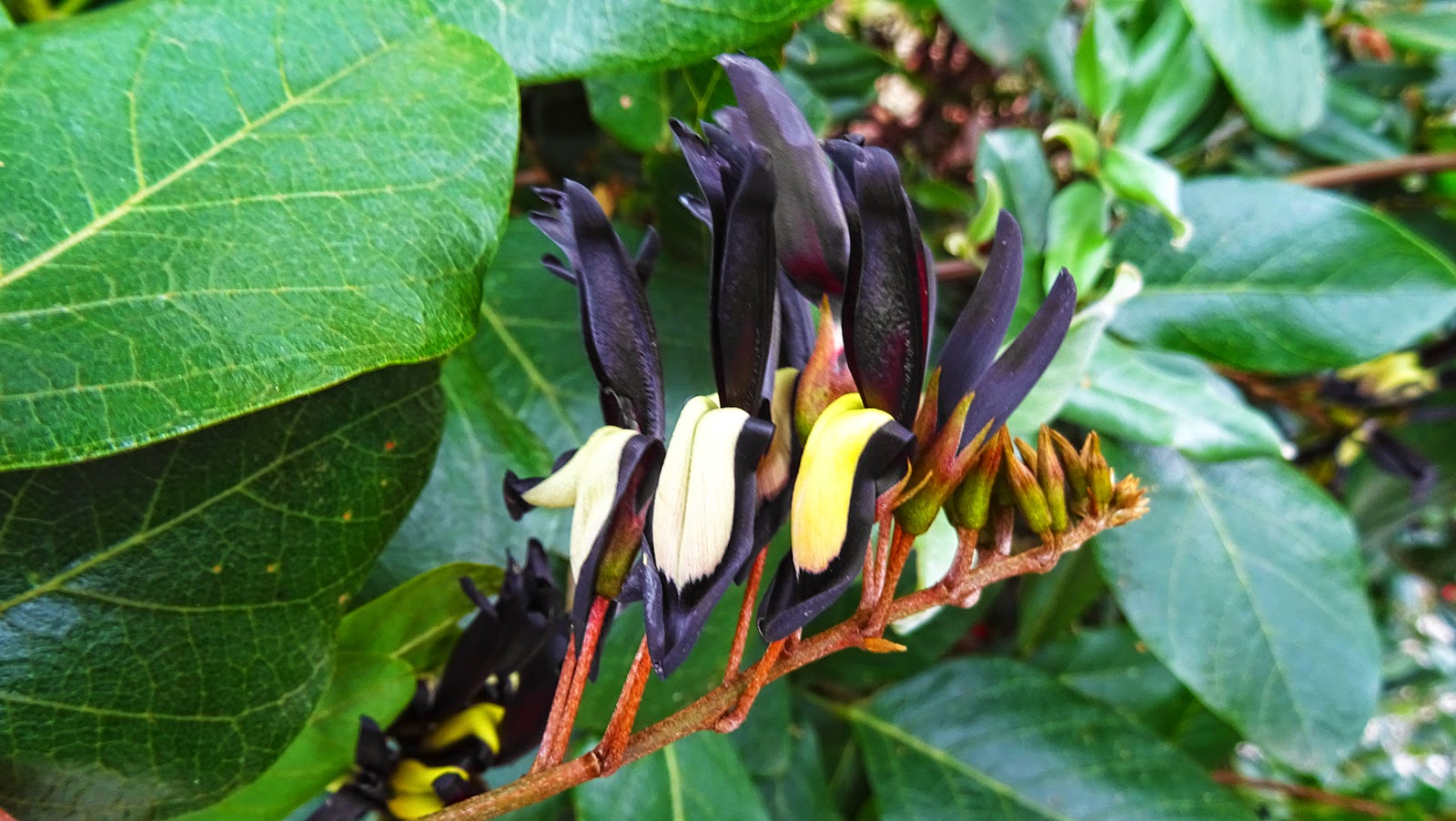
Kennedia nigricans (Black Kennedia or Black Coral Pea) is a species of flowering plant in the family Fabaceae, endemic to the south-west of Western Australia. It is a vigorous climber which can spread up to 6 metres in diameter or 4 metres in height and has dark green leaflets that are about 15 cm long.

Distinctive black and yellow pea flowers are produced between July and November in its native range. The species was first formally described as Kennedya nigricans by John Lindley in 1835 in Edward's Botanical Register, where it was also labelled as Dingy Flowered Kennedya. A cultivar known as Kennedia nigricans 'Minstrel' was registered with the Australian Cultivar Registration Authority by Goldup Nursery of Mount Evelyn, Victoria in September 1985. This cultivar was selected from a batch of seedlings in 1983 and has a pale colouration instead of the yellow, which appears almost white.

This plant is noted for its vigour and can be used to cover embankments or unsightly structures. The species is adapted to a range of soils and prefers a sunny position. It is resistant to drought and has some frost tolerance. The species can be propagated by scarified seed or cuttings of semi-mature growth, while the cultivar requires propagation from cuttings to remain true to type.

This post is part of the Floral Friday Fotos meme.


Tuesday, 12 February 2013

STURT'S DESERT PEA

Swainsona formosa, Sturt's Desert Pea, is an Australian plant in the genus Swainsona, family Fabaceae, named after English botanist Isaac Swainson, famous for its distinctive blood-red leaf-like flowers, each with a bulbous black centre, or "boss". It is one of Australia's best known wildflowers. It is native to the arid regions of central and north-western Australia, and its range extends into all mainland Australian states with the exception of Victoria.

The plant flowers from spring to summer, particularly after rain. There is a natural pure white form, as well as hybridised varieties which can have flowers ranging from blood scarlet, to pink and even pale cream, with variously coloured central bosses. Several tricolour variants have been recorded, including the cultivars marginata (white keel with red margin, red flag and purple-black boss), tricolour (white keel, red flag, pink boss), and elegans (white flag and keel, both with red margins). Flowers are bird-pollinated in the wild.

The fruit is a legume, about 5 centimetres long, and each yields 50 or more flat, kidney-shaped seeds at maturity. Most forms of the plant are low-growing or prostrate, however in the Pilbara region of north-western Australia varieties growing as tall as 2 metres have been observed.

This post is part of the Nature Footsteps Floral Macros meme,

and also part of the Ruby Tuesday meme.