Showing posts with label vine. Show all posts

Thursday, 13 April 2023

HIBBERTIA

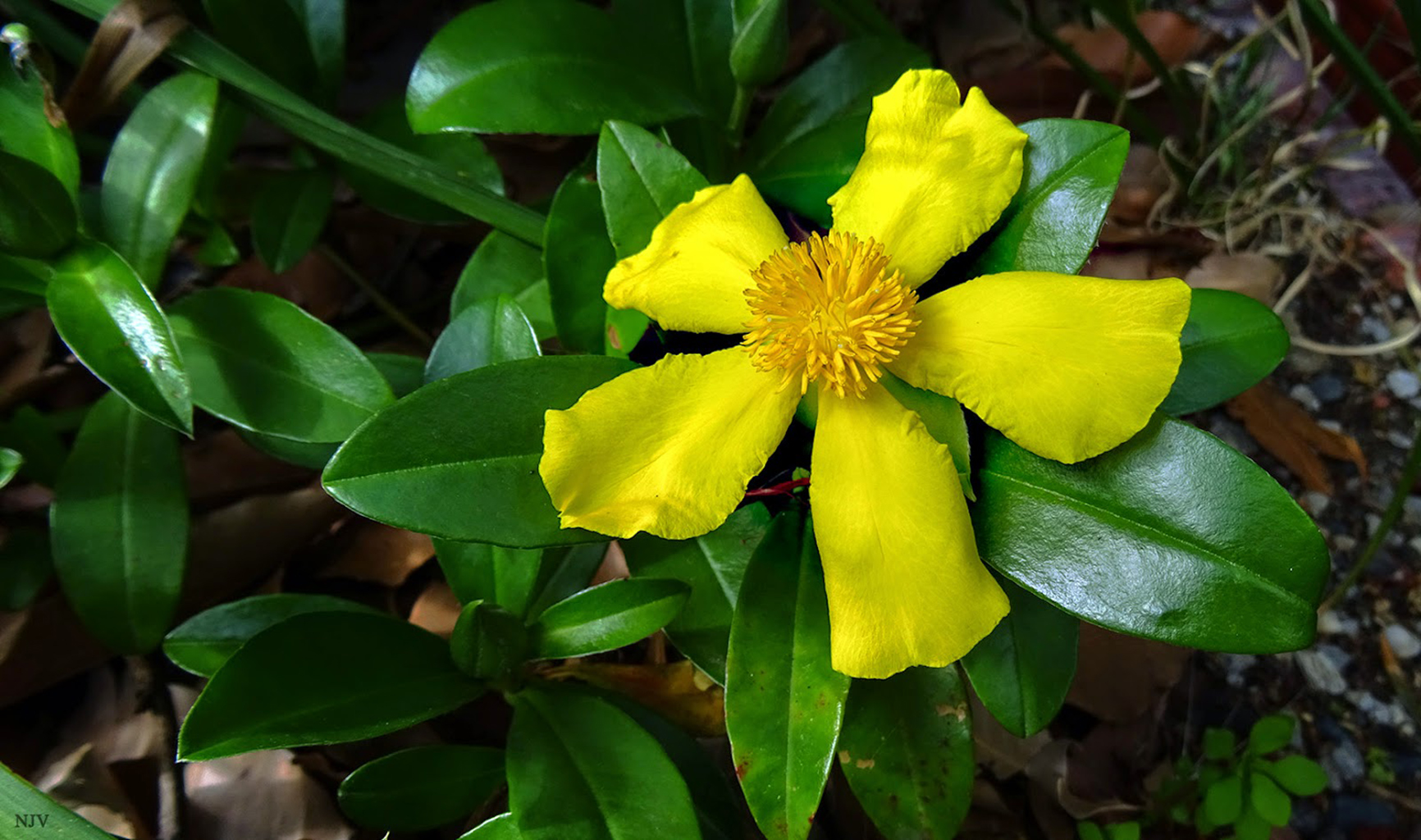
Hibbertia scandens (also known as Snake Vine, Climbing Guinea Flower or Golden Guinea Vine) is an Australian native vine in the Dilleniaceae family.

Hibbertia scandens occurs in an area that extends from south-eastern New South Wales upwards to north-east Queensland. This species is commonly cultivated, and adapts to a wide range of growing conditions. Although it readily grows in semi-shaded areas, it flowers best in full sun.

This post is part of the Floral Friday Fotos meme


Thursday, 24 January 2019

MORNING GLORY

Ipomoea is the largest genus in the flowering plant family Convolvulaceae, with over 500 species. Most of these are called morning glories, but this can also refer to related genera. Those formerly separated in Calonyction (Greek καλός, kalos, good and νύκτα, nycta, night) are called moonflowers. The generic name is derived from the Greek words ιπς (ips) or ιπος (ipos), meaning "worm" or "bindweed," and όμοιος (homoios), meaning "resembling". It refers to their twining habit.

The genus occurs throughout the tropical and subtropical regions of the world, and comprises annual and perennial herbaceous plants, lianas, shrubs and small trees; most of the species are twining climbing plants. Ipomoea nil is a species of Ipomoea morning glory known by several common names, including picotee morning glory, ivy morning glory, and Japanese morning glory. It is native to most of the tropical world, and has been introduced widely.

It is cultivated as an attractive ornamental plant in many places, and the descendants of garden escapees now grow wild. This is a climbing annual herb with three-pointed leaves 3 to 8 centimeters long. The flowers are several centimeters wide and appear in various shades of blue, pink or rose, often with white stripes or edges or blends of colours. Common cultivars include 'Scarlet O'Hara', 'Early Call', and 'Rose Silk'.

This post is part of the Floral Friday Fotos meme.

Thursday, 25 January 2018

IPOMOEA

Ipomoea is the largest genus in the flowering plant family Convolvulaceae, with over 500 species. It is a large and diverse group with common names including morning glory, sweet potato, bindweed, moonflower, etc. The most widespread common name is morning glories, but there are also species in related genera bearing the same common name. Those formerly separated in Calonyction (Greek καλός, kalos, good and νύκτα, nycta, night) are called moonflowers. The generic name is derived from the Greek words ιπς (ips) or ιπος (ipos), meaning "worm" or "bindweed," and όμοιος (homoios), meaning "resembling". It refers to their twining habit.

The genus occurs throughout the tropical and subtropical regions of the world, and comprises annual and perennial herbaceous plants, lianas, shrubs and small trees; most of the species are twining climbing plants. Ipomoea tricolor (morning glory) is native to the New World tropics, and widely cultivated and naturalised elsewhere. It is an herbaceous annual or perennial twining liana growing to 2–4 m tall. The leaves are spirally arranged, 3–7 cm long with a 1.5–6 cm long petiole.

The flowers are trumpet-shaped, 4–9 cm in diameter, most commonly blue with a white to golden yellow centre.In cultivation, the species is very commonly grown misnamed as Ipomoea violacea, actually a different though related species. Numerous cultivars of I. tricolor with different flower colours have been selected for use as ornamental plants; widely grown examples include Blue Star, Flying Saucers, Heavenly Blue, Heavenly Blue Improved, Pearly Gates, Rainbow Flash, Skylark, Summer Skies and Wedding Bells. The cultivar 'Heavenly Blue' has gained the Royal Horticultural Society's Award of Garden Merit.

This post is part of the Floral Friday Fotos meme.


Thursday, 10 December 2015

STEPHANOTIS

Stephanotis floribunda syn. S. jasminoides (Madagascar jasmine, waxflower, Hawaiian wedding flower, bridal wreath) is a species of flowering plant in the family Apocynaceae, native to Madagascar. Growing to 6 m or more, it is an evergreen woody climber with glossy, leathery oval leaves and clusters of pure white, waxy, intensely fragrant tubular flowers.

Madagascar's climate, with its moderate temperatures, high humidity and seasonal cycles of hot, wet summers and cool, dry winters provides the optimal growing conditions for Stephanotis. Grown commercially, the trumpet-shaped blooms are in season year-round, provided they are given enough light and water, and are a popular component of bridal bouquets. It is a vigorous climber, tough-stemmed, bearing dark green leathery leaves, which grow in pairs at regular intervals along the vine. It grows best in sunny, tropical conditions, or inside. They can grow from 2–6 meters, and are widely cultivated as garden plants. They can flourish for years, grown indoors on a sunny windowsill. They can be moved outside or into a greenhouse during the summer.

The flowers are waxy, star-shaped and highly scented, about 3 cm long, in clusters and are produced in summer. This vine flowers only on new growth, and thus pruning should be kept to a minimum, especially during the growth season. Flowers fade to yellow after several days and the deep, rich fragrance turns sour in smell. The blooms are a favourite in weddings, used in bridal bouquets, corsages and decorations. Normally the plant has to be a little old and root bound to start flowering. Once it does, the result is very rewarding. The flowers are long-lasting and sweetly scented.

This post is part of the Floral Friday Fotos meme.

Thursday, 16 October 2014

BLACK CORAL PEA

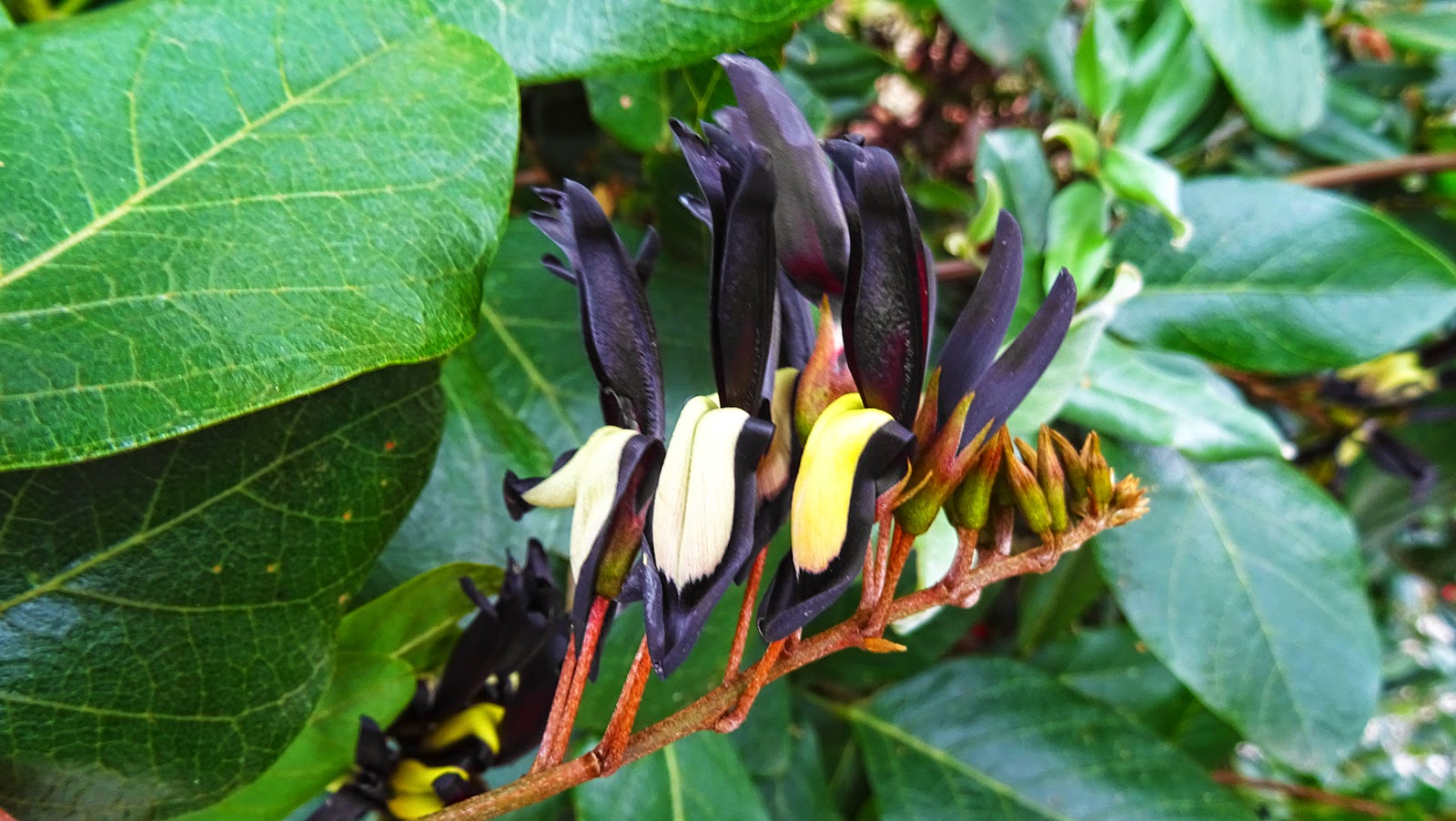
Kennedia nigricans (Black Kennedia or Black Coral Pea) is a species of flowering plant in the family Fabaceae, endemic to the south-west of Western Australia. It is a vigorous climber which can spread up to 6 metres in diameter or 4 metres in height and has dark green leaflets that are about 15 cm long.

Distinctive black and yellow pea flowers are produced between July and November in its native range. The species was first formally described as Kennedya nigricans by John Lindley in 1835 in Edward's Botanical Register, where it was also labelled as Dingy Flowered Kennedya. A cultivar known as Kennedia nigricans 'Minstrel' was registered with the Australian Cultivar Registration Authority by Goldup Nursery of Mount Evelyn, Victoria in September 1985. This cultivar was selected from a batch of seedlings in 1983 and has a pale colouration instead of the yellow, which appears almost white.

This plant is noted for its vigour and can be used to cover embankments or unsightly structures. The species is adapted to a range of soils and prefers a sunny position. It is resistant to drought and has some frost tolerance. The species can be propagated by scarified seed or cuttings of semi-mature growth, while the cultivar requires propagation from cuttings to remain true to type.

This post is part of the Floral Friday Fotos meme.