This post is part of the Saturday Critters meme.
Showing posts with label black. Show all posts
Saturday, 22 August 2020
Thursday, 4 June 2020
BLACK TULIP
A FLORAL TRIBUTE TO BLACK LIVES UNJUSTLY LOST OR WASTED
This post is part of the Floral Friday Fotos meme.
Friday, 6 July 2018
WINTRY SUNRISE
A beautiful wintry sunrise from my window.
This post is part of the Skywatch Friday meme,
and also part of the Friday Photo Journal meme.
This post is part of the Skywatch Friday meme,
and also part of the Friday Photo Journal meme.
Thursday, 5 February 2015
BAT FLOWER
Tacca integrifolia (white bat plant) has strange, almost bizarre flowers resembling a bat’s black face with white ears and long whiskers. It is found naturally in south-east Asia and from eastern India to southern China. It belongs to the yam family, Dioscoraceae.
It is an upright leafy plant with grey-green, narrow leaves growing from an underground fleshy root. The flowers are borne in flower heads of up to thirty blooms. These form the bat’s face. They range in colour from purple-red to brown. The flowers are topped by white floral leaves called bracts, which resemble bat’s ears. Filaments up to 20cm long or more hang from the flowers. The similar black bat plant has black or purple bracts. There is also an Australian native species called T. leontopetaloides.
This plant is suited to the tropics and subtropics. Outside these areas bat plants can be grown in filtered light in a humid glasshouse or conservatory, with a minimum temperature of about 15°C. It produces extraordinary flowers, has attractive foliage and is a stunning novelty plant. It is difficult to grow, may be hard to find and therefore suited to dedicated green thumbs!
This post is part of the Floral Friday Fotos meme.
It is an upright leafy plant with grey-green, narrow leaves growing from an underground fleshy root. The flowers are borne in flower heads of up to thirty blooms. These form the bat’s face. They range in colour from purple-red to brown. The flowers are topped by white floral leaves called bracts, which resemble bat’s ears. Filaments up to 20cm long or more hang from the flowers. The similar black bat plant has black or purple bracts. There is also an Australian native species called T. leontopetaloides.
This plant is suited to the tropics and subtropics. Outside these areas bat plants can be grown in filtered light in a humid glasshouse or conservatory, with a minimum temperature of about 15°C. It produces extraordinary flowers, has attractive foliage and is a stunning novelty plant. It is difficult to grow, may be hard to find and therefore suited to dedicated green thumbs!
This post is part of the Floral Friday Fotos meme.
Thursday, 16 October 2014
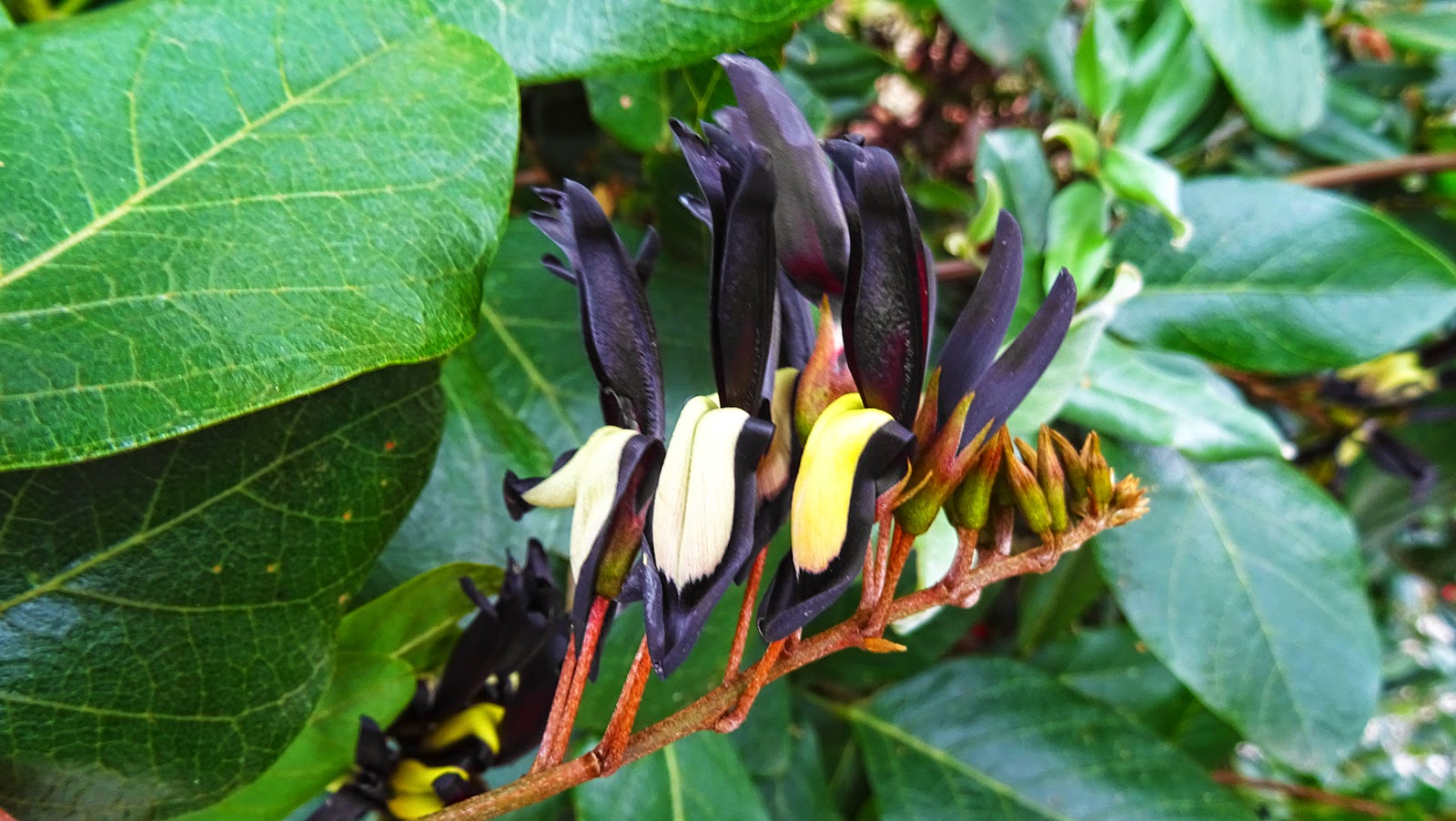
BLACK CORAL PEA
Kennedia nigricans (Black Kennedia or Black Coral Pea) is a species of flowering plant in the family Fabaceae, endemic to the south-west of Western Australia. It is a vigorous climber which can spread up to 6 metres in diameter or 4 metres in height and has dark green leaflets that are about 15 cm long.
Distinctive black and yellow pea flowers are produced between July and November in its native range. The species was first formally described as Kennedya nigricans by John Lindley in 1835 in Edward's Botanical Register, where it was also labelled as Dingy Flowered Kennedya. A cultivar known as Kennedia nigricans 'Minstrel' was registered with the Australian Cultivar Registration Authority by Goldup Nursery of Mount Evelyn, Victoria in September 1985. This cultivar was selected from a batch of seedlings in 1983 and has a pale colouration instead of the yellow, which appears almost white.
This plant is noted for its vigour and can be used to cover embankments or unsightly structures. The species is adapted to a range of soils and prefers a sunny position. It is resistant to drought and has some frost tolerance. The species can be propagated by scarified seed or cuttings of semi-mature growth, while the cultivar requires propagation from cuttings to remain true to type.
This post is part of the Floral Friday Fotos meme.
Distinctive black and yellow pea flowers are produced between July and November in its native range. The species was first formally described as Kennedya nigricans by John Lindley in 1835 in Edward's Botanical Register, where it was also labelled as Dingy Flowered Kennedya. A cultivar known as Kennedia nigricans 'Minstrel' was registered with the Australian Cultivar Registration Authority by Goldup Nursery of Mount Evelyn, Victoria in September 1985. This cultivar was selected from a batch of seedlings in 1983 and has a pale colouration instead of the yellow, which appears almost white.
This plant is noted for its vigour and can be used to cover embankments or unsightly structures. The species is adapted to a range of soils and prefers a sunny position. It is resistant to drought and has some frost tolerance. The species can be propagated by scarified seed or cuttings of semi-mature growth, while the cultivar requires propagation from cuttings to remain true to type.
This post is part of the Floral Friday Fotos meme.
Subscribe to:
Posts (Atom)