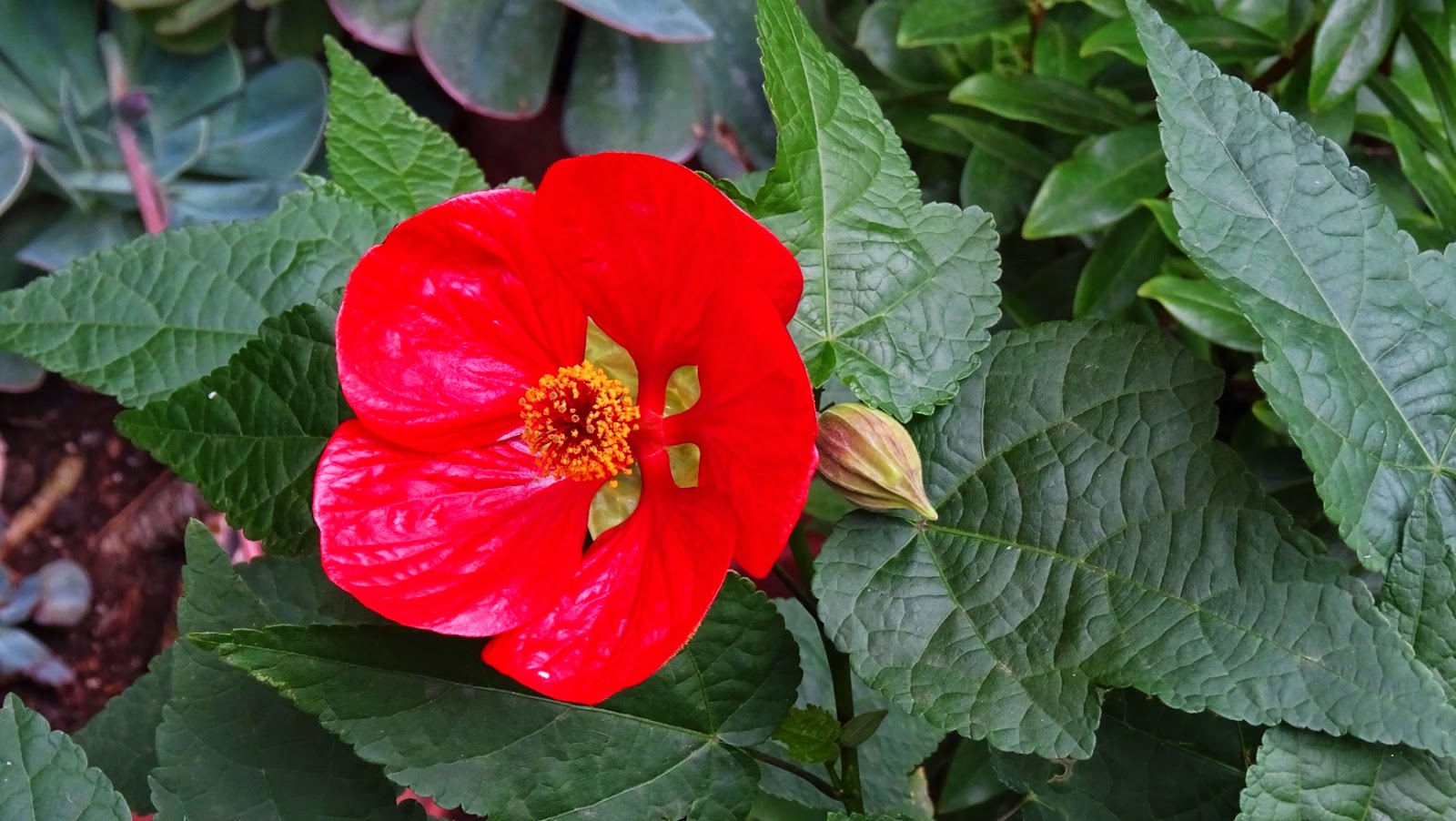
Aptenia cordifolia is a species of succulent plant in the ice plant family known by the common names heartleaf, ice plant and baby sun rose. Perhaps the most common plant seen under this name is actually Aptenia 'Red Apple', a hybrid with red flowers and bright green leaves, whose parents are A. cordifolia and A. (Platythyra) haeckeliana. The true species of A. cordifolia has magenta purple flowers and more heart-shaped, mid-green, textured leaves.
Native to southern Africa, this species has become widely known as an ornamental plant. It is a mat-forming perennial herb growing in flat clumps on the ground from a woody base. Stems reach up to about 60 centimetres long. The bright green leaves are generally heart-shaped and up to 3 centimetres long. They are covered in very fine bumps. Bright pink to purplish flowers appear in the leaf axils and are open during the day. The fruit is a capsule just over a centimetre long.
The hybrid, Aptenia 'Red Apple', has, in some areas, escaped cultivation and now grows as an introduced species. Its far more vigorous growth and ability to root from small bits of stem makes it a poor choice for planting adjacent to wild lands as it can overwhelm native plants.
This post is part of the Floral Friday Fotos meme,
and also part of the Friday Greens meme.
Friday, 10 April 2015
Thursday, 9 April 2015
CHIVES IN FLOWER
Chives is the common name of Allium schoenoprasum, the smallest species of the edible onion genus. A perennial plant, it is native to Europe, Asia and North America. A. schoenoprasum is the only species of Allium native to both the New and the Old Worlds. The name of the species derives from the Greek skhoínos (sedge) and práson (leek). Its English name, chives, derives from the French word cive, from cepa, the Latin word for onion.
Chives are a commonly used herb and can be found in grocery stores or grown in home gardens. In culinary use, the scapes and the unopened, immature flower buds are diced and used as an ingredient for fish, potatoes, soups, and other dishes. Chives have insect-repelling properties that can be used in gardens to control pests.
Chives are a bulb-forming herbaceous perennial plant, growing to 30–50 cm tall. The bulbs are slender, conical, 2–3 cm long and 1 cm broad, and grow in dense clusters from the roots. The scapes (or stems) are hollow and tubular, up to 50 cm long and 2–3 mm across, with a soft texture, although, prior to the emergence of a flower, they may appear stiffer than usual. The leaves, which are shorter than the scapes, are also hollow and tubular, or terete, (round in cross-section) which distinguishes it at a glance from Garlic Chives.
The flowers are pale purple, and star-shaped with six petals, 1–2 cm wide, and produced in a dense inflorescence of 10-30 together; before opening, the inflorescence is surrounded by a papery bract. The seeds are produced in a small three-valved capsule, maturing in summer. The herb flowers from April to May in the southern parts of its habitat zones and in June in the northern parts (November to February in the Southern Hemisphere).
This post is part of the Floral Friday Fotos meme.
Wednesday, 8 April 2015
MANTA RAY
Manta rays are large eagle rays belonging to the genus Manta. The larger species, M. birostris, reaches 7 m in width while the smaller, M. alfredi, reaches 5.5 m. Both have triangular pectoral fins, horn-shaped cephalic fins and large, forward-facing mouths. They are classified among the Elasmobranchii (sharks and rays) and are placed in the eagle ray family, Myliobatidae.
Mantas are found in temperate, subtropical and tropical waters. Both species are pelagic; M. birostris migrates across open oceans, singly or in groups, while M. alfredi tends to be resident and coastal. They are filter feeders and eat large quantities of zooplankton, which they swallow with their open mouths as they swim. Gestation lasts over a year, producing live pups. Mantas may visit cleaning stations for the removal of parasites. Like whales, they breach, for unknown reasons.
Both species are listed as vulnerable by the International Union for Conservation of Nature. Anthropogenic threats include pollution, entanglement in fishing nets, and direct harvesting for their gill rakers for use in Chinese medicine. Their slow reproductive rate exacerbates these threats. They are protected in international waters by the Convention on Migratory Species of Wild Animals, but are more vulnerable closer to shore. Areas where mantas congregate are popular with tourists. Only a few aquariums are large enough to house them. In general, these large fish are seldom seen and difficult to study. The manta seen here is in the Melbourne Aquarium.
This post is part of the Wednesday Waters meme,
and also part of the Waterworld Wednesday meme,
Tuesday, 7 April 2015
WALHALLA, VICTORIA, AUSTRALIA
Walhalla is a small town in Victoria, about 180 kilometres east of the state capital Melbourne. It is located in the Great Dividing Range, in the steep Stringers Creek valley, approximately four kilometres upstream of the creek's junction with the Thomson River. The area around the town is designated as an historic area which then adjoins the Baw Baw National Park.
It was founded as a gold-mining community in early 1863 and at its peak home to around 2,500 residents. Today, the town has a population of fewer than 20 permanent residents, though it has a large proportion of houses owned as weekenders. It attracts large numbers of tourists and is a major focus of the regional tourism industry. The town's name is taken from an early gold mine in the area, named for the German hall of fame, the Walhalla temple (Valhalla from Norse legend).
Gold mining was already becoming largely unprofitable in the early 20th century and the last of the major mines closed in 1914. With the disappearance of the main industry in town, the bulk of the population soon left. Until the growth of the tourist industry in the 1970s and 80s, Walhalla survived as a ghost town for most of the twentieth century. Several major public buildings including the Mechanics Institute and Star Hotel were destroyed in two fire events in 1944 and 1951 and a number of buildings were destroyed without being rebuilt. The school closed in 1965 and further fires, floods and neglect slowly chipped away at the remains of the town.
Since around 1977, Walhalla has experienced something of a renaissance with a booming tourist industry and the restoration or reconstruction of numerous historical buildings in the town, including the Star Hotel, Mechanics Institute, Windsor House, Elliott's Bakery and reconstruction of the Thomson–Walhalla section of the former narrow-gauge railway.
This post is part of the Our World Tuesday meme,
and also part of the Ruby Tuesday meme,
and also part of the Trees & Bushes meme.
Monday, 6 April 2015
ADELAIDE RAILWAY STATION
The Adelaide Central Railway Station on North Terrace.
This post is part of the Monday Mellow Yellows meme.
Sunday, 5 April 2015
TSAMBIKA MONASTERY RHODES
The Monastery of Panagia Tsambika (The Lambent Virgin) in Rhodes, Greece: The Monastery of Panagia Tsambika is located about 25 km south of Rhodes Town, between Kolymbia and Archangelos. The old monastery of Tsambika is built on top of a steep hill with gorgeous view to the sea and the surrounding area, while the new monastery, which is functional today, is found on the road that connects Archangelos to Rhodes Town.
It is not known when the old monastery was founded, but we know that it was reconstructed in 1770 by a monk. Some resources mention that an altar to goddess Artemis stood on the same site in antiquity and sacrifices of animals used to take place there.
This monastery was built according to the Dodecanesian architecture with thick white-washed walls and hollow roof tiles. The floor of the temple and the yard are covered with mosaics of pebbles and shells. Some icons date from the 19th century, while the iconostasis is even older.
The name of the monastery comes from the word "tsamba", which means spark in the local dialect. In fact, tradition says that a local shepherd found an icon of Virgin Mary on top of the cliff, where the old monastery was later built, following a vigil light. The icon of Panagia Tsambika is considered miracle-working, particularly for childless women, which is why many women offer child dolls to the icon of Panagia. This monastery is considered a protector of the island and in fact many locals are named Tsambikos (men) and Tsambika (women).
This post is part of the Spiritual Sundays meme,
and also part of the inSPIREd Sunday meme.
It is not known when the old monastery was founded, but we know that it was reconstructed in 1770 by a monk. Some resources mention that an altar to goddess Artemis stood on the same site in antiquity and sacrifices of animals used to take place there.
This monastery was built according to the Dodecanesian architecture with thick white-washed walls and hollow roof tiles. The floor of the temple and the yard are covered with mosaics of pebbles and shells. Some icons date from the 19th century, while the iconostasis is even older.
The name of the monastery comes from the word "tsamba", which means spark in the local dialect. In fact, tradition says that a local shepherd found an icon of Virgin Mary on top of the cliff, where the old monastery was later built, following a vigil light. The icon of Panagia Tsambika is considered miracle-working, particularly for childless women, which is why many women offer child dolls to the icon of Panagia. This monastery is considered a protector of the island and in fact many locals are named Tsambikos (men) and Tsambika (women).
HAPPY EASTER TO ALL WHO CELEBRATE IT THIS WEEK!
This post is part of the Spiritual Sundays meme,
and also part of the inSPIREd Sunday meme.
Saturday, 4 April 2015
WARRANDYTE REFLECTIONS
Warrandyte is a suburb of Melbourne, Victoria, Australia, 24 km north-east of Melbourne's Central Business District. Its local government area is the City of Manningham. At the 2011 census, Warrandyte had a population of 5,520.
Warrandyte was founded as a Victorian town, located in the once gold-rich rolling hills east of Melbourne, and is now on the north-eastern boundary of suburban Melbourne. Gold was first discovered in the town in 1851 and together, with towns like Bendigo and Ballarat, led the way in gold discoveries during the Victorian gold rush. Today Warrandyte retains much of its past in its surviving buildings of the Colonial period and remains a twin community with North Warrandyte, which borders the Yarra River to its north.
The Yarra River is a prominent feature of the town and the lush vegetation on its banks provides ample opportunity for pleasant walks and leisure activities.
This post is part of the Weekend Reflections meme,
and also part of the Weekly TopShot meme,
and also part of the Scenic Weekends meme.
Friday, 3 April 2015
GREEN IGUANA
The green iguana or common iguana (Iguana iguana) is a large, arboreal, mostly herbivorous species of lizard of the genus Iguana native to Central, South America, and the Caribbean. Usually, this animal is simply called the iguana. The green iguana ranges over a large geographic area, from southern Brazil and Paraguay as far north as Mexico and the Caribbean Islands. They are very common throughout Puerto Rico, where they are colloquially known as "Gallina de palo" and considered as an invasive species introduced from South America; in the United States feral populations exist in South Florida (including the Florida Keys), Hawaii, and the Rio Grande Valley of Texas.
A herbivore, it has adapted significantly with regard to locomotion and osmoregulation as a result of its diet. It grows to 1.5 metres in length from head to tail, although a few specimens have grown more than 2 metres with body-weights upward of 9.1 kg.
Commonly found in captivity as a pet due to its calm disposition and bright colours, it can be very demanding to care for properly. Space requirements and the need for special lighting and heat can prove challenging to an amateur hobbyist.
This post is part of the Friday Greens meme.
Thursday, 2 April 2015
ABUTILON
Abutilons or Chinese lanterns are closely related to hibiscus, and most of the hundred or so species have pendulous, hibiscus-like flowers. Cultivars produced by hybridising some of the South American abutilons have all been placed in one group known as Abutilon x hybridum, and these are the ones most commonly grown in Australian gardens. They have a wispy, delicate form and colourful, lantern-shaped flowers. For gardeners who prefer plants with a more dense habit, new compact varieties are also available. This compact abutilon is growing very happily in a large pot on our porch.
They are evergreen shrubs with attractive maple-like leaves and an open, pendulous habit. They grow to about 2-3 metres tall (or 50-100 cm if a compact variety). Flowers are produced in September to December, but they spot flower at other times. Flower colours include white, pink, red, yellow, orange and salmon. Abutilons grow well in most parts of Australia, except for the very cold mountain zones. In inland areas be sure to water well and keep protected with mulch. In hot inland climates abutilons appreciate some light shade.
A full sun position is best, but abutilons will also flower in part shade. They like a rich, well drained soil and a cool root run. Water well and mulch. Avoid heavy feeding as abutilons are inclined to produce foliage at the expense of flowers. Light prune to shape toward the end of winter in frost free gardens. Leave until early spring in frost-prone areas. They can become untidy and leggy like hibiscus. As abutilons are members of the Malvaceae family, they are also subject to attack by hibiscus beetle and metallic flea beetle. These pests make holes in leaves and flowers and are difficult to control with pesticides.
This post is part of the Floral Friday Fotos meme.
Wednesday, 1 April 2015
Subscribe to:
Posts (Atom)