Showing posts with label history. Show all posts

Sunday, 27 July 2025

SUNDAY BEST #440 - STATE LIBRARY VICTORIA

Welcome to the meme, "My Sunday Best", which is a photographic and creative meme that allows you to showcase your talents in imaging. Every Sunday, you can post here showing an image you have created using your camera, (and/or) image processing software, and/or painting and drawing in the conventional way and have scanned in.
The rules are simple:
1) Create your image and post it up on your blog;
2) Put the "My Sunday Best" logo image link somewhere on your post so people can click and come by here;
3) Leave a comment here once you have posted;
4) Visit other posters' blogs and be amazed with their creativity.
Please do not use this meme to advertise our goods or services. This is a creative meme and any inappropriate links or comments shall be removed immediately.
State Library Victoria (SLV) is the state library of Victoria, Australia. Located in Melbourne, it was established in 1854 as the Melbourne Public Library, making it Australia's oldest public library and one of the first free libraries in the world. It is also Australia's busiest public library and, as of 2023, the third busiest library globally. The magnificent Dome Reading room is shown here.

You are invited to the Inlinkz link party!

Click here to enter
Last week, Veredit in Germany posted some beautiful photos of a heritage forest. Please visit her blog for more great shots!


Sunday, 8 December 2024

SUNDAY BEST #408 - IN THE CLOISTERS

Welcome to the meme, "My Sunday Best", which is a photographic and creative meme that allows you to showcase your talents in imaging. Every Sunday, you can post here showing an image you have created using your camera, (and/or) image processing software, and/or painting and drawing in the conventional way and have scanned in.
The rules are simple:
1) Create your image and post it up on your blog;
2) Put the "My Sunday Best" logo image link somewhere on your post so people can click and come by here;
3) Leave a comment here once you have posted
4) Visit other posters' blogs and be amazed with their creativity.
Please do not use this meme to advertise our goods or services. This is a creative meme and any inappropriate links or comments shall be removed immediately.
An architectural embellishment in the cloisters of the University of Melbourne's Old Law Quadrangle.

You are invited to the Inlinkz link party!

Click here to enter
Last week, Rupam Sarma in India posted this wonderful B&W image. Please visit his blog for more great shots.


Monday, 3 June 2024

GOTHIC

This mosaic features the former English, Scottish & Australian Bank (now ANZ ‘Gothic Bank’) at 382-392 Collins Street (north-east corner of Collins and Queen Streets). This edifice is considered to be the finest secular Gothic Revival building in Australia. It was erected as the head office of the ES&A Bank in 1883-87. The top two floors were the residence of George Verdon, general manager of the bank, and an enlightened patron, who commissioned noted architect William Wardell, and together they created this masterpiece.

The flat stone exterior is punctuated by delicately elaborated openings, those of the first floor porches in Venetian Gothic tracery. Inside, the banking chamber is a tour-de-force of rich Gothic imagery and 19th century technology – the columns, ribbing and sculptural capitals are all made of iron. Verdon’s residence above remains substantially intact (also lavishly ornamented), and was occupied by the women only Lyceum Club in the 1920s. The bank expanded in 1922 to occupy the adjacent buildings on both streets, and the banking chamber was seamlessly extended into the former Stock Exchange.

This post is part of the Mosaic Monday meme,
and also part of the Seasons meme.


Sunday, 19 November 2023

SUNDAY BEST #353 - UNIVERSITY

Welcome to the meme, "My Sunday Best", which is a photographic and creative meme that allows you to showcase your talents in imaging. Every Sunday, you can post here showing an image you have created using your camera, (and/or) image processing software, and/or painting and drawing in the conventional way and have scanned in.
The rules are simple:|1) Create your image and post it up on your blog;
2) Put the "My Sunday Best" logo image link somewhere on your post so people can click and come by here;
3) Leave a comment here once you have posted;
4) Visit other posters' blogs and be amazed with their creativity.
Please do not use this meme to advertise our goods or services. This is a creative meme and any inappropriate links or comments shall be removed immediately.
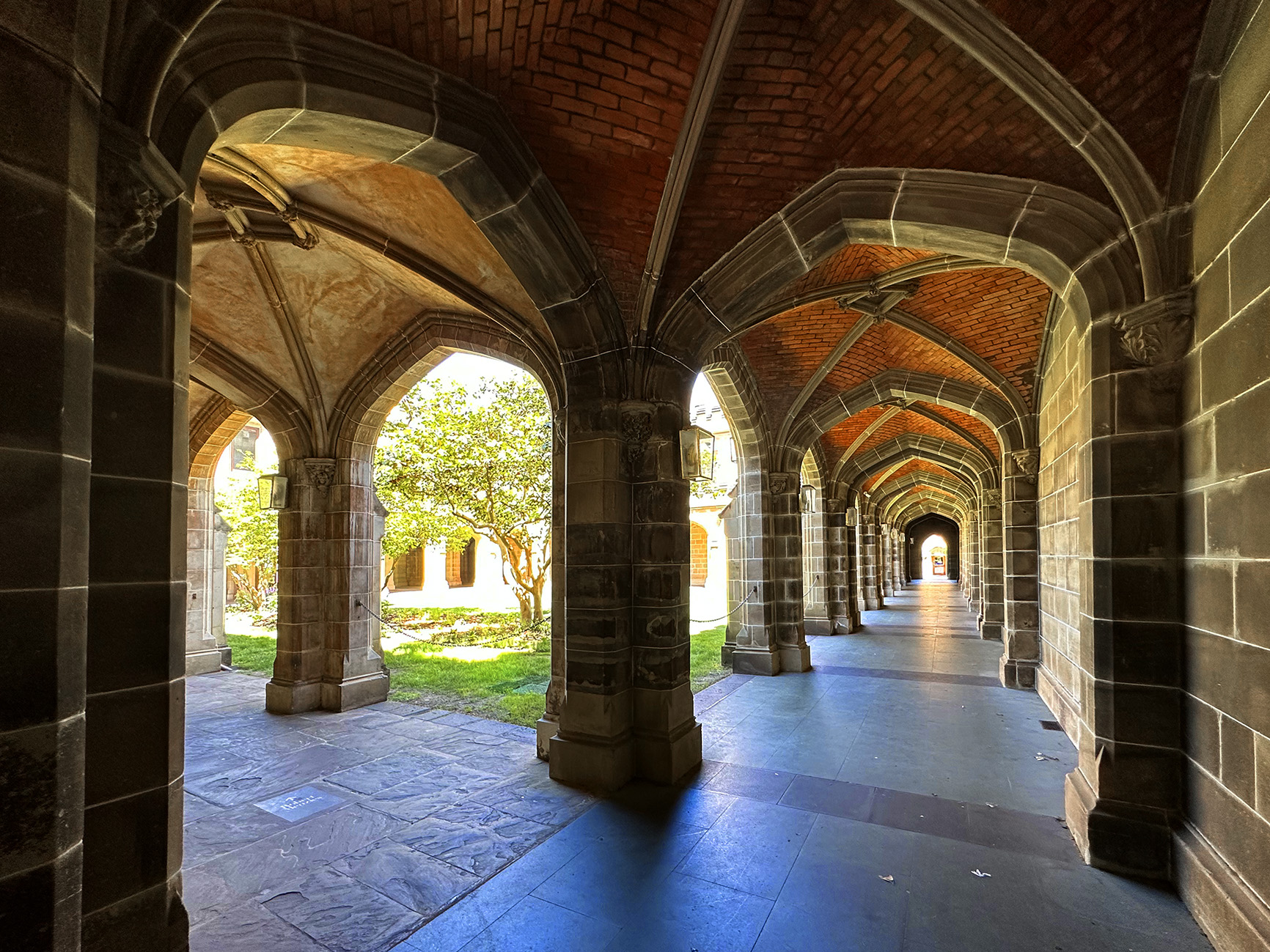
The old Law School Cloisters and Quadrangle at the University of Melbourne. The east and west sides of the Quadrangle Building were completed by October 1855 and the imposing north wing in 1857. The vaulted cloisters of the east and west wings were not added until 1930 and the quadrangle was not fully enclosed until 1969.

You are invited to the Inlinkz link party!

Click here to enter
Last week, Csuhpat1 in the USA posted some great photos of the Ocean. Please visit his blog for more great shots.


Tuesday, 13 April 2021

LOS ANGELES, USA

Los Angeles (Spanish for “The Angels”), officially the City of Los Angeles and often known by its initials L.A., is the cultural, financial, and commercial centre of Southern California. With a U.S. Census-estimated 2016 population of 3,976,322, it is the second-most populous city in the United States (after New York City) and the most populous city in the state of California. Located in a large coastal basin surrounded on three sides by mountains reaching up to and over 3,000 m, Los Angeles covers an area of about 1,210 km2. The city is also the seat of Los Angeles County, the most populated county in the country.

Los Angeles City Hall (photo), completed 1928, is the centre of the government of the city of Los Angeles, California, and houses the mayor’s office and the meeting chambers and offices of the Los Angeles City Council. It is located in the Civic Center district of downtown Los Angeles in the city block bounded by Main, Temple, First, and Spring streets.The building was designed by John Parkinson, John C. Austin, and Albert C. Martin, Sr., and was completed in 1928. Dedication ceremonies were held on April 26, 1928. It has 32 floors and, at 138 m high, is the tallest base-isolated structure in the world, having undergone a seismic retrofit from 1998 to 2001 so that the building will sustain minimal damage and remain functional after a magnitude 8.2 earthquake. The concrete in its tower was made with sand from each of California's 58 counties and water from its 21 historical missions.

City Hall’s distinctive tower was based on the shape of the Mausoleum of Mausolus in Asia Minor, and shows the influence of the Los Angeles Public Library, completed shortly before the structure was begun. An image of City Hall has been on Los Angeles Police Department badges since 1940. To keep the City’s architecture harmonious, prior to the late 1950s the Charter of the City of Los Angeles did not permit any portion of any building other than a purely decorative tower to be more than 46 m. Therefore, from its completion in 1928 until 1964, the City Hall was the tallest building in Los Angeles, and shared the skyline with only a few structures having decorative towers, including the Richfield Tower and the Eastern Columbia Building.

City Hall has an observation deck, free to the public and open Monday through Friday during business hours. The peak of the pyramid at the top of the building is an airplane beacon named in honour of Colonel Charles A. Lindbergh, cf Lindbergh Beacon. Circa 1939, there was an art gallery, in Room 351 on the third floor, that exhibited paintings by California artists. The building was designated a Los Angeles Historic-Cultural Monument in 1976.

This post is part of the Our World Tuesday meme,
and also part of the Ruby Tuesday meme,
and also part of the Travel Tuesday meme,
and also part of the Wordless Wednesday meme.


Tuesday, 9 February 2021

OLD BRIDGE, GREECE

Τhis old, one-arched stone bridge of Palaeokarya was built around 1525, and has a length of 26 metres, an arc opening of 19 metres and a height from the river bed 10 metres. Behind it is a 12 metre high waterfall, with the river continuing after the bridge to a lesser waterfall 2 metres high. The river that passes through the spot is Palaeokaritis and if we continue the journey downstream we reach the gorge of Palaeokarya where there is still a functioning watermill where one can watch flour being milled.

The bridge of Palaiokarya joined Thessaly to Epirus and was a busy route at that time. Now it is in a deserted spot and is surrounded by great natural beauty. The bridge frames steep, high rocks with much low-lying vegetation and trees. A large variety of herbs and rare wildflowers grows in the area in Spring and Summer. There is also a great number of animals and birds in the forest around the old bridge.

This post is part of the Our World Tuesday meme,
and also part of the Travel Tuesday meme,
and also part of the Wordless Wednesday meme.


Thursday, 10 September 2020

PATERSON'S CURSE

Paterson's Curse (Echium plantagineum) is an invasive plant species in Australia. The name "Salvation Jane" originated from, and is mostly used in South Australia, due to its use as a source of food for grazing animals when the less drought tolerant grazing pastures die off. Other names are Blueweed, Lady Campbell Weed, Riverina Bluebell, and Purple Viper's Bugloss.

Three other Echium species have been introduced and are of concern; Viper's Bugloss (Echium vulgare) is the most common of them. Viper's Bugloss is biennial, with a single unbranched flowering stem and smaller, more blue flowers, but is otherwise similar. This species is also useful for honey production. Paterson's Curse has positive uses — it is the source for a particularly fine grade of honey.

As a fodder plant, with proper handling, it can be valuable fodder over summer for cattle and sheep, but not livestock without ruminant digestive systems. In the 1880s it was introduced to Australia, probably both as an accidental contaminate of pasture seed and as an ornamental plant. It is said that both names for the plant derive from Jane Paterson or Patterson, an early settler of the country near Albury. She brought the first seeds from Europe to beautify a garden, and then could only watch helplessly as the weed infested previously productive pastures for many miles around.

Paterson's Curse is now a dominant broadleaf pasture weed through much of New South Wales, the Australian Capital Territory, Victoria, South Australia and Tasmania and also infests native grasslands, heathlands and woodlands. Echium plantagineum contains pyrrolizidine alkaloids and is poisonous. When eaten in large quantities, it causes reduced livestock weight or even (in severe cases) death. Paterson's Curse can kill horses and irritate the udders of dairy cows and the skin of humans. After the 2003 Canberra bushfires over 40 recorded horses were put down after eating the weed.

This post is part of the Floral Friday Fotos meme.


Tuesday, 16 June 2020

VERONA, ITALY

Verona is a city on the Adige river in Veneto, northern Italy, with approximately 265,000 inhabitants and one of the seven provincial capitals of the region. It is the second largest city municipality in the region and the third largest in northeast Italy. The metropolitan area of Verona covers an area of 1,426 km2 and has a population of 714,274 inhabitants.

It is one of the main tourist destinations in northern Italy, owing to its artistic heritage, several annual fairs, shows, and operas, such as the lyrical season in the Arena, the ancient amphitheatre built by the Romans, which is well preserved and forms a centrepiece for city life.

Three of Shakespeare's plays are set in Verona: 'Romeo and Juliet', 'The Two Gentlemen of Verona', and 'The Taming of the Shrew'. It is unknown if Shakespeare ever visited Verona or Italy at all, but his plays have lured many visitors to Verona and surrounding cities many times over. The city has been awarded World Heritage Site status by UNESCO because of its urban structure and architecture. The photo above is taken at the Piazza delle Erbe.

This post is part of the Our World Tuesday meme,
and also part of the Ruby Tuesday meme,
and also part of the Travel Tuesday meme,
and also part of the Wordless Wednesday meme.

Saturday, 4 January 2020

KEW BOATHOUSE

Historic Studley Park Boathouse, Kew, is only 10 minutes from the Melbourne city centre and offers visitors the opportunity to dine in the restaurant, relax over a lighter meal in the indoor/outdoor café, or have a light snack from the kiosk while enjoying sweeping views of the Yarra River and natural bushland.

You can also hire row boats, canoes and kayaks from the oldest operating boathouse in Australia. Open every day of the year except Christmas Day. Kids love the place as there are activities, animals and wide open spaces to play in.

This post is part of the Weekend Reflections meme.

Sunday, 22 December 2019

MY SUNDAY BEST MEME #149 - LUCERNE

Welcome to the meme, "My Sunday Best", which is a photographic and creative meme that allows you to showcase your talents in imaging. Every Sunday, you can post here showing an image you have created using your camera, (and/or) image processing software, and/or painting and drawing in the conventional way and have scanned in.

The rules are simple:
1) Create your image and post it up on your blog;
2) Put the "My Sunday Best" logo image link somewhere on your post so people can click and come by here;
3) Leave a comment here once you have posted;
4) Visit other posters' blogs and be amazed with their creativity!

Please do not use this meme to advertise your goods or services. This is a creative meme and any inappropriate links or comments shall be removed immediately!

The theme is of your own choosing, so post on any subject you desire.
Lucerne (Luzern) is a city in north-central Switzerland, in the German-speaking portion of that country. Lucerne is the capital of the Canton of Lucerne and the capital of the district of the same name. With a population of about 76,200 people, Lucerne is the most populous city in Central Switzerland, and a nexus of transportation, telecommunications, and government of this region. The city's urban area consists of 17 cities and towns located in three different cantons with an overall population of about 250,000 people.

Due to its location on the shore of Lake Lucerne (der Vierwaldstättersee), within sight of Mount Pilatus and Rigi in the Swiss Alps, Lucerne has long been a destination for tourists. One of the city's famous landmarks is the Chapel Bridge (Kapellbrücke), a wooden bridge first erected in the 14th century.

Last week Jesh from the USA shared some of her photos and I especially liked this image, which is my favourite for the week. Please visit her blog for more of her images.

Tuesday, 3 December 2019

BRUGES, BELGIUM

Bruges (Dutch: Brugge) is the capital and largest city of the province of West Flanders in the Flemish Region of Belgium, in the northwest of the country. The area of the whole city amounts to more than 13,840 hectares, including 1,075 hectares off the coast, at Zeebrugge (from Brugge aan zee meaning “Bruges by the Sea”).The historic city centre is a prominent World Heritage Site of UNESCO.

It is oval and about 430 hectares in size. The city’s total population is 117,073 (1 January 2008), of whom around 20,000 live in the city centre. The metropolitan area, including the outer commuter zone, covers an area of 616 km2 and has a total of 255,844 inhabitants as of 1 January 2008.

Along with a few other canal-based northern cities, such as Amsterdam, it is sometimes referred to as "The Venice of the North". Bruges has a significant economic importance thanks to its port and was once one of the world’s chief commercial cities. Bruges is well known as the seat of the College of Europe, an elite university institute for European studies regarded as “the EU’s very own Oxbridge.”

Bruges has most of its medieval architecture intact, making it one of the most well-preserved medieval towns in Europe. The historic centre of Bruges has been a UNESCO World Heritage Site since 2000. Many of its medieval buildings are notable, including the Church of Our Lady, whose brick spire reaches 122.3 m, making it one of the world's highest brick towers/buildings. The sculpture Madonna and Child, which can be seen in the transept, is believed to be the only of Michelangelo’s sculptures to have left Italy within his lifetime.

Bruges’ most famous landmark is its 13th-century belfry, housing a municipal carillon comprising 48 bells. The city still employs a full-time carillonneur, who gives free concerts on a regular basis.

This post is part of the Our World Tuesday meme,
and also part of the Travel Tuesday meme,
and also part of the Wordless Wednesday meme.

Tuesday, 26 November 2019

KIEV, UKRAINE

Kiev (Ukrainian: Київ) is the capital and largest city of Ukraine, located in the north central part of the country on the Dnieper River. The population in July 2015 was 2,887,974 (though higher estimated numbers have been cited in the press), making Kiev the 7th most populous city in Europe. Kiev is an important industrial, scientific, educational, and cultural centre of Eastern Europe. It is home to many high-tech industries, higher education institutions, and world-famous historical landmarks. The city has an extensive infrastructure and highly developed system of public transport, including the Kiev Metro.

The city’s name is said to derive from the name of Kyi, one of its four legendary founders. During its history, Kiev, one of the oldest cities in Eastern Europe, passed through several stages of great prominence and relative obscurity. The city probably existed as a commercial centre as early as the 5th century. A Slavic settlement on the great trade route between Scandinavia and Constantinople, Kiev was a tributary of the Khazars, until seized by the Varangians (Vikings) in the mid-9th century. Under Varangian rule, the city became a capital of the Kievan Rus', the first East Slavic state.

Completely destroyed during the Mongol invasion in 1240, the city lost most of its influence for the centuries to come. It was a provincial capital of marginal importance in the outskirts of the territories controlled by its powerful neighbours; first the Grand Duchy of Lithuania, followed by Poland and Russia. The city prospered again during the Russian Empire’s Industrial Revolution in the late 19th century. In 1917, after the Ukrainian National Republic declared independence from the Russian Empire, Kiev became its capital.

From 1921 onwards Kiev was a city of the Ukrainian Soviet Socialist Republic, which was proclaimed by the Red Army, and, from 1934, Kiev was its capital. During World War II, the city again suffered significant damage, but quickly recovered in the post-war years, remaining the third largest city of the Soviet Union. Following the collapse of the Soviet Union and Ukrainian independence in 1991, Kiev remained the capital of Ukraine and experienced a steady migration influx of ethnic Ukrainians from other regions of the country.

During the country’s transformation to a market economy and electoral democracy, Kiev has continued to be Ukraine’s largest and richest city. Kiev’s armament-dependent industrial output fell after the Soviet collapse, adversely affecting science and technology. But new sectors of the economy such as services and finance facilitated Kiev’s growth in salaries and investment, as well as providing continuous funding for the development of housing and urban infrastructure. Kiev emerged as the most pro-Western region of Ukraine where parties advocating tighter integration with the European Union dominate during elections.

This post is part of the Our World Tuesday meme,
and also part of the Ruby Tuesday meme,
and also part of the Travel Tuesday meme,
and also part of the Wordless Wednesday meme.

Tuesday, 19 November 2019

NEW ORLEANS, USA

New Orleans (French: La Nouvelle-Orléans) is a major United States port and the largest city and metropolitan area in the state of Louisiana. The population of the city was 343,829 as of the 2010 U.S. Census. The New Orleans metropolitan area (New Orleans–Metairie–Kenner Metropolitan Statistical Area) had a population of 1,167,764 in 2010 and was the 46th largest in the United States. The New Orleans–Metairie–Bogalusa Combined Statistical Area, a larger trading area, had a 2010 population of 1,452,502. Before Hurricane Katrina, Orleans Parish was the most populous parish in Louisiana. As of 2015, it ranked third, trailing neighbouring Jefferson Parish and East Baton Rouge Parish.

The city of New Orleans is geographically coextensive with Orleans Parish. The city is known for its distinct French and Spanish Creole architecture, as well as its cross-cultural and multilingual heritage. New Orleans is famous for its cuisine, music (particularly as the birthplace of jazz) and its annual celebrations and festivals, most notably Mardi Gras. The city is often referred to as the “most unique” in the United States.

New Orleans is located in southeastern Louisiana, and occupies both sides of the Mississippi River. The heart of the city and its French Quarter is on the river’s north side. The city and Orleans Parish (French: Paroisse d’Orléans) are coterminous. The city and parish are bounded by the parishes of St. Tammany to the north, St. Bernard to the east, Plaquemines to the south, and Jefferson to the south and west. Lake Pontchartrain, part of which lies within the city limits, lies to the north and Lake Borgne lies to the east.

This post is part of the Our World Tuesday meme,
and also part of the Ruby Tuesday meme,
and also part of the Travel Tuesday meme,
and also part of the Wordless Wednesday meme.

Tuesday, 15 October 2019

VALLADOLID, SPAIN

Valladolid is a city in Spain and the de facto capital of the autonomous community of Castile and León. It has a population of 309,714 people (2013 est.), making it Spain's 13th most populous municipality and northwestern Spain’s biggest city. Its metropolitan area ranks 20th in Spain with a population of 414,244 people in 23 municipalities. The city is situated at the confluence of the Pisuerga and Esgueva rivers 15 km before they join the Duero, and located within five winegrowing regions: Ribera del Duero, Rueda, Toro, Tierra de León, and Cigales.

Valladolid was originally settled in pre-Roman times by the Celtic Vaccaei people, and later the Romans themselves. It remained a small settlement until being re-established by King Alfonso VI of Castile as a Lordship for the Count Pedro Ansúrez in 1072. It grew to prominence in the Middle Ages as the seat of the Court of Castile and being endowed with fairs and different institutions as a collegiate church, University (1241), Royal Court and Chancery and the Royal Mint.

The Catholic Monarchs, Isabel I of Castile and Ferdinand II of Aragon, married in Valladolid in 1469 and established it as the capital of the Kingdom of Castile and later of united Spain. Christopher Columbus died in Valladolid in 1506, while authors Francisco de Quevedo and Miguel de Cervantes lived and worked in the city. The city was briefly the capital of Habsburg Spain under Phillip III between 1601 and 1606, before returning indefinitely to Madrid. The city then declined until the arrival of the railway in the 19th century, and with its industrialisation into the 20th century.

The Old Town is made up of a variety of historic houses, palaces, churches, plazas, avenues and parks, and includes the National Museum of Sculpture, the Museum of Contemporary Art Patio Herreriano or the Oriental Museum, as well as the houses of José Zorrilla and Cervantes which are open as museums. Among the events that are held each year in the city there is Holy Week, Valladolid International Film Week (Seminci), and the Theatre Festival and street arts (TAC).

This post is part of the Our World Tuesday meme,
and also part of the Travel Tuesday meme,
and also part of the Wordless Wednesday meme.

Tuesday, 8 October 2019

CARCASSONE, FRANCE

Carcassonne is a fortified town in the French department of Aude, in the region of Occitanie. It is the departmental prefecture. Inhabited since the Neolithic period, Carcassonne is located in the Aude plain between historic trade routes, linking the Atlantic to the Mediterranean sea and the Massif Central to the Pyrénées. Its strategic importance was quickly recognised by the Romans, who occupied its hilltop until the demise of the Western Roman Empire. In the fifth century, it was taken over by the Visigoths, who founded the city.

Its strategic location led successive rulers to expand its fortifications until the Treaty of the Pyrenees in 1659. The city is famous for the Cité de Carcassonne, a medieval fortress restored by the theorist and architect Eugène Viollet-le-Duc in 1853 and added to the UNESCO list of World Heritage Sites in 1997. Consequently, Carcassonne relies heavily on tourism but also counts manufacture and wine-making as some of its other key economic sectors.

The fortified city itself consists essentially of a concentric design of two outer walls with 53 towers and barbicans to prevent attack by siege engines. The castle itself possesses its own drawbridge and ditch leading to a central keep. The walls consist of towers built over quite a long period. One section is Roman and is notably different from the medieval walls with the tell-tale red brick layers and the shallow pitch terracotta tile roofs. One of these towers housed the Catholic Inquisition in the 13th century and is still known as “The Inquisition Tower”. 

Carcassonne was demilitarised under Napoleon and the Restoration, and the fortified cité of Carcassonne fell into such disrepair that the French government decided that it should be demolished. A decree to that effect that was made official in 1849 caused an uproar.The antiquary and mayor of Carcassonne, Jean-Pierre Cros-Mayrevieille, and the writer Prosper Mérimée, the first inspector of ancient monuments, led a campaign to preserve the fortress as a historical monument. Later in the year the architect Eugène Viollet-le-Duc, already at work restoring the Basilica of Saint-Nazaire, was commissioned to renovate the place. In 1853, work began with the west and southwest walls, followed by the towers of the porte Narbonnaise and the principal entrance to the cité.

The fortifications were consolidated here and there, but the chief attention was paid to restoring the roofing of the towers and the ramparts, where Viollet-le-Duc ordered the destruction of structures that had encroached against the walls, some of them of considerable age.Viollet-le-Duc left copious notes and drawings on his death in 1879, when his pupil Paul Boeswillwald and, later, the architect Nodet continued the rehabilitation of Carcassonne. The restoration was strongly criticised during Viollet-le-Duc’s lifetime. Fresh from work in the north of France, he made the error of using slates and restoring the roofs as point-free environment. Yet, overall, Viollet-le-Duc’s achievement at Carcassonne is agreed to be a work of genius, though not of the strictest authenticity.

This post is part of the Our World Tuesday meme,
and also part of the Ruby Tuesday meme,
and also part of the Travel Tuesday meme,
and also part of the Wordless Wednesday meme.

Wednesday, 25 September 2019

LIBRARY

The State Library of Victoria is the central library of the state of Victoria, Australia, located in Melbourne. It is on the block bounded by Swanston, La Trobe, Russell, and Little Lonsdale streets, in the northern centre of the central business district. The library holds over 2 million books and 16,000 serials, including the diaries of the city's founders, John Batman and John Pascoe Fawkner, and the folios of Captain James Cook, R.N.. It also houses the original armour of Ned Kelly.

In 1853, the decision to build a state library was made at the instigation of Lieutenant-Governor Charles La Trobe and Mr Justice Redmond Barry, Q.C. (Sir Redmond from 1860). A competition was held to decide who would design the new building; local architect Joseph Reed, who later designed the Melbourne Town Hall, Ormond College and the Royal Exhibition Building, won the commission. On 3 July 1854, the recently inaugurated Governor Sir Charles Hotham laid the foundation stone of both the new library and the University of Melbourne. The library opened in 1856, with a collection of 3,800 books chosen by Mr Justice Barry, the President of Trustees. Augustus H. Tulk, the first librarian, was appointed three months after the opening.

The library underwent major refurbishments between 1990 and 2004, designed by architects Ancher Mortlock & Woolley. The project cost approximately A$200 million. The reading room closed in 1999 to allow for renovation, during which natural light was returned. The renamed La Trobe Reading Room reopened in 2003. The Library’s vast collection dates back to 1854 and includes material on almost every subject you can think of, with a special focus on material from Victoria. From art, children’s books, war and family history to film, business and industry, and Australian history, there is plenty for curious browsers and serious researchers alike.

While most people know about the Library's extensive book collections, there's plenty to surprise in other historical collections, which date back to 1854. They include more than 350,000 photographs, personal manuscripts & diaries, maps, old magazines & journals, newspapers, comics, and even old advertising and theatre programs. There is also an eclectic array of textiles and personal items.

This post is part of the Wordless Wednesday meme,
and also part of the ABC Wednesday meme.


Tuesday, 17 September 2019

LAUNCESTON, TASMANIA

Launceston is a city in the north of Tasmania, Australia, at the junction of the North Esk and South Esk rivers where they become the Tamar River. Launceston is the second largest city in Tasmania after Hobart. With a population of 86,633, Launceston is the twelfth-largest non-capital city in Australia. It is the only inland city in Tasmania.

Settled by Europeans in March 1806, Launceston is one of Australia’s oldest cities and is home to many historic buildings. Like many Australian places, it was named after a town in the United Kingdom – in this case, Launceston, Cornwall. Launceston has also been home to several firsts such as the first use of anaesthetic in the Southern Hemisphere, the first Australian city to have underground sewers and the first Australian city to be lit by hydroelectricity. The city has a temperate climate with four distinct seasons. Local government is split between the City of Launceston and the Meander Valley and West Tamar Councils.

Built in two complementary sections forty years apart (1863 and 1903), King’s Bridge near Launceston, Tasmania, is a very elegant and gracefully arched, open girder steel bridge which carries Bridge Road/Trevallyn Road across the Tamar River. Built to carry main road traffic north from Launceston to the town on the coasts of Bass Strait, the bridge is now protected from heavy West Tamar traffic by the newer adjoining Paterson Bridge, which was brought into service in the 1960s. King’s Bridge is now reserved for local traffic only. Part of the bridge’s appeal is that it is the perfect terminating element to the renowned Launceston Gorge within the Trevallyn State Reserve. The reserve is bounded by the South Esk River on all but the northern side. In the east is the Trevallyn Lake, formed by the Trevallyn Dam, and in the east is Cataract Gorge.

This post is part of the Our World Tuesday meme,
and also part of the Ruby Tuesday meme,
and also part of the Travel Tuesday meme,
and also part of the Wordless Wednesday meme.

Tuesday, 3 September 2019

YORK, UK

York is a historic walled city at the confluence of the rivers Ouse and Foss in North Yorkshire, England. The municipality is the traditional county town of Yorkshire to which it gives its name. The city has a rich heritage and has provided the backdrop to major political events in England throughout much of its two millennia of existence. The city offers a wealth of historic attractions, of which York Minster is the most prominent, and a variety of cultural and sporting activities making it a popular tourist destination for millions.

The city was founded by the Romans as Eboracum in 71 AD. It became the capital of the Roman province of Britannia Inferior, and later of the kingdoms of Northumbria and Jórvík. In the Middle Ages, York grew as a major wool trading centre and became the capital of the northern ecclesiastical province of the Church of England, a role it has retained.

In the 19th century, York became a hub of the railway network and a confectionery manufacturing centre. In recent decades, the economy of York has moved from being dominated by its confectionery and railway-related industries to one that provides services. The University of York and health services have become major employers, whilst tourism has become an important element of the local economy.

From 1996, the term City of York describes a unitary authority area which includes rural areas beyond the old city boundaries. In 2011 the urban area had a population of 153,717, while in 2010 the entire unitary authority had an estimated population of 202,400.

The Cathedral and Metropolitical Church of Saint Peter in York, commonly known as York Minster, is the cathedral of York, England, and is one of the largest of its kind in Northern Europe. The minster is the seat of the Archbishop of York, the second-highest office of the Church of England, and is the mother church for the Diocese of York and the Province of York. It is run by a dean and chapter, under the Dean of York. The title “minster” is attributed to churches established in the Anglo-Saxon period as missionary teaching churches, and serves now as an honorific title. Services in the minster are sometimes regarded as on the High Church or Anglo-Catholic end of the Anglican continuum.

This post is part of the Our World Tuesday meme,
and also part of the Ruby Tuesday meme,
and also part of the Travel Tuesday meme,
and also part of the Wordless Wednesday meme.

Tuesday, 27 August 2019

FLORENCE, ITALY

Florence (Italian: Firenze) is the capital city of the Italian region of Tuscany and of the province of Florence. It is the most populous city in Tuscany, with approximately 382,000 inhabitants, expanding to over 1,520,000 in the metropolitan area. Florence is famous for its history: A centre of medieval European trade and finance and one of the wealthiest cities of the time, it is considered the birthplace of the Renaissance, and has been called “the Athens of the Middle Ages”.

A turbulent political history includes periods of rule by the powerful Medici family, and numerous religious and republican revolutions. From 1865 to 1871 the city was the capital of the recently established Kingdom of Italy. The Historic Centre of Florence attracts millions of tourists each year, and Euromonitor International ranked the city as the world's 89th most visited in 2012, with 1.8 million visitors.

It was declared a World Heritage Site by UNESCO in 1982. The city is noted for its culture, Renaissance art and architecture and monuments. The city also contains numerous museums and art galleries, such as the Uffizi Gallery and the Palazzo Pitti, and still exerts an influence in the fields of art, culture and politics. Due to Florence's artistic and architectural heritage, it has been ranked by Forbes as one of the most beautiful cities in the world.

Florence is an important city in Italian fashion, being ranked in the top 51 fashion capitals of the world; furthermore, it is a major national economic centre, as a tourist and industrial hub. In 2008, the city had the 17th highest average income in Italy. And if it’s all too much for you, why not sit down, relax and enjoy a cup of genuine Italian coffee in the piazza?

This post is part of the Our World Tuesday meme,
and also part of the Ruby Tuesday meme,
and also part of the Travel Tuesday meme,
and also part of the Wordless Wednesday meme.

Tuesday, 6 August 2019

İZMIR, TURKEY

İzmir is a metropolitan city in the western extremity of Anatolia and the third most populous city in Turkey, after Istanbul and Ankara. It is the second most populous city on the Aegean Sea after Athens, Greece. In 2014, the city of İzmir had a population of 2,847,691, while İzmir Province had a total population of 4,113,072. İzmir’s metropolitan area extends along the outlying waters of the Gulf of İzmir and inland to the north across the Gediz River delta; to the east along an alluvial plain created by several small streams; and to a slightly more rugged terrain in the south.

In classical antiquity the city was known as Smyrna (Greek: Σμύρνη Smyrne), a name which remained in use in English and other foreign languages until the Turkish Postal Service Law (Posta Hizmet Kanunu) of 28 March 1930, which made İzmir the internationally recognised name. İzmir has almost 4,000 years of recorded urban history and even longer as an advanced human settlement. Lying on an advantageous location at the head of a gulf running down in a deep indentation, midway on the western Anatolian coast, it has been one of the principal mercantile cities of the Mediterranean Sea for much of its history.

İzmir hosted the Mediterranean Games in 1971 and the World University Games (Universiade) in 2005. The city of İzmir is composed of several metropolitan districts. Of these, Konak district corresponds to historical İzmir, this district’s area having constituted the “İzmir Municipality” (Turkish: İzmir Belediyesi) area until 1984. With the constitution of the “Greater İzmir Metropolitan Municipality” (Turkish: İzmir Büyükşehir Belediyesi), the city of İzmir grouped together initially nine, and more recently eleven, metropolitan districts, namely Balçova, Bayraklı, Bornova, Buca, Çiğli, Gaziemir, Güzelbahçe, Karabağlar, Karşıyaka, Konak and Narlıdere. In an ongoing process, the Mayor of İzmir was also vested with authority over additional districts reaching from Bergama in the north to Selçuk in the south, bringing the number of districts considered as being part of İzmir to twenty-one, two of these having been only partially administratively included in İzmir.

Izmir Clock Tower (Turkish: İzmir Saat Kulesi) is a historic clock tower located at the Konak Square in Konak district of İzmir, Turkey. The clock tower was designed by the Levantine French architect Raymond Charles Père and built in 1901 to commemorate the 25th anniversary of Abdülhamid II's accession to the throne (reigned 1876–1909). The clock itself was a gift from German Emperor Wilhelm II (reigned 1888–1918). It is decorated in an elaborate Ottoman architecture style.

The tower, which has an iron and lead skeleton, is 25 m high and features four fountains (şadırvan), which are placed around the base in a circular pattern. The columns are inspired by Moorish themes. The clock tower was depicted on the reverse of the Turkish 500 lira banknotes of 1983-1989. In the former Balkan provinces of the Ottoman Empire, particularly in present-day Serbian, Bosnian and Montenegrin towns such as Belgrade, Prijepolje, Sarajevo, Banja Luka, Gradačac and Stara Varoš, similar Ottoman era clock towers still exist and are called Sahat Kula (derived from the Turkish words Saat Kulesi, meaning Clock Tower.)

This post is part of the Our World Tuesday meme,
and also part of the Travel Tuesday meme,
and also part of the Wordless Wednesday meme.