Showing posts with label zoo. Show all posts

Saturday, 9 February 2019

GORILLA

The Royal Melbourne Zoological Gardens, commonly known as the Melbourne Zoo, contains more than 320 animal species from Australia and around the world. The zoo is 4 kilometres north of the centre of Melbourne. It is accessible via Royal Park station on the Upfield railway line, and is also accessible via tram routes 55 and 19, as well as by bicycle on the Capital City Trail. Bicycles are not allowed inside the zoo itself.

The Royal Melbourne Zoological Gardens is a full institutional member of the Zoo and Aquarium Association (ZAA) and the World Association of Zoos and Aquariums. Nobody misses a visit to meet the Western Lowland Gorillas at Melbourne Zoo. These fascinating creatures, which are from the same family as humans, Orang-utans and chimpanzees, share many features with us – they even giggle when amused! Melbourne Zoo is one of 150 zoological institutions worldwide participating in a survival breeding program for Western Lowland Gorillas. The population within these participating zoos totals 856 gorillas.

This post is part of the Saturday Critters meme,
and also part of the Camera Critters meme.


Saturday, 12 May 2018

MELBOURNE ZOO

The Royal Melbourne Zoological Gardens, commonly known as the Melbourne Zoo, contains more than 320 animal species from Australia and around the world. The zoo is 4 kilometres north of the centre of Melbourne. It is accessible via Royal Park station on the Upfield railway line, and is also accessible via tram routes 55 and 19, as well as by bicycle on the Capital City Trail. Bicycles are not allowed inside the zoo itself. The Royal Melbourne Zoological Gardens is a full institutional member of the Zoo and Aquarium Association (ZAA) and the World Association of Zoos and Aquariums.

This post is part of the Saturday Critters meme,
and also part of the Camera Critters meme.




Wednesday, 6 January 2016

ZOO, SAN DIEGO

The San Diego Zoo is a zoo in Balboa Park, San Diego, California housing over 3,700 animals of more than 650 species and subspecies. Its parent organisation, San Diego Zoo Global, is the largest zoological membership association in the world, with more than 250,000 member households and 130,000 child memberships, representing more than a half million people. San Diego Zoo pioneered the concept of open-air, cageless exhibits that re-create natural animal habitats. It is one of the few zoos in the world that houses the giant panda. In 2013, the zoo added a new Koalafornia Adventure, providing an Australian experience.

It is privately operated by the nonprofit Zoological Society of San Diego on 100 acres (40 ha) of parkland leased from the City of San Diego, and ownership of all animals, equipment and other assets rests with the City of San Diego. The San Diego Zoo is an accredited member of the Association of Zoos and Aquariums (AZA) and the American Alliance of Museums (AAM), and a member of the Zoological Association of America (ZAA) and the World Association of Zoos and Aquariums (WAZA). San Diego Zoo Global also operates the San Diego Zoo Safari Park and the San Diego Zoo Institute for Conservation Research.


This post is part of the Travel Tuesday meme,

and also part of the Wednesday Waters meme,
and also part of the Waterworld Wednesday meme,
and also part of the Outdoor Wednesday meme,
and also part of the Wordless Wednesday meme,
and also part of the ABC Wednesday meme.


Friday, 3 April 2015

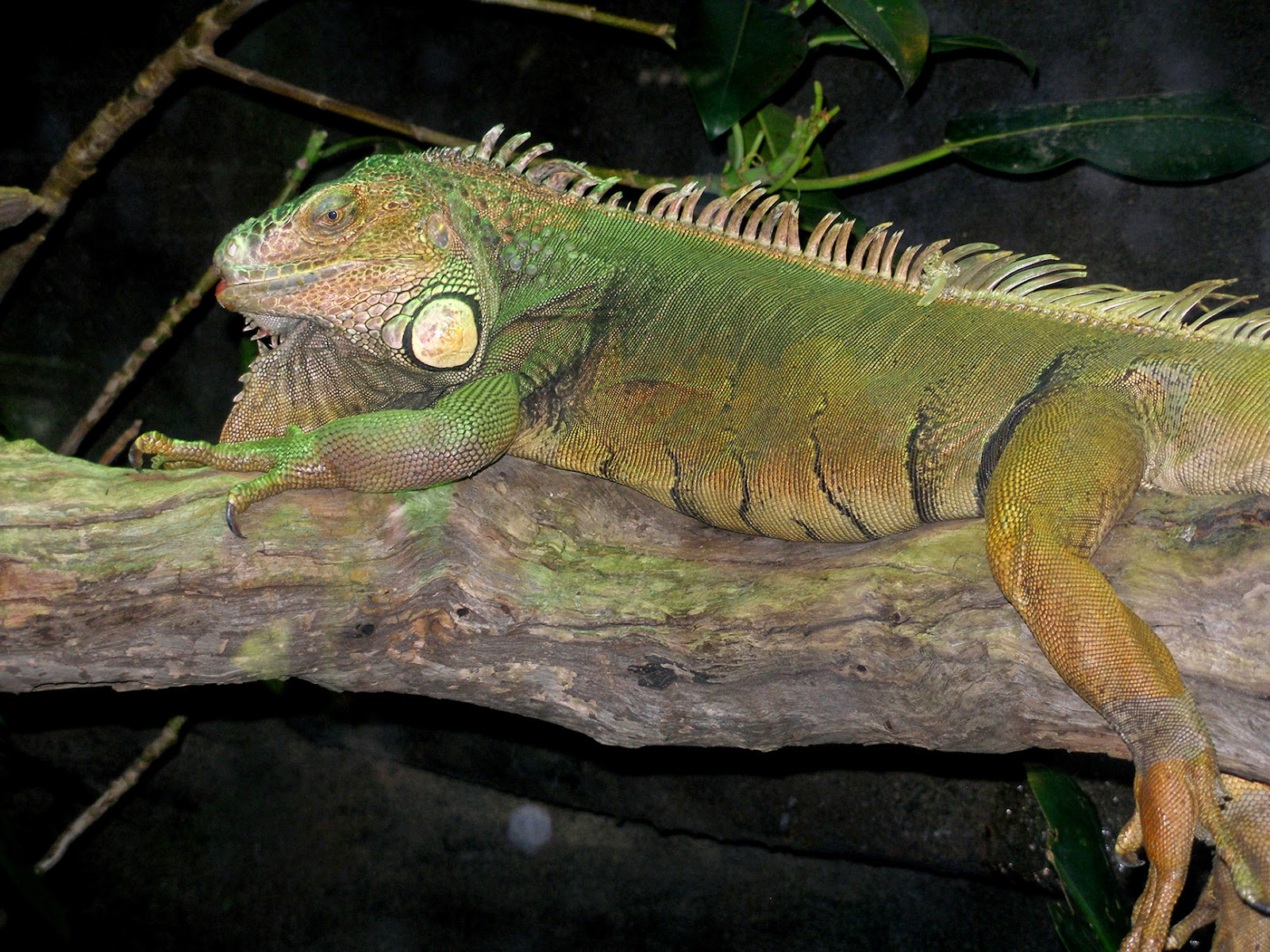
GREEN IGUANA

The green iguana or common iguana (Iguana iguana) is a large, arboreal, mostly herbivorous species of lizard of the genus Iguana native to Central, South America, and the Caribbean. Usually, this animal is simply called the iguana. The green iguana ranges over a large geographic area, from southern Brazil and Paraguay as far north as Mexico and the Caribbean Islands. They are very common throughout Puerto Rico, where they are colloquially known as "Gallina de palo" and considered as an invasive species introduced from South America; in the United States feral populations exist in South Florida (including the Florida Keys), Hawaii, and the Rio Grande Valley of Texas.

A herbivore, it has adapted significantly with regard to locomotion and osmoregulation as a result of its diet. It grows to 1.5 metres  in length from head to tail, although a few specimens have grown more than 2 metres  with body-weights upward of 9.1 kg.

Commonly found in captivity as a pet due to its calm disposition and bright colours, it can be very demanding to care for properly. Space requirements and the need for special lighting and heat can prove challenging to an amateur hobbyist.

This post is part of the Friday Greens meme.