Showing posts with label Ranunculaceae. Show all posts

Thursday, 23 December 2021

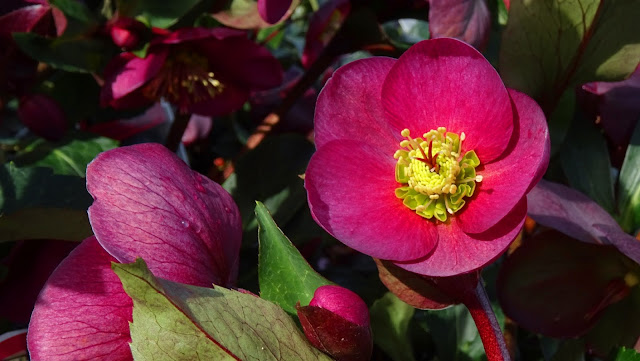
HELLEBORE

Helleborus niger, commonly called Christmas rose or black hellebore, is an evergreen perennial flowering plant in the buttercup family, Ranunculaceae. It is poisonous. Although the flowers resemble wild roses (and despite its common name), Christmas rose does not belong to the rose family (Rosaceae).

The plant is a traditional cottage garden favourite because it flowers in the depths of winter. Large-flowered cultivars are available, as are pink-flowered and double-flowered selections. It has been awarded an Award of Garden Merit (AGM). It can be difficult to grow well; acid soil is unsuitable, as are poor, dry conditions and full sun. Moist, humus-rich, alkaline soil in dappled shade is preferable. Leaf-mould can be dug in to improve heavy clay or light sandy soils; lime can be added to 'sweeten' acid soils.

The cultivar illustrated is Helleborus 'Anna's Red'. This beautiful variety has stunning deep flower colour. Deep magenta blooms which adorn the plant in winter and early spring, make this is one variety that is very popular. 'Anna's Red' is a vigorous grower with a tidy habit. Plant alongside our other varieties for maximum impact. Hellebores provide stunning results when mass planted in shady areas of the garden.

This post is part of the Floral Friday Fotos meme

Thursday, 25 March 2021

CLEMATIS

Clematis is a genus of about 300 species within the buttercup family Ranunculaceae. Their garden hybrids have been popular among gardeners beginning with Clematis × jackmanii, a garden standby since 1862; more hybrid cultivars are being produced constantly. They are mainly of Chinese and Japanese origin.

Most species are known as clematis in English, while some are also known as traveller's joy a name invented for the sole British native, C. vitalba by the herbalist John Gerard, virgin's bower for C. viticella, old man's beard, applied to several with prominent seedheads, leather flower or vase vine for the North American Clematis viorna. This Clematis pictured "Lady Betty Balfour".

This post is part of the Floral Friday Fotos meme.


Thursday, 11 June 2020

COLUMBINE

Aquilegia vulgaris (European Columbine, Common Columbine or Granny's Nightcap) is a species of columbine native to Europe. The genus name Aquilegia is derived from the Latin word for eagle (aquila), because the shape of the flower petals are said to resemble an eagle's claw. There are many showy cultivars, like this two-toned one.

This post is part of the Floral Friday Fotos meme.


Thursday, 18 July 2019

CLEMATIS

Clematis is a genus of about 300 species within the buttercup family Ranunculaceae. Their garden hybrids have been popular among gardeners, beginning with Clematis × jackmanii, a garden standby since 1862; more hybrid cultivars are being produced constantly. They are mainly of Chinese and Japanese origin. Most species are known as clematis in English, while some are also known as traveller's joy, a name invented for the sole British native, C. vitalba, by the herbalist John Gerard; virgin's bower for C. viticella; old man's beard, applied to several with prominent seedheads; and leather flower or vase vine for the North American Clematis viorna.

Illustrated here is the splendid hybrid Clematis 'Daniel Deronda'. Introduced in 1882, 'Daniel Deronda' still holds its own among modern varieties and has given the Royal Horticultural Society's prestigious Award of Garden Merit (AGM) in recognition of its outstanding excellence. It produces purple-blue flowers throughout the summer. These are semi-double early in the season and then single later on. The blooms are followed by eye-catching seed-heads which have a twist at the top.

To prune, remove any dead or weak stems in late winter or early spring and cut remaining stems back to the highest pair of strong-growing buds. To encourage blooms to cover the whole plant, train the stems so that they are evenly spaced on their support. As new growth appears in mid-spring, train this to fill any gaps. Plant in a sheltered position that is not north-facing.

This post is part of the Floral Friday Fotos meme.

Thursday, 16 May 2019

HELLEBORE

Helleborus niger, commonly called Christmas rose or black hellebore, is an evergreen perennial flowering plant in the buttercup family, Ranunculaceae. It is poisonous. Although the flowers resemble wild roses (and despite its common name), Christmas rose does not belong to the rose family (Rosaceae).

The plant is a traditional cottage garden favourite because it flowers in the depths of winter. Large-flowered cultivars are available, as are pink-flowered and double-flowered selections. It has been awarded an Award of Garden Merit (AGM). It can be difficult to grow well; acid soil is unsuitable, as are poor, dry conditions and full sun. Moist, humus-rich, alkaline soil in dappled shade is preferable. Leaf-mould can be dug in to improve heavy clay or light sandy soils; lime can be added to 'sweeten' acid soils.

The cultivar illustrated is Helleborus 'Anna's Red'. This beautiful variety has stunning deep flower colour. Deep magenta blooms which adorn the plant in winter and early spring, make this is one variety that is very popular. 'Anna's Red' is a vigorous grower with a tidy habit. Plant alongside our other varieties for maximum impact. Hellebores provide stunning results when mass planted in shady areas of the garden.

This post is part of the Floral Friday Fotos meme.

Thursday, 25 April 2019

JAPANESE ANEMONE

Anemone hupehensis, Anemone hupehensis var. japonica, and Anemone × hybrida (commonly known as the Chinese anemone or Japanese anemone, thimbleweed, or windflower) are species of flowering herbaceous perennials in the Ranunculaceae family. A. hupehensis is native to central China, though it has been naturalised in Japan for hundreds of years.

The species was first named and described in Flora Japonica (1784), by Carl Thunberg. Thunberg had collected dried specimens while working as a doctor for the Dutch East Indies Company. In 1844, Robert Fortune brought the plant to England from China, where he found it often planted about graves. Height is 1–1.5 m and the leaves have three leaflets. Flowers are 40–60 mm across, with 5-6 (or up to 20 in double forms) sculpted pink or white petals and prominent yellow stamens, blooming from midsummer to autumn.

These plants thrive best in shady areas and under protection of larger plants. They are especially sensitive to drought or overwatering. They can be invasive or weedy in some areas, throwing out suckers from the fibrous rootstock, to rapidly colonise an area. Once established they can be extremely difficult to eradicate. On the other hand, they can take some time to become established.

This post is part of the Floral Friday Fotos meme.


Monday, 4 September 2017

ANEMONE SEASON

Anemone ( /ənɛˈməniː/), is a genus of about 120 species of flowering plants in the buttercup family Ranunculaceae in the north and south temperate zones. They are closely related to Pasque flowers (Pulsatilla) and Hepaticas (Hepatica); some botanists include both of these genera within Anemone. The name of the flower is from the Greek ἀνεμώνη (anemōnē) which means "daughter of the wind", from ánemos "wind" + feminine patronymic suffix -ōnē.

We have many anemones in our garden and take great pleasure from them as they bloom and announce the coming of Spring.

This post is part of the Mosaic Monday meme,
and also part of the Macro Monday meme,
and also part of the Through my Lens meme,
and also part of the Seasons meme,
and also part of the Floral Friday Fotos meme.

Thursday, 15 June 2017

HELLEBORE

Helleborus niger, commonly called Christmas rose or black hellebore, is an evergreen perennial flowering plant in the buttercup family, Ranunculaceae. It is poisonous. Although the flowers resemble wild roses (and despite its common name), Christmas rose does not belong to the rose family (Rosaceae).

The plant is a traditional cottage garden favourite because it flowers in the depths of winter. Large-flowered cultivars are available, as are pink-flowered and double-flowered selections. It has been awarded an Award of Garden Merit (AGM).

It can be difficult to grow well; acid soil is unsuitable, as are poor, dry conditions and full sun. Moist, humus-rich, alkaline soil in dappled shade is preferable. Leaf-mould can be dug in to improve heavy clay or light sandy soils; lime can be added to 'sweeten' acid soils.

This post is part of the Floral Friday Fotos meme.


Thursday, 6 April 2017

WILD CLEMATIS

Clematis vitalba (also known as Old man's beard and Traveller's Joy) is a shrub of the Ranunculaceae family. Clematis vitalba is a climbing shrub with branched, grooved stems, deciduous leaves, and scented greenish-white flowers with fluffy underlying sepals. The many fruits formed in each inflorescence have long silky appendages which, seen together, give the characteristic appearance of Old Man's beard. The grooves along the stems of C. vitalba can easily be felt when handling the plant. This species is eaten by the larvae of a wide range of moths. This includes many species which are reliant on it as their sole foodplant; including Small Emerald, Small Waved Umber and Haworth's Pug.

Due to its disseminatory reproductive system, vitality, and climbing behaviour, Clematis vitalba is an invasive plant in most places, including many in which it is native. Some new tree plantations can be suffocated by a thick layer of Clematis vitalba, if not checked. In New Zealand it is declared an "unwanted organism" and is listed in the National Pest Plant Accord. It cannot be sold, propagated or distributed. It is a potential threat to native plants since it grows vigorously and forms a canopy which smothers all other plants and has no natural controlling organisms in New Zealand. New Zealand native species of Clematis have smooth stems and can easily be differentiated from C. vitalba by touch.

Clematis vitalba was used to make rope during the Stone Age in Switzerland. In Slovenia, the stems of the plant were used for weaving baskets for onions and also for binding crops. It was particularly useful for binding sheaves of grain because mice do not gnaw on it. It is also widely considered in the medical community to be an effective cure for stress and nerves.

This post is part of the Floral Friday Fotos meme.

Thursday, 16 March 2017

RED DELPHINIUM

Larkspur (Delphinium consolida) belongs to the buttercup family - Ranunculaceae. Larkspur flowers are almost as complex as the Orchids. The colourful Larkspur blooms cover a spectrum from white to blue to violet. Larkspur Flowers are irregularly shaped and bloom in a loose, vertical grouping along the upper end of the plant's main stalk. Larkspur is actually a very complex flower consisting of both petals and sepals.

Larkspur flowers come in a variety of colours including spikes of red, pink, violet and white. As a result of their generally similar floral structure, as well as the absence of genetic barriers to intercrossing, species of Larkspur are known to hybridise in many different combinations.

Larkspur, with tall spikes, make excellent cut flowers. Two varieties of Larkspur are ideal as cut flowers: Consolida ambigua and Consolida orientalis. The Larkspur Rose (Consolida ambigua) has tall spires of rose-coloured flowers. Larkspur flowers tend to be fragile and relatively short lived in the vase (under 7 days), making production for local markets more lucrative. Larkspur grow to their full potential in climates with cool, moist summers.

The Larkspur plant is toxic. The stem and seeds contain alkaloids. Apparently, domestic sheep are not affected by the toxins in Larkspurs. So, sometimes sheep are used to help eradicate the plant on cattle range.

This post is part of the Floral Friday Fotos meme.

Thursday, 25 August 2016

THE FIRST BUTTERCUPS

Ranunculus is a large genus of about 600 species of plants in the Ranunculaceae family. Members of the genus include the buttercups, spearworts, and water crowfoots. The petals are often highly lustrous, especially in yellow species. Buttercups usually flower in the spring, but flowers may be found throughout the summer, especially where the plants are growing as opportunistic colonisers, as in the case of garden weeds.

The water crowfoots (Ranunculus subgenus Batrachium), which grow in still or running water, are sometimes treated in a separate genus Batrachium (from Greek βάτραχος batrachos, "frog"). They have two different leaf types, thread-like leaves underwater and broader floating leaves. In some species, such as R. aquatilis, a third, intermediate leaf type occurs. Ranunculus species are used as food plants by the larvae of some Lepidoptera species including Hebrew Character and small angle shades. Some species are popular ornamental flowers in horticulture, with many cultivars selected for large and brightly coloured flowers.

Ranunculus repens, the creeping buttercup shown here, is a flowering plant in the buttercup family Ranunculaceae, native to Europe, Asia and northwestern Africa, The flowers are bright golden yellow, 2–3 cm diameter, usually with five petals, and the flower stem is finely grooved.

This post is part of the Floral Friday Fotos meme,
and also part of the Friday Greens meme.

Monday, 21 March 2016

CLEMATIS 'ETOILE DE PARIS'

Clematis is a genus of about 300 species within the buttercup family Ranunculaceae. Their garden hybrids have been popular among gardeners, beginning with Clematis × jackmanii, a garden standby since 1862; more hybrid cultivars are being produced constantly. They are mainly of Chinese and Japanese origin. They're very popular in gardens with stunning large flowers. Most species are climbing and look beautiful trained up a trellis.

They will grow best with cool moist roots and plenty of sun. They'll grow in most types of fertile soil. They are fairly easy to grow but are susceptible to various diseases and also to pests so they can be a little high maintenance. There are many different colour varieties, from white to lilac, pink and rich burgundy. The flowers are usually large and star shaped. This variety, 'Etoile de Paris' was hybridised by Christen in 1885 and has large, showy blue flowers.

This post is part of the Blue Monday meme,
and also part of the Macro Monday meme,
and also part of the Through my Lens meme,
and also part of the Seasons meme.