Showing posts with label Malvaceae. Show all posts

Thursday, 19 November 2020

COMMON MALLOW

Malva neglecta is an annual growing to 0.6 m. It is also known as common mallow in the United States and also buttonweed, cheeseplant, cheeseweed, dwarf mallow and roundleaf mallow. This plant is often consumed as a food, with its leaves, stalks and seed all being considered edible. This is especially true of the seeds, which contain 21% protein and 15.2% fat.

This post is part of the Floral Friday Fotos meme.


Thursday, 24 October 2019

HIBISCUS 'TROPICANA'

Hibiscus rosa-sinensis, known colloquially as Chinese hibiscus, China rose, Hawaiian hibiscus, and shoe flower, is a species of flowering plant in the Hibisceae tribe of the family Malvaceae, native to East Asia. It is widely grown as an ornamental plant throughout the tropics and subtropics.

As it does not tolerate temperatures below 10 °C, in temperate regions it is best grown under glass. However, plants in containers may be placed outside during the summer months or moved into shelter during the winter months. Numerous varieties, cultivars, and hybrids are available, with flower colours ranging from white through yellow and orange to scarlet and shades of pink, with both single and double sets of petals.

The cultivar 'Cooperi' has gained the Royal Horticultural Society's Award of Garden Merit. Illustrated here is a Flamenco™ Hibiscus 'Tropicana', featuring spectacular long-lasting (4-5 days) large flowers. These varieties have a compact, well branched habit that provides a neat frame for the lush dark green foliage and the many spectacular full blooms that appear continuously during the warmer months.

This post is part of the Floral Friday Fotos meme.

Thursday, 4 July 2019

CHINESE LANTERN

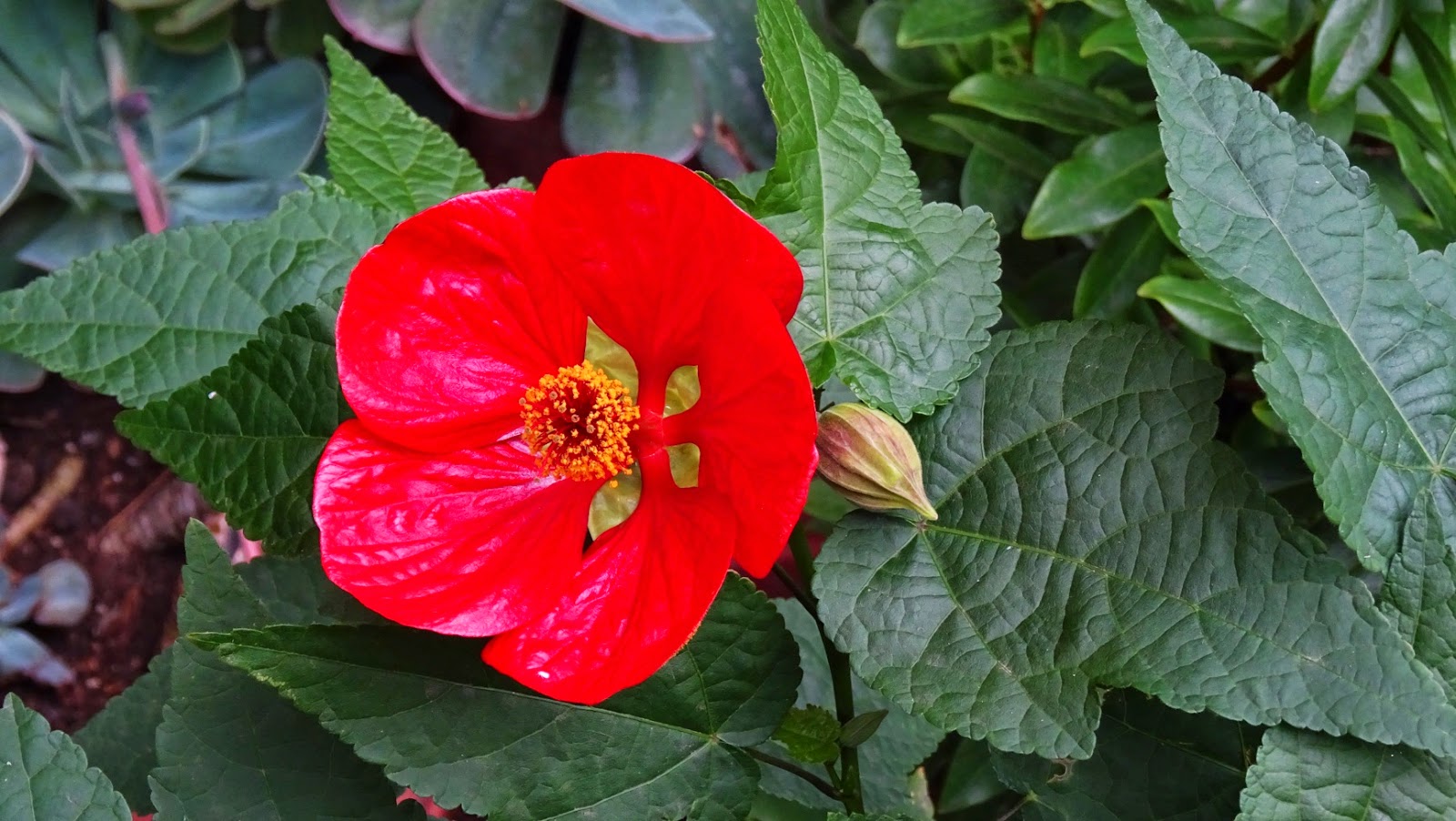
Abutilon or 'Chinese lanterns' are closely related to hibiscus, and most of the hundred or so species have pendulous, hibiscus-like flowers. Cultivars produced by hybridising some of the South American abutilons have all been placed in one group known as Abutilon x hybridum, and these are the ones most commonly grown in Australian gardens.

They have a wispy, delicate form and colourful, lantern-shaped flowers. For gardeners who prefer plants with a more dense habit, new compact varieties are also available. Another popular abutilon is Abutilon megapotamicum, which is a prostrate or ground covering species with small orange flowers.

Abutilon are evergreen shrubs with attractive maple-like leaves and an open, pendulous habit. They grow to about 2-3 metres tall. Flowers in the Southern Hemisphere are produced in September to December, but they spot flower at other times. Flower colours include white, pink, red, yellow, orange and salmon. These plants grow well in most parts of Australia, except for the very cold mountain zones. In inland areas be sure to water well and keep protected with mulch. In hot inland climates abutilons appreciate some light shade.

This post is part of the Floral Friday Fotos meme.

Thursday, 28 June 2018

NATIVE LILAC HIBISCUS

Alyogyne huegelii is a flowering plant found in the Southwest botanical province of Western Australia, extending along its entire coastline. A large flowered shrub, the species favours the sands of coastal shrublands and heath. The large flower, highly variable in colour, is similar to that of Hibiscus. It was previously placed in that genus, and is commonly named "Lilac Hibiscus". It is widely cultivated as a flowering plant for the garden, but the varieties and cultivars previously published are no longer formally recognised.

Alyogyne is a shrub to four metres with many alternate branches, although lower ones may be sparse. Bright green leaves are divided in three to five in outline; margins are irregular, lobate to toothed; pubescent and strongly veined lobes are coarse in shape. The flowerstalk at the leaf axil is long, tilting at the single flower. The flowers have five luminous petals up to 70 mm long, these are overlapping and have slight ridges. The colour is cream or mauve, or the lilac of the name by which it is traded. The staminal tube structure contains numerous whorled anthers, these are yellow. The five styles of this are fused until the tip, which is composed of swollen and apparently divided stigma. This is supported on a five-lobed calyx, within an arrangement of up to 10 partly fused bracts.

As with all the Malvales, the flowers last around a day – becoming deeply coloured and papery when spent. They are numerous in the long flowering period in Australia being between June and January.

This post is part of the Floral Friday Fotos meme.


Monday, 21 November 2016

ABUTILON

Abutilon or Chinese lantern is closely related to Hibiscus, and most of the hundred or so species have pendulous, hibiscus-like flowers. Cultivars produced by hybridising some of the South American abutilons have all been placed in one group known as Abutilon x hybridum, and these are the ones most commonly grown in Australian gardens. They have a wispy, delicate form and colourful, lantern-shaped flowers. For gardeners who prefer plants with a more dense habit, new compact varieties are also available.

They are evergreen shrubs with attractive maple-like leaves and an open, pendulous habit. They grow to about 2-3 metres tall (or 50-100 cm if a compact variety). Flowers are produced in September to December, but they spot flower at other times. Flower colours include white, pink, red, yellow, orange and salmon. Abutilons grow well in most parts of Australia, except for the very cold mountain zones. In inland areas be sure to water well and keep protected with mulch. In hot inland climates abutilons appreciate some light shade.

A full sun position is best, but abutilons will also flower in part shade. They like a rich, well drained soil and a cool root run. Water well and mulch. Avoid heavy feeding as abutilons are inclined to produce foliage at the expense of flowers. Light prune to shape toward the end of winter in frost free gardens. Leave until early spring in frost-prone areas. They can become untidy and leggy like hibiscus. As abutilons are members of the Malvaceae family, they are also subject to attack by hibiscus beetle and metallic flea beetle. These pests make holes in leaves and flowers and are difficult to control with pesticides.

We have had a very hot day in Melbourne today with maximum temperatures in the high 30s˚C. Fortunately, a cool change and rain came in the afternoon and the garden recovered a little...

This post is part of the Blue Monday meme,
and also part of the Monday Mellow Yellow meme,
and also part of the Through my Lens meme,
and also part of the Seasons meme.


Wednesday, 15 June 2016

WET

Abutilon is a large genus of flowering plants in the mallow family, Malvaceae. It is distributed throughout the tropics and subtropics of the Americas, Africa, Asia, and Australia. General common names include Indian mallow and velvetleaf. The genus name is an 18th-century New Latin word that came from the Arabic ’abū-ṭīlūn (أبو طيلون), the name given by Avicenna to this or a similar genus.

This post is part of the Wednesday Waters meme,
and also part of the Waterworld Wednesday meme,
and also part of the Outdoor Wednesday meme,
and also part of the Wordless Wednesday meme,
and also part of the ABC Wednesday meme.

Thursday, 2 April 2015

ABUTILON

Abutilons or Chinese lanterns are closely related to hibiscus, and most of the hundred or so species have pendulous, hibiscus-like flowers. Cultivars produced by hybridising some of the South American abutilons have all been placed in one group known as Abutilon x hybridum, and these are the ones most commonly grown in Australian gardens. They have a wispy, delicate form and colourful, lantern-shaped flowers. For gardeners who prefer plants with a more dense habit, new compact varieties are also available. This compact abutilon is growing very happily in a large pot on our porch.

They are evergreen shrubs with attractive maple-like leaves and an open, pendulous habit. They grow to about 2-3 metres tall (or 50-100 cm if a compact variety). Flowers are produced in September to December, but they spot flower at other times. Flower colours include white, pink, red, yellow, orange and salmon. Abutilons grow well in most parts of Australia, except for the very cold mountain zones. In inland areas be sure to water well and keep protected with mulch. In hot inland climates abutilons appreciate some light shade.

A full sun position is best, but abutilons will also flower in part shade. They like a rich, well drained soil and a cool root run. Water well and mulch. Avoid heavy feeding as abutilons are inclined to produce foliage at the expense of flowers. Light prune to shape toward the end of winter in frost free gardens. Leave until early spring in frost-prone areas. They can become untidy and leggy like hibiscus. As abutilons are members of the Malvaceae family, they are also subject to attack by hibiscus beetle and metallic flea beetle. These pests make holes in leaves and flowers and are difficult to control with pesticides.

This post is part of the Floral Friday Fotos meme.


Thursday, 18 December 2014

KURRAJONG FLOWERS

Brachychiton populneus x acerifolius 'Bella Pink' is a small to medium sized shade tree offering glossy green foliage and pretty clusters of salmon pink, bell-shaped flowers in Summer.   As a grafted tree, it is more compact in size which makes it highly suitable for domestic landscapes. Flowers are bird attracting.

The form and colour of this magnificent Australian tree makes it suitable for many urban situations including commercial landscapes, streetscapes, schools, parks and golf courses. It is a very reliable shade tree in smaller gardens.

Brachychiton populneus, commonly known as the Kurrajong, is a small to medium sized tree found naturally in Australia in a diversity of habitats from wetter coastal districts to semi-arid interiors of Victoria, New South Wales and Queensland. The extended trunk is a water storage device for survival in a warm dry climate. The bell-shaped flowers are variable in colour while the leaves vary considerably in shape.

The leaves are either simple and pointed, or may be 3 - 9 lobed. Saplings grow from a drought and fire resistant tap-rooted tuber. Kurrajong has multiple uses. Seeds are eaten by Aboriginal people after roasting. The soft spongy wood was used for making shields, and the bark as a fibre. The leaves are also used as emergency fodder for drought-affected animal stock. It has been introduced as an ornamental tree to south-western Australia, South Africa, Louisiana, California, Arizona and Mediterranean countries. In Western Australia it was observed to be invasive in disturbed areas.

This post is part of the Floral Friday Fotos meme.


Tuesday, 8 April 2014

HIBISCUS

Hibiscus is a genus of flowering plants in the mallow family, Malvaceae. It is quite large, containing several hundred species that are native to warm-temperate, subtropical and tropical regions throughout the world. Member species are often noted for their showy flowers and are commonly known simply as hibiscus, or less widely known as rose mallow. The genus includes both annual and perennial herbaceous plants, as well as woody shrubs and small trees. The generic name is derived from the Greek word ἱβίσκος (hibískos), which was the name Pedanius Dioscorides (ca. 40–90) gave to Althaea officinalis.

Hibiscus rosa-sinensis shown here, was probably native to Southern China and south-east Asia, then spread to the Pacific Islands long before Europeans reached that part of the world. Today it is very popular as an ornamental plant in most warm countries, and the original red flowered plant has undergone tremendous development. Hundreds of cultivars are now available, with double and semi-double flowers in all colours except true blues and purples.

This post is part of the Nature Footsteps Floral Macros meme,
and also part of the Our World Tuesday meme,
and also part of the Ruby Tuesday meme.

Sunday, 3 November 2013

MALLOW

Malva is a genus of about 25–30 species of herbaceous annual, biennial, and perennial plants in the family Malvaceae (of which it is the type genus), one of several closely related genera in the family to bear the common English name mallow. The genus is widespread throughout the temperate, subtropical and tropical regions of Africa, Asia and Europe. The plant shown here is Malva sylvestris.

The word "mallow" is derived from Old English "malwe", which was imported from Latin "malva", cognate with Ancient Greek μαλάχη (malakhē) meaning "mallow", both perhaps reflecting a Mediterranean term. A number of species, previously considered to belong to Lavatera, have been moved to Malva.The leaves are alternate, palmately lobed. The flowers are from 0.5–5 cm diameter, with five pink or white petals.The colour mauve was in 1859 named after the French name for this plant.

This post is part of the I Heart Macros meme.

Tuesday, 14 May 2013

YELLOW HIBISCUS

Hibiscus is a genus of flowering plants in the mallow family, Malvaceae. It is quite large, containing several hundred species that are native to warm-temperate, subtropical and tropical regions throughout the world.

Member species are often noted for their showy flowers and are commonly known simply as hibiscus, or less widely known as rose mallow. The genus includes both annual and perennial herbaceous plants, as well as woody shrubs and small trees. The generic name is derived from the Greek word ἱβίσκος (hibískos), which was the name Pedanius Dioscorides (ca. 40–90) gave to Althaea officinalis.

This post is part of the Nature Footsteps Floral Macros meme.

Tuesday, 16 April 2013

HIBISCUS

Hibiscus is a genus of flowering plants in the mallow family, Malvaceae. It is quite large, containing several hundred species that are native to warm-temperate, subtropical and tropical regions throughout the world. Member species are often noted for their showy flowers and are commonly known simply as hibiscus, or less widely known as rose mallow. The genus includes both annual and perennial herbaceous plants, as well as woody shrubs and small trees. The generic name is derived from the Greek word ἱβίσκος (hibískos), which was the name Pedanius Dioscorides (ca. 40–90) gave to Althaea officinalis.

This post is part of the Nature Footsteps Floral Macros meme.
and part of the Ruby Tuesday meme.