In Greek mythology, the Labyrinth (Greek λαβύρινθος labyrinthos, literally the building complex at Knossos "the house of the labrys" [double axe]) was an elaborate structure designed and built by the legendary artificer Daedalus for King Minos of Crete at Knossos. Its function was to hold the Minotaur, a mythical creature that was half man and half bull and was eventually killed by the Athenian hero Theseus. Daedalus had so cunningly made the Labyrinth that he could barely escape it after he built it. Theseus was aided by Ariadne, who provided him with a skein of thread, literally the "clew", or "clue", so he could find his way out again.
In colloquial English, labyrinth is generally synonymous with maze, but many contemporary scholars observe a distinction between the two: maze refers to a complex branching (multicursal) puzzle with choices of path and direction; while a single-path (unicursal) labyrinth has only a single, non-branching path, which leads to the centre. A labyrinth in this sense has an unambiguous route to the centre and back and is not designed to be difficult to navigate.
In Christian symbology the labyrinth stands for our journey through life and that walking it can take us on a journey to the centre of our own beings. It is also widely known that in the Middle Ages walking this sacred path of the labyrinth was seen as a pilgrimage and, indeed, prayer labyrinths were called "Chemin de Jerusalem" (Roads of Jerusalem).
This labyrinth here, is in the garden of the Catholic Church of St John in the Melbourne suburb of Heidelberg.
This post is part of the Outdoor Wednesday meme,
and also part of the ABC Wednesday meme.
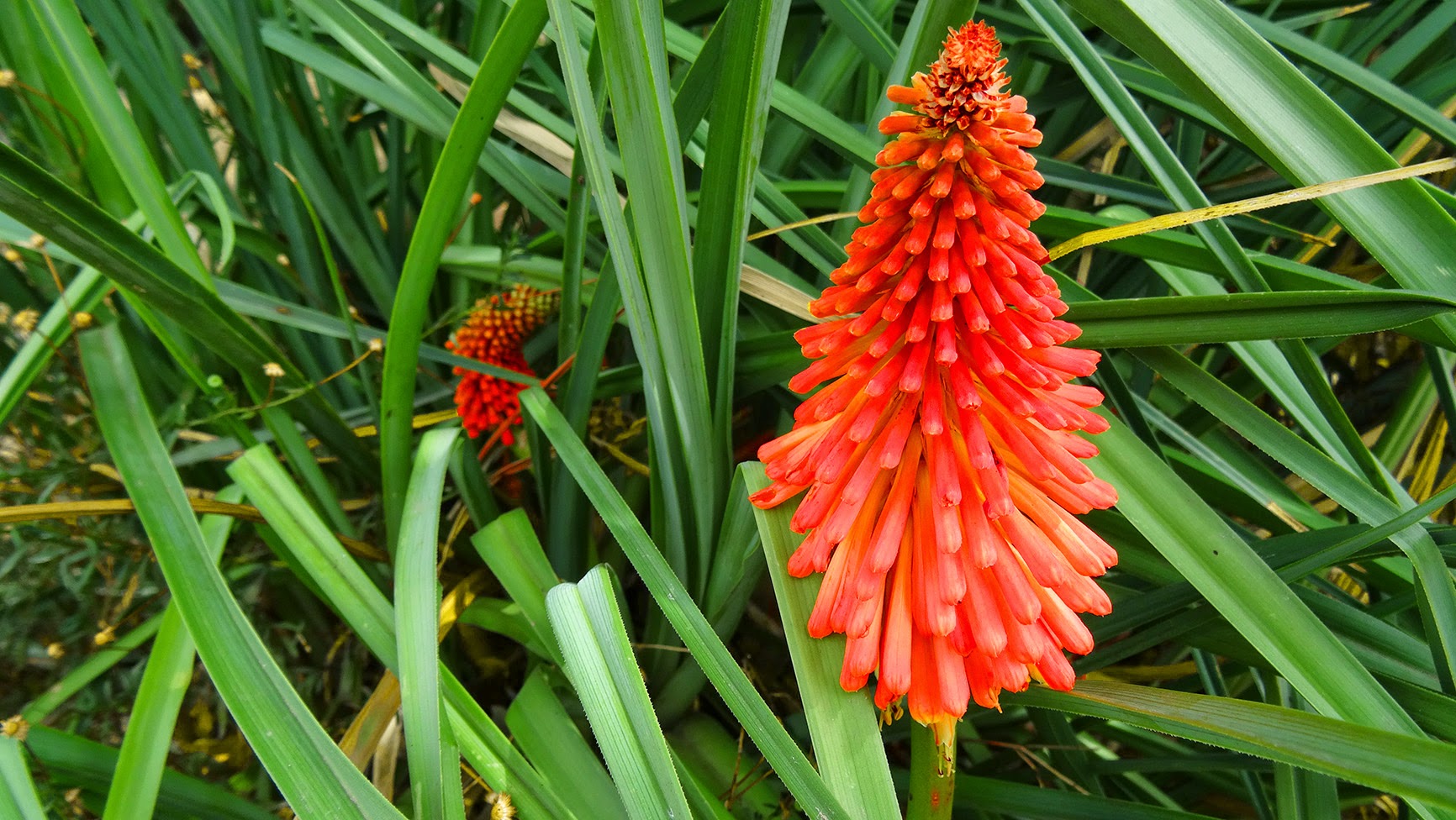
Kniphofia, also called tritoma, red hot poker, torch lily, knofflers or poker plant, is a genus of flowering plants in the family Xanthorrhoeaceae, subfamily Asphodeloideae, that includes 70 or more species native to Africa. Herbaceous species and hybrids have narrow, grass-like leaves 10–100 cm long, while perennial species have broader, strap-shaped foliage up to 1.5 m long.
All plants produce spikes of upright, brightly coloured flowers well above the foliage, in shades of red, orange and yellow, often bicoloured. The flowers produce copious nectar while blooming and are attractive to bees. In the New World they may attract sap-suckers such as hummingbirds and New World orioles.The Kniphofia genus is named after Johann Hieronymus Kniphof, an 18th-century German physician and botanist.
This post is part of the Nature Footsteps Floral Macros meme,
The first photo is the flowering head of the herb, dill (Anethum graveolens) growing in our garden. I have played with layers and filters in Photoshop in the next two images and have also added some additional material from a photo of actual fireworks in the last image to get the derivatives. Which is your favourite image?
This post is part of the Mandarin Orange Monday meme,
and also part of the Monday Mellow Yellows meme,
and also part of the Nature Footsteps Inspiring Photography meme.
The original Tran Quoc pagoda was built in the 6th century and is considered the oldest in Vietnam. It was founded on the bank of the Red River by King Ly Nam De who named it Khai Quoc (National Founder). Much later, it was moved to its present site beside Hanoi’s Ho Tay (West) Lake during the reign of King Le Kinh Tong (1600-1618) and renamed Tran Quoc (National Defence). The current building is the result of major renovations in 1815.
The term "pagoda" is from Portuguese "pagode", perhaps based on Persian "butkada" - ‘temple of idols,’ influenced by Prakrit "bhagodī" - ‘divine’. This temple is a popular place of pilgrimage and devotions, with many faithful coming to pray and lay dedications close to the altar within the temple.
This post is part of the Scenic Weekends meme,
and also part of the inSPIREd Sunday meme.
Darling Harbour is a harbour adjacent to the city centre of Sydney, New South Wales, Australia. It is also a large recreational and pedestrian precinct that is situated on western outskirts of the Sydney central business district. The locality extends northwards from Chinatown, along both sides of Cockle Bay to King Street Wharf on the east, and to the suburb of Pyrmont on the west. Cockle Bay is just one of the waterways that makes up Darling Harbour, which opens north into the much larger Port Jackson.The precinct and its immediate surroundings are administered independently of the local government area of the City of Sydney, by a New South Wales state government statutory authority, the Sydney Harbour Foreshore Authority.
This post is part of the Weekend Reflections meme,
and also part of the Weekly TopShot meme,
and also part of the Scenic Weekends meme.
The Australian White Ibis (Threskiornis moluccus), is a wading bird of the ibis family Threskiornithidae. It is widespread across much of Australia. It has a predominantly white plumage with a bare, black head, long downcurved bill and black legs. See another photo here.
Historically rare in urban areas, the Australian White Ibis has immigrated to urban areas of the east coast in increasing numbers since the late 1970s. It is now commonly seen in Wollongong, Sydney, the Gold Coast, Brisbane and Townsville. Debate continues on whether to consider it a pest or vulnerable species. Populations have disappeared from natural breeding areas such as the Macquarie Marshes in northwestern New South Wales. Despite this, the species has been culled in parts of Sydney due to their smell and at times obtrusive nature. Its sister species is the Sacred Ibis (Threskiornis aethiopicus).
This post is part of the Skywatch Friday meme.
Penstemon is a genus of plants found mainly in the Americas from Alaska to Guatemala, the 250 species of perennials and subshrubs in this genus range from tiny carpeting plants to rapid growers that can exceed 1.2 m tall. They have recently been reclassified and from the Scrophulariaceae family, they are now in the Plantaginaceae family.
In recent years many new garden varieties have become available, generally with increased hardiness and increased flower production. In favourable conditions, these are reliable plants, suitable for border planting, rock gardens, woodland gardens, and "wild" gardens. The pretty flowers resemble those of the foxgloves (Digitalis), and, indeed, they belong to the related family Scrophulariaceae. Native Americans used several species, primarily for their analgesic and styptic properties but also to control stomach disorders.
Penstemon 'Tubular Bells - Wine Red' is a robust plant with strong upright stems that hold striking deep red flowers with a soft white throat. This flamboyant penstemon really makes its presence felt in any cottage garden theme. Tubular Bells Wine Red will flower from June to September (Northern Hemisphere) and December to April (Southern Hemisphere), and is best planted in full sun or partial shade. Height: 40cm.
This post is part of the Floral Friday Fotos meme.
The koala (Phascolarctos cinereus or, inaccurately, koala bear) is an arboreal herbivorous marsupial native to Australia. It is the only extant representative of the family Phascolarctidae, and its closest living relatives are the wombats. The koala is found in coastal areas of the mainland's eastern and southern regions, inhabiting Queensland, New South Wales, Victoria and South Australia. It is easily recognisable by its stout, tailless body; round, fluffy ears; and large, spoon-shaped nose. The koala has a body length of 60–85 cm and weighs 4–15 kg. Pelage colour ranges from silver grey to chocolate brown. Koalas from the northern populations are typically smaller and lighter in colour than their counterparts further south. It is possible that these populations are separate subspecies, but this is disputed.
Koalas typically inhabit open eucalypt woodlands, and the leaves of these trees make up most of their diet. Because this eucalypt diet has limited nutritional and caloric content, koalas are largely sedentary and sleep for up to 20 hours a day. They are asocial animals, and bonding exists only between mothers and dependent offspring. Adult males communicate with loud bellows that intimidate rivals and attract mates. Males mark their presence with secretions from scent glands located on their chests. Being marsupials, koalas give birth to underdeveloped young that crawl into their mothers' pouches, where they stay for the first six to seven months of their life. These young koalas are known as joeys, and are fully weaned at around a year. Koalas have few natural predators and parasites but are threatened by various pathogens, like Chlamydiaceae bacteria and the koala retrovirus, as well as by bushfires and droughts.
Koalas were hunted by indigenous Australians and depicted in myths and cave art for millennia. The first recorded encounter between a European and a koala was in 1798, and an image of the animal was published in 1810 by naturalist George Perry. Botanist Robert Brown wrote the first detailed scientific description of the koala in 1814, although his work remained unpublished for 180 years. Popular artist John Gould illustrated and described the koala, introducing the species to the general British public. Further details about the animal's biology were revealed in the 19th century by several English scientists.
Because of its distinctive appearance, the koala is recognised worldwide as a symbol of Australia. Koalas are listed as of Least Concern by the International Union for Conservation of Nature. The Australian government lists populations in Queensland and New South Wales as Vulnerable. The animal was hunted heavily in the early 20th century for its fur, and large-scale cullings in Queensland resulted in a public outcry that initiated a movement to protect the species. Sanctuaries were established, and translocation efforts moved to new regions koalas whose habitat had become fragmented or reduced. The biggest threat to their existence is habitat destruction caused by agriculture and urbanisation.
This post is part of the Outdoor Wednesday meme,
Rosa 'Mister Lincoln' is a large flowered (hybrid tea) bush rose introduced in 1964. (AARS 1965). It is a tall red rose is renowned for its strong fragrance (in still air it can be detected up to 3 metres away) and its deep, red colour. It grows to about 1.2 metres high and 1 metre across. The leaves are matt dark green. The buds are deep red and open up into large, velvety red, double blossoms. It has typically around 30 to 35 petals per flower. It is a vigorous plant that performs well in all climates. Mister Lincoln is hardy to zone 5-9.
This post is part of the Our World Tuesday meme,