Wednesday, 9 May 2012

LITCHFIELD NATIONAL PARK, NT, AUSTRALIA

Litchfield National Park, covering approximately 1500 km2, is near the township of Batchelor, 100 km south-west of Darwin, in the Northern Territory of Australia. Each year the park attracts over 260,000 visitors. Proclaimed a national park in 1986, it is named after Frederick Henry Litchfield, a Territory pioneer, who explored areas of the Northern Territory from Escape Cliffs on the Timor Sea to the Daly River in 1864.

Florence Falls is a double-plunge waterfall leading to a popular swimming hole. A short distance away is the Buley Rockhole, where visitors will find a long series of cascading plunge pools, perfect for bathing in. A number of other spectacular falls can also be visited, including Wangi Falls, Tolmer Falls and Tjaetaba Falls.

Litchfield National Park offers a wide range of walking tracks, but it is strongly recommended that overnight walks are registered with the Overnight Walker Registration Scheme. Walkers must camp in designated campgrounds and do their utmost not to damage the flora and fauna of the Park.

Magnetic Termite Mounds are built by termites and are amazing architectural feats complete with arches, tunnels, chimneys, insulation and nursery chambers. The mounds are aligned north to south to minimise the exposure to the heat of the sun. You will experience seeing numerous Termite mounds are found all over  the Northern Territory, but Litchfield National Park and especially the formal viewing boardwalk and platform is a perfect place to see these imposing structures.

This post is part of Kim's Water World Wednesday meme,
and also part of Susan's Outdoor Wednesday meme,
and also part of Nature Footsteps Waters meme.


Tuesday, 8 May 2012

ANCIENT GRAVES, KOTZIA SQ, ATHENS


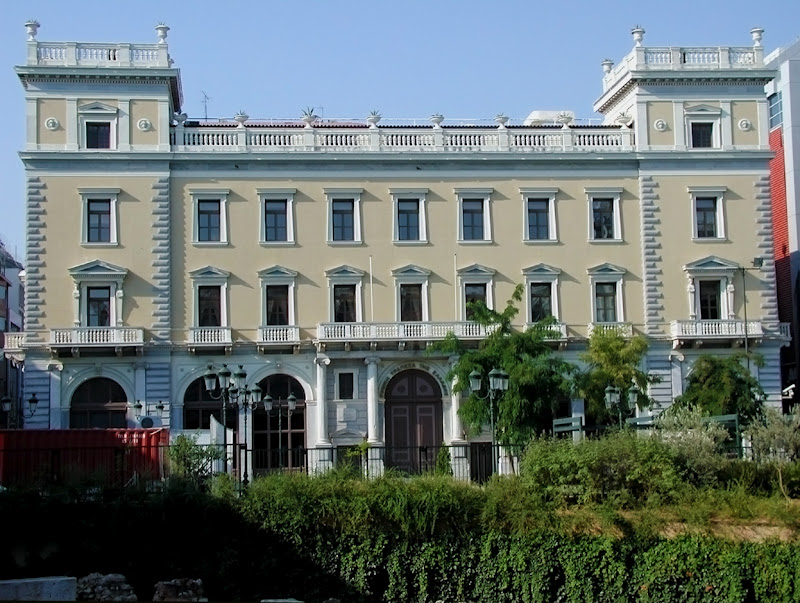
Kotzia Square is a square in central Athens, Greece. The square retains several charactertics of 19th century local neoclassical architecture, such as the City Hall of the Municipality of Athens and the National Bank of Greece Cultural Centre. In the middle of Kotzia square classical antiquities have been recently uncovered that include a large part of an ancient road, tombs and a small building. The square is situated just outside of the ancient Acharnean Gate of Classical Athens.

The archaeological site at Kotzia Square yielded many important archaeological finds. It is located directly outside the ancient city’s fortification, part of which were also revealed and is currently preserved in front of the National Bank of Athens building and at the Aiolou pedestrian precinct. Excavations revealed three ancient streets, a dense cemetery dating from the Protogeometric period (ninth century BC) until the Late Roman period (third century AD), a large complex of pottery workshops of the Late Roman period (late third - fourth century AD), and several houses.

Part of the famous Acharnean Street, which began at the city gate (currently in front of the National Bank of Greece building) and led towards the northern demes of Attica, occupies the centre of the archaeological site. Stratigraphical evidence indicates that the street was laid out in 480 BC and was widely used throughout the fifth century BC.

The cemetery stretched on both sides of Acharnean Street. The grave gifts found in association with burials and cremations cover a wide time span. They include all manner of terracotta vases, some of them by famous ancient pottery workshops, human and animal figurines, glass and terracotta unguentaria, bronze mirrors, gold jewellery, coins, and other objects. A large number of sculptures from funerary monuments, such as columns, pillars, and marble vases, were discovered throughout the excavated area. Many of these were inscribed with the names and origin of those buried in the cemetery. 

During the second half of the third century AD, after the devastating invasion of Athens by the Heruli, the cemetery fell into disuse, and a large complex of pottery workshops covered much of its area. The workshops operated during the fourth century AD, a period of prosperity for Athens. Archaeological finds from inside and around the pottery kilns show that they produced vases, domestic utensils, lamps, roof tiles, and antefixes.

The excavations at Kotzia Square were conducted in 1985-1988 during the construction of an underground car park and covered an area of 7,000 square metres. Additional investigation took place near the car park’s entrance and exit points in 1998-1999. Parts of the excavated area were conserved and fenced in 2003-2004, and are now accessible to visitors.

This post is part of Julie's Taphophile Tragics meme,
and also part of the Our World Tuesday meme.
Kotzia Square flanked by the neoclassical National Bank buildings

One of the National Bank of Greece buildings on the square
City Hall and Mayor of Athens office 
Part of the excavated ancient road
The archaeological site of Kotzia Square
Part of the ancient cemetery with remnants of the ancient city walls
The graves are all lined with large blocks of stone

An ancient memorial to "Ermagoras, son of Timon" 
In the  National Archaeological Museum of Athens one may see human remains with funerary offering vases. these have been recovered form ancient graves


Monday, 7 May 2012

AUTUMN PUDDLE

Autumn provides such wonderful opportunities for the photographer, and especially so when one is looking for mellow yellow shots!

This post is part of the Mellow Yellow Monday meme.

Sunday, 6 May 2012

MELBOURNE GENERAL CEMETERY CHAPEL

This Chapel is found in the grounds of the Melbourne General Cemetery, about which I have blogged about before, here. It is a Victorian bluestone building, along the lines of which many other coeval churches in Melbourne were built.

This post is part of the Psalm Sunday meme,
and also part of the Spiritual Sunday meme.

And here is a lovely Felix Mendelssohn setting of Psalm 2 op.78 "Warum toben die Heiden" with the Estonian Philharmonic Chamber Choir directed by Daniel Reuss.

Saturday, 5 May 2012

RAINY DAY

Another rainy day in Autumnal Melbourne day. Good opportunity for taking photos of reflections in water puddles.


This post is part of James' Weekend Reflections meme,
and also part of Madge's Weekly Top Shot meme.

Friday, 4 May 2012

AUTUMN SKIES

We are well into Autumn now in the Southern Hemisphere and the season is cool, gray and rainy in Melbourne. It is good to see the rain coming down, as memories of the serious droughts and bushfires several years back are still fresh.

The nights lengthening,
Cool, gray days with blessed rain
And silvery sun...

This post is part of Sylvia's Skywatch Friday meme,
and also for the Floral Friday Fotos meme.

Thursday, 3 May 2012

THE ROAD TO GUNDAGAI

Gundagai is a town in New South Wales, Australia. Although a small town, Gundagai is a popular topic for writers and has become a representative icon of a typical Australian country town. Located along the Murrumbidgee River and Muniong, Honeysuckle, Kimo, Mooney Mooney, Murrumbidgee and Tumut mountain ranges, Gundagai is 390 kilometres south-west of Sydney, the state capital and largest city in Australia. At the 2006 census the population of Gundagai was 1,998.

Gundagai, perhaps more than any other Australian locality, is referenced in stories, songs and poems. These include Theta's poem,'Ode to the Dead of Gundagai'. James Riley, 'The Gundagai Calamity', Jack Moses and others in 'Nine Miles From Gundagai', Jack O'Hagan songs 'Where the Dog Sits on the Tuckerbox (five miles from Gundagai)', 'Along The Road To Gundagai', 'Snake Gully Swagger', and 'When a Boy from Alabama Meets a Girl from Gundagai'. Gundagai also features in the song 'The Grand Old Hills of Gundagai'.  It is referenced in Scottish band Goodbye Mr. Mackenzie's song 'Dust'.

A 2010 publication 'Purple Threads' by Jeanine Leane has won a major literary award, the David Unaipon Award and has been shortlisted for a Commonwealth literary award. Other references in literature include Banjo Paterson's 'The Road to Gundagai' and the traditional ballad 'Flash Jack from Gundagai'. Additionally, the town is mentioned in Henry Lawson's 'Scots of the Riverina' and C. J. Dennis' 'The Traveller'. Miles Franklin's 'Brent of Bin Bin' saga is set in the area and it includes an account of the flood of 1852.

The most famous landmark is the Dog on the Tuckerbox. Read the sign for the history!

This post is part of Lesley's Signs, Signs meme.


Here is 'Along The Road To Gundagai' performed by Jack Davidson & His Dandies in 1938.

Wednesday, 2 May 2012

FARM NEAR MELBOURNE

Around Melbourne the rolling landscape is dotted with many farms, market gardens and also some lovely unspoilt countryside. The best way to appreciate this is flying into the City and ensuring you have a window seat! I love taking photos from the plane, and here is a small farm with several dams (reservoirs of water for stock to drink from - the lowermost almost rectangular body of water and the two small dams to the right of the photo), as well as a large ornamental lake in this particular farm.

Th second photo shows Deep Creek, quite close to the Tullamarine Airport in Melbourne.

This post is part of the Water World Wednesday meme,
and also the Nature Footsteps Waters meme,
and also the Outdoor Wednesday meme.


Tuesday, 1 May 2012

SICILIAN CEMETERY

When visiting Sicily we stopped at a couple  of cemeteries and had a wander through them. Italian cemeteries tend to be very crowded and the graves are very ornate and adorned with statues, carvings, flowers and text. One can tell space is at a premium, but at the same time the culture is very much influenced by the past, when in Etruscan and Graeco-Roman times the tomb was seen as the place where the dead spent their time after life so it had to be as home-like as possible. Hence the mausoleums and elaborate tombs of antiquity.

Many pagan traditions have survived in both Greece and Italy and those customs, beliefs and traditions that relate to the dead have been particularly resistant to change. Instead the introduced Christianity has adapted these old pagan traditions into new guises that were compatible with the new religion's belief systems.

The photos in this post are from a quite large cemetery in the outskirts fo Syracuse, Sicily. This post is part of Julie's Taphophile Tragics meme.
A high wall completely surrounds the cemetery
The text in the centre, on the pages of the open book reads: "Why do you look at me? As I am you will become; As you are I once was." This is a common ancient epitaph that has here been translated to Italian 
Interesting to see this modern-looking statue of a mourner in amongst the more traditional Christs and Madonnas
Even the dead live in high rise apartments!