Showing posts with label Russia. Show all posts

Tuesday, 10 September 2019

ST PETERSBURG, RUSSIA

Saint Petersburg (Russian: Санкт-Петербу́рг, tr. Sankt-Peterburg) is the second largest city in Russia, politically incorporated as a federal subject (a federal city). Situated on the Neva River, at the head of the Gulf of Finland on the Baltic Sea, it was named Saint Petersburg in 1703. In 1914, the name was changed from Saint Petersburg to Petrograd (Russian: Петрогра́д), in 1924 to Leningrad (Russian: Ленингра́д), and in 1991 back to Saint Petersburg.

Tsar Peter the Great founded Saint Petersburg on May 27 [O.S. 16] 1703. Between 1713–1728 and 1732–1918, Saint Petersburg was the imperial capital of Russia. In 1918, the central government bodies moved to Moscow. It is Russia’s second-largest city after Moscow, with five million inhabitants in 2012, and an important Russian port on the Baltic Sea. Saint Petersburg is the most Westernised city of Russia, as well as its cultural capital. It is the northernmost city in the world with a population of over one million.The Historic Centre of Saint Petersburg and Related Groups of Monuments constitute a UNESCO World Heritage Site. Saint Petersburg is home to The Hermitage, one of the largest art museums in the world. A large number of foreign consulates, international corporations, banks, and businesses have offices in Saint Petersburg.

We visited St Petersburg in 2001 and thoroughly enjoyed it, seeing an amazing number of significant sites, museums, historical and cultural areas. The people we met were courteous, helpful and friendly.

The Church of the Saviour on Spilled Blood (Russian: Церковь Спаса на Крови, Tserkovʹ Spasa na Krovi) is one of the main sights of St. Petersburg. Other names include the Church on Spilled Blood (Russian: Церковь на Крови, Tserkov’ na Krovi), the Temple of the Saviour on Spilled Blood (Russian: Храм Спаса на Крови, Khram Spasa na Krovi), and the Cathedral of the Resurrection of Christ (Russian: Собор Воскресения Христова, Sobor Voskreseniya Khristova). This church was built on the site where Emperor Alexander II was fatally wounded by political nihilists in March 1881.

The church was built between 1883 and 1907. The construction was funded by the imperial family.Architecturally, the Cathedral differs from St. Petersburg’s other structures. The city’s architecture is predominantly Baroque and Neoclassical, but the Saviour on Blood harks back to medieval Russian architecture in the spirit of romantic nationalism. It intentionally resembles the 17th-century Yaroslavl churches and the celebrated St. Basil’s Cathedral in Moscow.

This post is part of the Our World Tuesday meme,
and also part of the Ruby Tuesday meme,
and also part of the Travel Tuesday meme,
and also part of the Wordless Wednesday meme.


Tuesday, 19 June 2018

MOSCOW, RUSSIA

Moscow (Russian: Москва́) is the capital and most populous city of Russia, with 12.5 million residents within the city limits and 17.1 million within the urban area. Moscow is one of Russia's three federal cities. Moscow is a major political, economic, cultural, and scientific centre of Russia and Eastern Europe, as well as the largest city entirely on the European continent. According to Forbes 2013, Moscow has been ranked as the ninth most expensive city in the world by Mercer and has one of the world's largest urban economies, being ranked as an alpha global city according to the Globalization and World Cities Research Network, and is also one of the fastest growing tourist destinations in the world according to the MasterCard Global Destination Cities Index.

Moscow is the northernmost and coldest megacity and metropolis on Earth. It is home to the Ostankino Tower, the tallest free standing structure in Europe; the Federation Tower, the tallest skyscraper in Europe; and the Moscow International Business Centre. By its territorial expansion on July 1, 2012 southwest into the Moscow Oblast, the area of the capital more than doubled, going from 1,091 to 2,511 square kilometres, and it gained an additional population of 233,000 people.

Moscow is situated on the Moskva River in the Central Federal District of European Russia, making it Europe's most populated inland city. The city is well known for its architecture, particularly its historic buildings such as Saint Basil's Cathedral with its brightly coloured domes, from 1555–1561 on orders from Ivan the Terrible (see below). With over 40 percent of its territory covered by greenery, Moscow is one of the greenest capitals and major cities in Europe and the world, having the largest forest in an urban area within its borders—more than any other major city—even before its expansion in 2012.

The city has served as the capital of a progression of states, from the medieval Grand Duchy of Moscow and the subsequent Tsardom of Russia to the Russian Empire to the Soviet Union and the contemporary Russian Federation. Moscow is the seat of power of the Government of Russia, being the site of the Moscow Kremlin, a medieval city-fortress that is today the residence for work of the President of Russia. The Moscow Kremlin and Red Square are also one of several World Heritage Sites in the city. Both chambers of the Russian parliament (the State Duma and the Federation Council) also sit in the city. Moscow is considered the centre of Russian culture, having served as the home of Russian artists, scientists and sports figures and because of the presence of museums, academic and political institutions and theatres.

This post is part of the Our World Tuesday meme,
and also part of the Ruby Tuesday meme,
and also part of the Travel Tuesday meme,
and also part of the Wordless Wednesday meme.

Wednesday, 7 June 2017

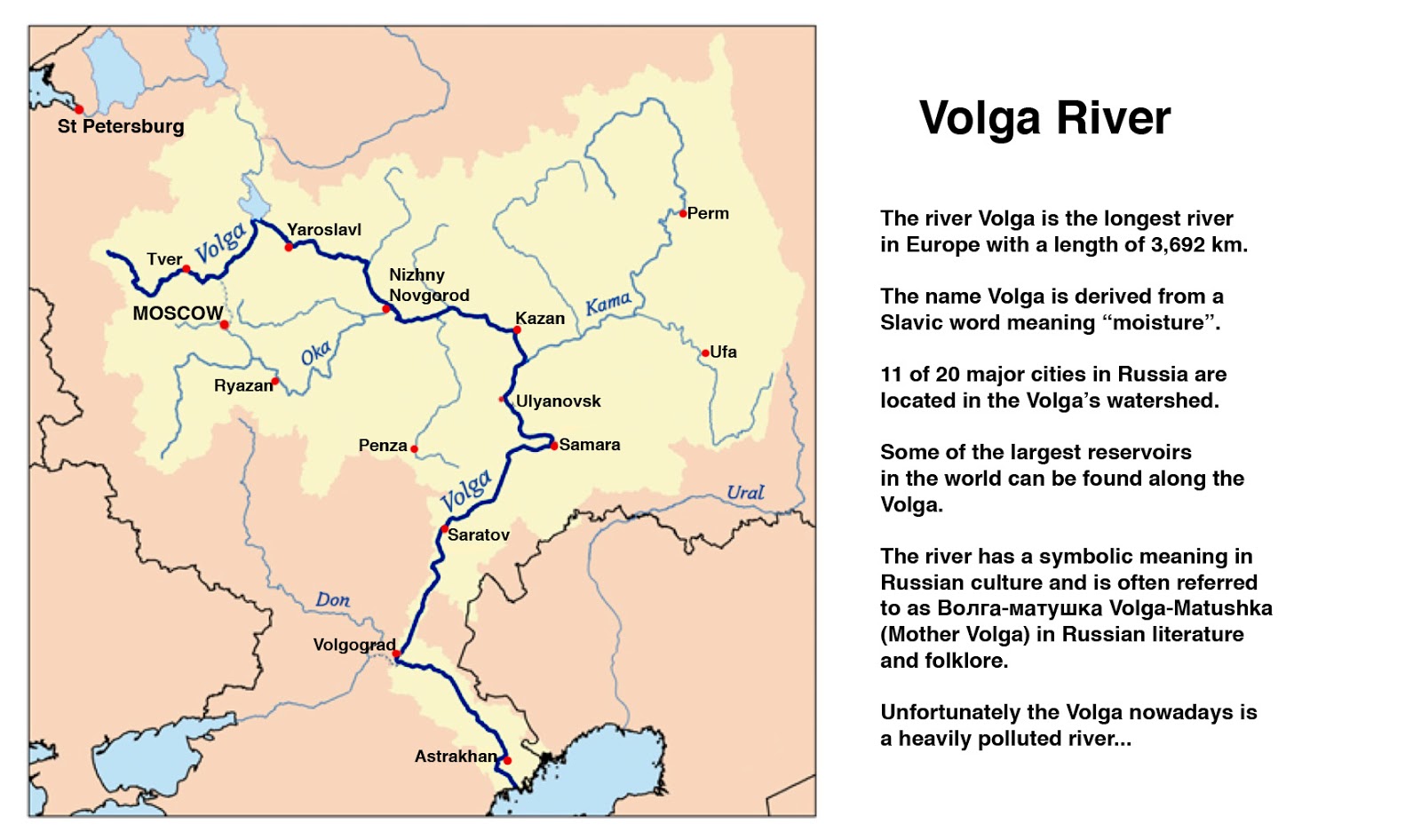
VOLGA RIVER

The Volga (Russian: Во́лга) is the longest river in Europe. It is also Europe's largest river in terms of discharge and watershed, with a length of 3,692 km. The river flows through central Russia and into the Caspian Sea, and is widely regarded as the national river of Russia. Eleven of the twenty largest cities of Russia, including the capital, Moscow, are located in the Volga's watershed. Some of the largest reservoirs in the world can be found along the Volga. The river has a symbolic meaning in Russian culture and is often referred to as Волга-матушка Volga-Matushka (Mother Volga) in Russian literature and folklore.

The Russian hydronym Volga (Волга) derives from Proto-Slavic *vòlga "wetness, moisture", which is preserved in many Slavic languages, including Ukrainian volóha (воло́га) "moisture", Russian vlaga (влага) "moisture", Bulgarian vlaga (влага) "moisture", Czech vláha "dampness", Serbian vlȁga "moisture", and Slovene vlaga "moisture" among others.

The Volga has many tributaries, most importantly the rivers Kama, the Oka, the Vetluga, and the Sura. The Volga and its tributaries form the Volga river system, which flows through an area of about 1,350,000 square kilometres in the most heavily populated part of Russia. The Volga Delta has a length of about 160 kilometres and includes as many as 500 channels and smaller rivers. The largest estuary in Europe, it is the only place in Russia where pelicans, flamingos, and lotuses may be found. The Volga freezes for most of its length for three months each year.

The Volga drains most of Western Russia. Its many large reservoirs provide irrigation and hydroelectric power. The Moscow Canal, the Volga–Don Canal, and the Volga–Baltic Waterway form navigable waterways connecting Moscow to the White Sea, the Baltic Sea, the Caspian Sea, the Sea of Azov and the Black Sea. High levels of chemical pollution have adversely affected the river and its habitats.

This post is part of the Travel Tuesday meme,
and also part of the Wednesday Waters meme,
and also part of the Outdoor Wednesday meme,
and also part of the Wordless Wednesday meme,
and also part of the ABC Wednesday meme.
Mother Volga statue facing the Rybinsk reservoir on the Volga River.
Tver on the Volga
River views between Moscow and Uglich: The flooded city of Kalyazin bell tower
Ilia Efimovich Repin (1844-1930) - Volga Boatmen (1870-1873). A burlak (Russian: бурла́к) was a person who hauled barges and other vessels upstream from the 17th to 20th centuries in the Russian Empire. Burlaks appeared in Russia at the end of 16th century and beginning of the 17th century. With the expansion of freight-hauling, the number of burlaks increased.
Song of the Volga Boatmen sung by the Red Army Chorus:

Tuesday, 12 July 2016

ST PETERSBURG, RUSSIA

Saint Petersburg (Russian: Санкт-Петербу́рг, tr. Sankt-Peterburg) is the second largest city in Russia, politically incorporated as a federal subject (a federal city). Situated on the Neva River, at the head of the Gulf of Finland on the Baltic Sea, it was named Saint Petersburg in 1703. In 1914, the name was changed from Saint Petersburg to Petrograd (Russian: Петрогра́д), in 1924 to Leningrad (Russian: Ленингра́д), and in 1991 back to Saint Petersburg.

Tsar Peter the Great founded Saint Petersburg on May 27 [O.S. 16] 1703. Between 1713–1728 and 1732–1918, Saint Petersburg was the imperial capital of Russia. In 1918, the central government bodies moved to Moscow.  It is Russia's second-largest city after Moscow, with five million inhabitants in 2012, and an important Russian port on the Baltic Sea. Saint Petersburg is the most Westernised city of Russia, as well as its cultural capital. It is the northernmost city in the world with a population of over one million.

The Historic Centre of Saint Petersburg and Related Groups of Monuments constitute a UNESCO World Heritage Site. Saint Petersburg is home to The Hermitage, one of the largest art museums in the world.  A large number of foreign consulates, international corporations, banks, and businesses have offices in Saint Petersburg.

We visited St Petersburg in 2001 and thoroughly enjoyed it, seeing an amazing number of significant sites, museums, historical and cultural areas. The people we met were courteous, helpful and friendly.

This post is part of the Our World Tuesday meme,
and also part of the Ruby Tuesday meme,
and also part of the Travel Tuesday meme,
and also part of the Wordless Wednesday meme


Saturday, 11 July 2015

SATURDAY SILHOUETTES #3

Welcome to the Saturday Silhouettes meme. This is a weekly meme that looks at SILHOUETTES in photography.

SILHOUETTE |ˌsɪlʊˈɛt| noun The dark shape and outline of someone or something visible in restricted light against a brighter background.
ORIGIN - late 18th century: Named (although the reason remains uncertain) after Étienne de Silhouette (1709–67), French author and politician.

Please join me by linking your photo in which a silhouette plays a prominent part in the composition of your image.


Tuesday, 21 February 2012

ST PETERSBURG - MASTERS OF ART NECROPOLIS

The Necropolis of the Masters of Arts was opened in August 1937. The development of that area began since the early days of the existence of the Alexander Nevsky monastery. In March 1823. Due to the small area of the existing St. Lazarus's (Lazarevskoye) cemetery (now the Necropolis of the eighteenth century), the chancellery of the Alexander Nevsky monastery proposed to "establish a similar cemetery".


Originally, the cemetery was called the New Lazarevskoye. In 1869 a burial chapel was built by the architect N.P. Grebenka and funded by the Polezhaevs, a wealthy merchant family. It was named Tikhvinskoye  after the wonder-working icon of Mother of God of Tikhvin. The cemetery's area was extended. According to the plan of 1881 the Tikhvinskoye cemetery already had its present-day boundaries and was enclosed by a stone wall.

Before the October Revolution the social status of the cemetery was very high. Here were buried mostly representatives of the nobility, manufacturers and well-off merchants. The necropolis was then extended to outstanding statesmen and military people, scientists, men of letters, composers, etc.


The imposing gate to the necropolis
Necropolis "Masters of Art"
By the end of 19th century the Tikhvinskoye cemetery had numbered 1325 gravestones: Monumental pedestal crosses of various shapes, numerous altars, icon cases, steles, chapels, massive vaults. The first post-Revolution years were a tragic page in the history of the Tikhvinskoye cemetery. As there was no possibility to ensure the protection of graves, the monuments were rapidly being ruined.


View of one of the avenues of the necropolis
In 1926 the Tikhvinskoye cemetery was closed. Nevertheless, burials took place until 1932 when it was decided to establish a museum-necropolis on the cemetery's territory. This was supposed to be a park-necropolis with the burial places of prominent people of culture. Its outward appearance, free from common graves, was not going to be like a common cemetery. 


Reconstruction began in 1936 and was completed mainly in August 1937. The Tikhvinskoye cemetery ceased to exist. Most monuments were destroyed. Those of high artistic value but with no remains were transferred to the adjacent Necropolis of the eighteenth century. It was done so as to clear the "Necropolis of the Masters of Arts". During reconstruction more than sixty reinterment places were added to the old monuments of the Tikhvinskoye cemetery which escaped destruction. Historically, no artists or actors were buried in the Tikhvinskoye cemetery. Monuments to the representatives of these arts have been transferred to the area. The result is an amazing collection of monuments to prominent artists, composers, poets, authors, musicians. I was especially interested to see the memorials of some the great Russian composers.


Left: Victor Marius Alphonse Petipa (11 March 1818 — 14 July  1910) was a French ballet dancer, teacher and choreographer. Petipa is considered to be the most influential ballet master and choreographer of ballet that has ever lived.
Right: 
Fyodor Ignatievich Stravinsky (Russian: Фёдор Игнатиевич Стравинский), 20 June, 1843 – 4 December, 1902) was a Russian bass opera singer and actor. He was the father of Igor Stravinsky and the grandfather of Soulima Stravinsky.
Pyotr Ilyich Tchaikovsky (Russian: Пётр Ильич Чайковский) (May 7, 1840 – November 6, 1893) was a Russian composer whose works included symphonies, operas, ballets, and chamber music. Some of these rate amongst the most popular concert and theatrical music in the classical repertoire.
The bust of Tchaikovsky
Anton Grigorevich Rubinstein (Russian: Анто́н Григо́рьевич Рубинште́йн) (November 28, 1829 – November 20, 1894) was a Russian pianist, composer and conductor. As a pianist he ranks amongst the great nineteenth-century keyboard virtuosos. He founded the Saint Petersburg Conservatory, which, together with the Moscow Conservatory founded by his brother Nikolai Rubinstein, were the first music schools of their type in Russia.
Nikolai Andreyevich Rimsky-Korsakov (Russian: Никола́й Андре́евич Ри́мский-Ко́рсаков, 18 March,1844 – 21 June, 1908) was a Russian composer, and a member of the group of composers known as The Five. He was a master of orchestration. His best-known orchestral compositions—Capriccio Espagnol, the Russian Easter Festival Overture, and the symphonic suite Scheherazade—are staples of the classical music repertoire, along with suites and excerpts from some of his 15 operas.
Mily Alexeyevich Balakirev (Russian: Ми́лий Алексе́евич Бала́кирев, 2 January, 1837  – 29 May, 1910), was a Russian pianist, conductor and composer known today primarily for his work promoting musical nationalism and his encouragement of more famous Russian composers, notably Pyotr Ilyich Tchaikovsky. He began his career as a pivotal figure, extending the fusion of traditional folk music and experimental classical music practices begun by composer Mikhail Glinka.
Left: Anton Stepanovich Arensky (Russian: Анто́н Степа́нович Аре́нский; 12 July, 1861 – 25 February, 1906), was a Russian composer of Romantic classical music, a pianist and a professor of music.
Right: 
Mikhail Ivanovich Glinka (Russian: Михаи́л Ива́нович Гли́нка, June 1,1804 – February 15, 1857), was the first Russian composer to gain wide recognition within his own country, and is often regarded as the father of Russian classical music. Glinka's compositions were an important influence on Russian composers, notably the members of The Five, who took Glinka's lead and produced a distinctive Russian style of music.
The Holy Trinity Alexander Nevsky Lavra is one of the first large architectural ensembles of St. Petersburg, dating back to the 18th century. This unique historic and artistic complex, outstanding from architectural and city planning points of view, is tightly linked with the history of Russia and its culture.
This is a post for the Taphophile Tragics meme.