Showing posts with label BeBirdin. Show all posts

Saturday, 30 June 2018

TAWNY FROGMOUTH

The tawny frogmouth (Podargus strigoides) is a species of frogmouth native to and found throughout the Australian mainland and Tasmania. Tawny frogmouths are big-headed, stocky birds often mistaken for owls due to their nocturnal habits and similar colouring. The tawny frogmouth is sometimes incorrectly referred to as "mopoke", a common name for the southern boobook, whose call is often confused with the tawny frogmouth's.

Tawny frogmouths are large, big-headed birds that can measure from 34 to 53 cm long. Weights have been recorded up to 680 g in the wild (and perhaps even more in captivity), but these are exceptionally high. Tawny frogmouths are stocky and compact with rounded wings and short legs. They have wide, heavy, olive-grey to blackish bills that are hooked at the tip and topped with distinctive tufts of bristles. Their eyes are large, yellow, and frontally placed, a trait shared by owls.

One of the best examples of cryptic plumage and mimicry in Australian birds is seen in the tawny frogmouth which perch low on tree branches during the day camouflaged as part of the tree. Their silvery-grey plumage patterned with white, black, and brown streaks and mottles allows them to freeze into the form of a broken tree branch and become practically invisible in broad daylight. The tawny frogmouth often chooses a broken part of a tree branch and perches upon it with its head thrust upwards at an acute angle using its very large, broad beak to emphasise the resemblance.

This post is part of the Saturday Critters meme,
and also part of the Camera Critters meme,
and also part of the I'd Rather Be Birdin' meme.

Saturday, 16 June 2018

DUCKS

In the Darebin Parklands, the waters of the Darebin Creek and the several ponds through the reserve offer a great environment for many species of waterfowl. Here are some chestnut teal ducks (Anas castanea). Chestnut teals are dabbling ducks found in Australia. They are protected under the National Parks and Wildlife Act 1974.

The chestnut teal is darker and a slightly bigger bird than the grey teal. The male has a distinctive green coloured head and mottled brown body. The female has a brown head and mottled brown body. The female is almost identical in appearance to the grey teal. The female chestnut teal has a loud penetrating "laughing" quack repeated rapidly nine times or more.

The chestnut teal is commonly distributed in south-eastern and south-western Australia, while vagrants may occur elsewhere. Tasmania and southern Victoria are the species’ stronghold, while vagrants can be found as far north as New Guinea and Lord Howe Island. The chestnut teal prefers coastal estuaries and wetlands, and is indifferent to salinity. This bird is an omnivore.

Chestnut teals form monogamous pairs that stay together outside the breeding season, defend the nest site and look after the young when hatched. Nests are usually located over water, in a down-lined tree hollow about 6–10 m high. Sometimes nests are placed on the ground, among clumps of grass near water. The young hatch and are ready to swim and walk within a day.

This post is part of the Weekend Reflections meme,
and also part of the Saturday Critters meme,
and also part of the Camera Critters meme,
and also part of the I'd Rather Be Birdin' meme.


Saturday, 5 May 2018

AUSTRALIAN DARTER

Anhinga novaehollandiae (family Anhingidae) is commonly known as the Australian darter. Because of its long and slender neck, this bird is sometimes called the snakebird. Usually inhabiting freshwater wetlands, darters swim with their bodies submerged beneath the water’s surface, with only the sinuous neck protruding above the water, enhancing its serpentine qualities. Darters forage by diving to depths of about 60 centimetres, and impaling fish with their sharp, spear-like beaks. Small fish are swallowed underwater, but larger ones are brought to the surface, where they are flicked off the bill (sometimes into the air) and then swallowed head-first.

This post is part of the Saturday Critters meme,
and also part of the Camera Critters meme,
and also part of the I'd Rather Be Birdin' meme.


Saturday, 24 March 2018

BIRDLIFE

Some birdlife at the Darebin Parklands, a nature reserve in the middle of suburban Melbourne, only about 6 km from the City centre.

Clockwise from upper left: Indian Miner; Rainbow Lorikeets; Butcherbird; Sulphur-Crested Cockatoo; Purple Swamphen; Pacific Black Duck; Crested Pigeon; Bronzewing Pigeon; Willy Wagtail.

This post is part of the Weekend Green meme,
and also part of the Weekend Reflections meme,
and also part of the Saturday Critters meme,
and also part of the Camera Critters meme,
and also part of the I'd Rather Be Birdin' meme.


Saturday, 17 March 2018

CHESTNUT TEAL FAMILY

Happy St Patrick's Day! As wearing of the green is customary, here is a  chestnut teal (Anas castanea) family. The chestnut teal is a dabbling duck found in Australia. It is protected under the National Parks and Wildlife Act 1974. The chestnut teal was described by the English naturalist Thomas Campbell Eyton in 1838 under the binomial name Mareca castanea. The specific epithet castanea is from the Latin castaneus for "chestnut-coloured" or "chestnut-brown". This duck is a sister species to the Sunda teal (Anas gibberifrons) that is endemic to Indonesia.

The chestnut teal is darker and a slightly bigger bird than the grey teal. The male has a distinctive green-coloured head and mottled brown body. The female has a brown head and mottled brown body. The female is almost identical in appearance to the grey teal. The female chestnut teal has a loud penetrating "laughing" quack repeated rapidly nine times or more.

The chestnut teal is commonly distributed in south-eastern and south-western Australia, while vagrants may occur elsewhere. Tasmania and southern Victoria are the species’ stronghold, while vagrants can be found as far north as New Guinea and Lord Howe Island. The chestnut teal prefers coastal estuaries and wetlands, and is indifferent to salinity. This bird is an omnivore.

Chestnut teals form monogamous pairs that stay together outside the breeding season, defend the nest site and look after the young when hatched. Nests are usually located over water, in a down-lined tree hollow about 6–10 m high. Sometimes nests are placed on the ground, among clumps of grass near water. The young hatch and are ready to swim and walk within a day.

This post is part of the Saturday Critters meme,
and also part of the Camera Critters meme,
and also part of the I'd Rather Be Birdin' meme,
and also part of the Weekend Reflections meme.

Saturday, 10 March 2018

AUSTRALIAN KINGFISHERS

Kingfishers are to be found all over Australia, but ­predominantly in coastal regions. We have 10 native species, including the kookaburra, which is the largest. Kingfishers nest in tree hollows, in burrows in riverbanks and in termite nests. They feed on small animals, including fish, frogs, yabbies, snakes, insects and nestlings of other birds.

Covered in brilliant green, blue, turquoise and orange plumage, some kingfishers were once in danger of being hunted to extinction for their feathers. Despite their elaborate appearance, these stocky birds are tough, and hunt by darting upon prey in a flash of colour from branches above the river or forest floor. The kingfisher’s heavy beak is the perfect tool for killing victims quickly – they smack their hapless prey against tree branches before swallowing it whole.

The Azure Kingfisher (Ceyx [Alcedo] azurea) length, 17–19cm; wingspan, 25–29cm makes its home along the banks of coastal and inland rivers, swamps and mangroves. During breeding season, it lines its nest with fish bones and scales. Found along much of our northern and eastern seaboards, as well as Tasmania, this species hunts for small mammals, reptiles, fish and frogs.

This one was seen in the Darebin Parklands in suburban Melbourne. They are shy birds, usually keeping out of sight  and easily disturbed if encountered, flying off rapidly.

This post is part of the Saturday Critters meme,
and also part of the Camera Critters meme,
and also part of the I'd Rather Be Birdin' meme.

Saturday, 17 February 2018

CORMORANT

The Australian pied cormorant, Phalacrocorax varius, also known as the pied cormorant, pied shag, or great pied cormorant, is a medium-sized member of the cormorant family. It is found around the coasts of Australasia. In New Zealand it is usually known either as the pied shag or by its Māori name of Kāruhiruhi. Older sources may refer to it as the "yellow-faced cormorant".

In New Zealand its range on the east coast extends as far south as Christchurch, though this is a recent extension—older books report it no further south than Kaikoura. In Australia it is only moderately common in the eastern states, but abundant in the west.

Although typically found in marine habitat—sometimes solitary, sometimes in pairs, sometimes in vast flocks of hundreds or thousands—it is also attracted to inland waters, including lakes, deep and open swamps, and rivers. The pied cormorant appears to feed largely on benthic fish. It will dive both in shallow, still water and in rapidly moving currents. Typical dive times are around 40 seconds, with a recovery period of 10–15 seconds between dives.

This post is part of the Weekend Reflections meme,
and also part of the Saturday Critters meme
and also part of the Camera Critters meme,
and also part of the I'd Rather Be Birdin' meme.


Saturday, 3 February 2018

PURPLE SWAMP HENS

The Australasian swamphen (Porphyrio melanotus), family Rallidae, is a species of swamphen occurring in eastern Indonesia, the Moluccas, Aru and Kai Islands, as well as in Papua New Guinea and Australia. It is also found in New Zealand where it is known as the Pūkeko, derived from the Māori language. The Australasian swamphen previously was considered a subspecies of the purple swamphen (Porphyrio porphyrio).

For such a bulky bird, the Swamphen is an accomplished flier and will readily take to the air to escape danger. In flight, the long legs and elongated toes trail behind or hang underneath the body. Purple Swamphens are proficient swimmers, but prefer to wander on the edges of the water, among reeds and on floating vegetation.

The diet of the Purple Swamphen includes the soft shoots of reeds and rushes and small animals, such as frogs and snails. However, it is a reputed egg stealer and will also eat ducklings when it can catch them. The Purple Swamphen uses its long toes to grasp food while eating.

Purple Swamphens are generally found in small groups and studies have shown that these consist of more males than females. More than one male will mate with a single female. All family members, and occasionally the young from a previous brood, share in incubation and care of the young. The nest consists of a platform of trampled reeds with the surrounding vegetation sometimes being used to form a shelter. Often two broods will be raised in a year.

This post is part of the Weekend Green meme,
and also part of the Weekend Reflections meme,
and also part of the Saturday Critters meme,
and also part of the Camera Critters meme,
and also part of the I'd Rather Be Birdin' meme.


Saturday, 27 January 2018

NANKEEN NIGHT HERON

The nankeen night heron (Nycticorax caledonicus) also commonly referred to as the rufous night heron, and in Melanesia as Melabaob, is a medium-sized heron. It is found in Indonesia, the Philippines, Papua New Guinea, Melanesia, and throughout much of Australia except the arid inland. A small colony has also established near Wanganui, New Zealand.

The nankeen night heron stands about 60 cm tall with a stooped appearance. It is a stocky heron with rich cinnamon upperparts, white-buff underparts, a black crown, and yellow legs and feet. The head is large, the neck short (giving a stooped appearance), and the legs relatively short. During breeding the back of the head bears three white nuptial plumes. The bill is dark olive-green, and the eyes are yellow. Young birds are heavily spotted and streaked white, brown and orange-brown. As they mature, the black cap of the adult develops first, with the body plumage remaining streaked for some time.

It is not strictly nocturnal. It often feeds during the day, especially during wet weather. The bird is dependent on a diet of small fish, reptiles, insects and sometimes eggs. It can be seen around freshwater rivers, lakes, bulrushes, estuaries, harbours and in residential fishponds for goldfish.

The species breeds in the period from September to April, building a nest platform out of sticks. It nests communally, near water. Two to five light green eggs are laid, with a 22-day incubation followed by a 42- to 49-day fledging period. Widespread throughout its large range, the nankeen night heron is evaluated as Least Concern on the IUCN Red List of Threatened Species.

This post is part of the Weekend Green meme,
and also part of the Saturday Critters meme,
and also part of the Camera Critters meme,
and also part of the I'd Rather Be Birdin' meme.


Saturday, 13 January 2018

DUCKLING

This post is part of the Saturday Critters meme,
and also part of the Camera Critters meme,
and also part of the I'd Rather Be Birdin' meme,
and also part of the Weekend Reflections meme.

Saturday, 23 December 2017

BLACK & WHITE BIRDS

These birds are all common in the Darebin Parklands in suburban Melbourne. It was only as I was looking at the photos that I realised they were all dressed in fashionable black and white...

This post is part of the Saturday Critters meme,
and also part of the Camera Critters meme,
and also part of the I'd Rather Be Birdin' meme.
The pied currawong (Strepera graculina) is a medium-sized black passerine bird native to eastern Australia and Lord Howe Island. One of three currawong species in the genus Strepera, it is closely related to the butcherbirds and Australian magpie of the family Artamidae. Six subspecies are recognised. 

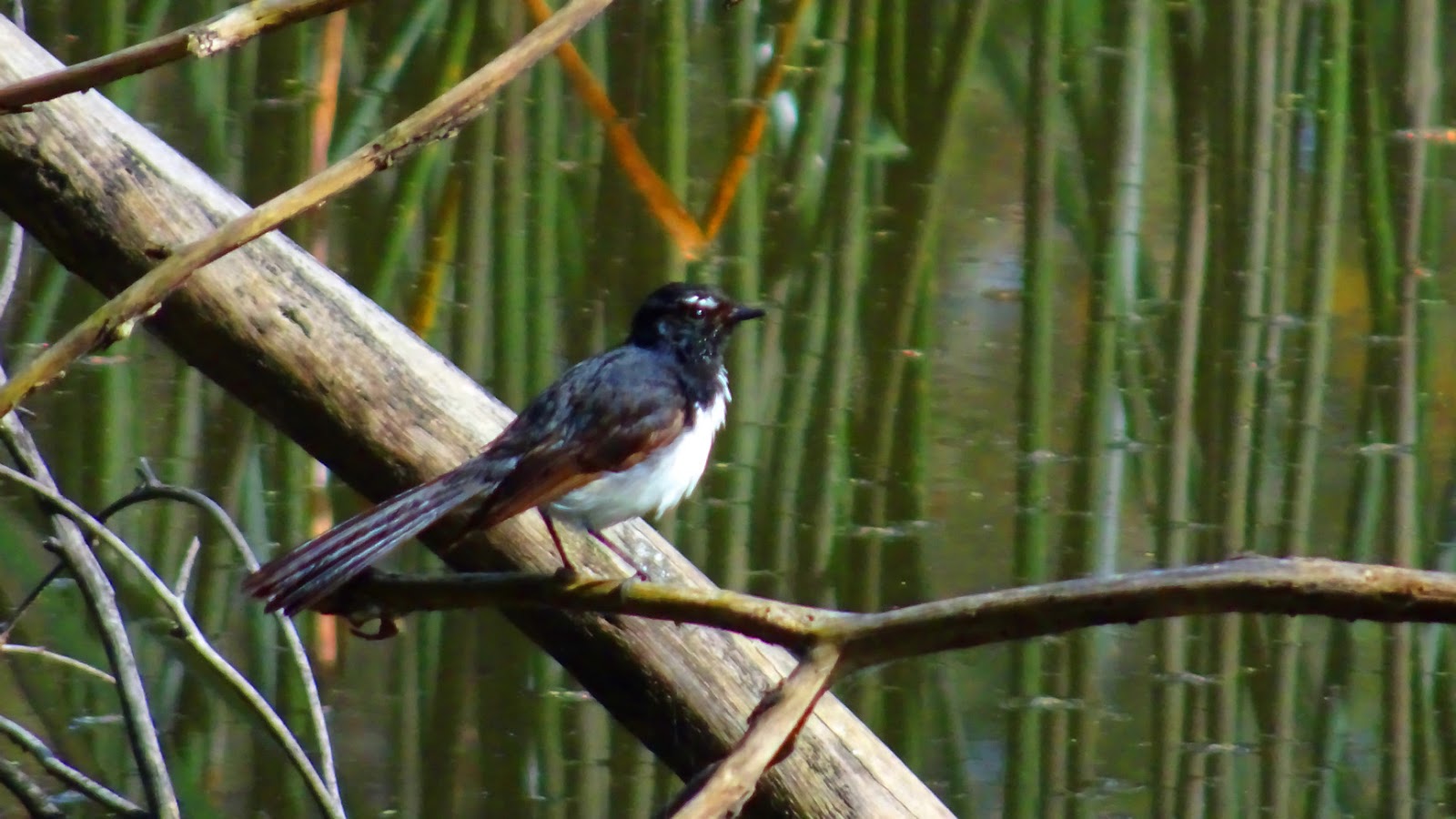
The willie (or willy) wagtail (Rhipidura leucophrys) is a passerine bird native to Australia, New Guinea, the Solomon Islands, the Bismarck Archipelago, and Eastern Indonesia. It is a common and familiar bird throughout much of its range, living in most habitats apart from thick forest.

The Australian white ibis (Threskiornis moluccus) is a wading bird of the ibis family, Threskiornithidae. It is widespread across much of Australia

The Eurasian Coot (Fulica atra family Rallidae), with its sooty-black plumage and gleaming white bill and frontal shield covering its forehead, is a familiar bird across Europe and Asia as well as Australia. It is often seen running across the water’s surface or swimming in huge flocks on large wetlands, but they equally often occur on small ponds. They require submerged aquatic vegetation or mats of floating waterweed, among which they forage, diving below the surface for up to 20 seconds, or plucking the stems of emergent shoots.

The magpie-lark (Grallina cyanoleuca) is a conspicuous Australian bird of small to medium size, also known as the mudlark in Victoria and Western Australia, the Murray magpie in South Australia, and as the peewee in New South Wales and Queensland

The Australian magpie (Cracticus tibicen) is a medium-sized black and white passerine bird native to Australia and southern New Guinea

On the right is the the little pied cormorant, little shag or kawaupaka (Microcarbo melanoleucos) is a common Australasian waterbird, found around the coasts, islands, estuaries, and inland waters of Australia, New Guinea, New Zealand, Malaysia, and Indonesia. On the left is a noisy miner (Manorina melanocephala), which is a bird in the honeyeater family, Meliphagidae, and is endemic to eastern and south-eastern Australia
The Grey Butcherbird (Cracticus torquatus) is a widely distributed species endemic to Australia. The grey butcherbird occurs in a range of different habitats including arid, semi-arid and temperate zones. The grey butcherbird is found across southern Australia, but is absent from the deserts of central Australia and the monsoon tropics of northern Australia.

Saturday, 9 December 2017

CHICKS ARE GROWING...

You may have seen some photos of the nesting moorhen I posted. The chicks are really growing fast now and have almost reached adult size.

This post is part of the Weekend Green meme,
and also part of the Saturday Critters meme,
and also part of the I'd Rather Be Birdin' meme,
and also part of the Camera Critters meme.


Saturday, 4 November 2017

PACIFIC DUCKLINGS

The Pacific black duck (Anas superciliosa) is a dabbling duck found in much of Indonesia, New Guinea, Australia, New Zealand, and many islands in the southwestern Pacific, reaching to the Caroline Islands in the north and French Polynesia in the east. It is usually called the grey duck in New Zealand, where it is also known by its Maori name, pārera.

This sociable duck is found in a variety of wetland habitats, and its nesting habits are much like those of the mallard, which is encroaching on its range in New Zealand. It feeds by upending, like other Anas ducks. It has a dark body, and a paler head with a dark crown and facial stripes. In flight, it shows a green speculum and pale underwing. All plumages are similar.

The size range is 54–61 cm; males tend to be larger than females, and some island forms are smaller and darker than the main populations. It is not resident on the Marianas islands, but sometimes occurs there during migration. The now extinct Mariana mallard was probably originally derived from hybrids between this species and the mallard, which came to the islands during migration and settled down there.

This post is part of the Weekend Reflections meme,
and also part of the Saturday Critters meme,
and also part of the Camera Critters meme,
and also part of the I'd Rather Be Birdin' meme.

Saturday, 28 October 2017

PARENTS...

In the Darebin Parklands, the waters of the Darebin Creek and the several ponds through the reserve offer a great environment for many species of waterfowl. Nesting boxes are also provided for these birds and many take advantage of these "apartments" as a secure place to raise their young. Here is a couple of chestnut teal ducks (Anas castanea).

Chestnut teals are dabbling ducks found in Australia. They are protected under the National Parks and Wildlife Act 1974. The chestnut teal is darker and a slightly bigger bird than the grey teal. The male has a distinctive green coloured head and mottled brown body. The female has a brown head and mottled brown body. The female is almost identical in appearance to the grey teal. The female chestnut teal has a loud penetrating "laughing" quack repeated rapidly nine times or more.

The chestnut teal is commonly distributed in south-eastern and south-western Australia, while vagrants may occur elsewhere. Tasmania and southern Victoria are the species’ stronghold, while vagrants can be found as far north as New Guinea and Lord Howe Island. The chestnut teal prefers coastal estuaries and wetlands, and is indifferent to salinity. This bird is an omnivore.

Chestnut teals form monogamous pairs that stay together outside the breeding season, defend the nest site and look after the young when hatched. Nests are usually located over water, in a down-lined tree hollow about 6–10 m high. Sometimes nests are placed on the ground, among clumps of grass near water. The young hatch and are ready to swim and walk within a day.

This post is part of the Saturday Critters meme,
and also part of the Camera Critters meme,
and also part of the I'd Rather Be Birdin' meme.


Saturday, 21 October 2017

KOOKABURRA BREAKFAST

Kookaburras are terrestrial tree kingfishers of the genus Dacelo native to Australia and New Guinea, which grow to between 28–42 cm in length. The name is a loanword from Wiradjuri guuguubarra, onomatopoeic of its call. The loud distinctive call of the Laughing Kookaburra is widely used as a stock sound effect in situations that involve an Australian bush setting. They are found in habitats ranging from humid forest to arid savanna, as well as in suburban areas with tall trees or near running water. Even though they belong to the larger group known as "kingfishers", kookaburras are not closely associated with water.

The genus Dacelo was introduced by the English zoologist William Elford Leach in 1815. The name Dacelo is an anagram of Alcedo, the Latin word for a kingfisher. The laughing kookaburras shown here are Dacelo novaeguineae (native to eastern Australia, introduced to southwest). The female is feeding the juvenile a little lizard. Kookaburras are almost exclusively carnivorous, eating mice, snakes, insects, small reptiles, and the young of other birds; they have also been known to take goldfish from garden ponds. In zoos they are usually fed food for birds of prey.

This post is part of the Saturday Critters meme,
and also part of the I'd Rather Be Birdin' meme,
and also part of the Camera Critters meme.


Saturday, 14 October 2017

CURRAWONG

Currawongs are three species of medium-sized passerine birds belonging to the genus Strepera in the family Artamidae native to Australasia. These are the grey currawong (Strepera versicolor), pied currawong (S. graculina), and black currawong (S. fuliginosa).

The common name comes from the call of the familiar pied currawong of eastern Australia and is onomatopoeic. They were formerly known as crow-shrikes or bell-magpies. Despite their resemblance to crows and ravens, they are only distantly related to the Corvidae, instead belonging to an Afro-Asian radiation of birds of superfamily Malaconotoidea. The true currawongs are a little larger than the Australian magpie, smaller than the ravens (except possibly the little raven, which is only slightly larger on average), but broadly similar in appearance. They are easily distinguished by their yellow eyes, in contrast to the red eyes of a magpie and white eyes of Australian crows and ravens.

Currawongs are also characterised by the hooked tips of their long, sharply pointed beaks. They are not as terrestrial as the magpie and have shorter legs. They are omnivorous, foraging in foliage, on tree trunks and limbs, and on the ground, taking insects and larvae (often dug out from under the bark of trees), fruit, and the nestlings of other birds. They are distinguishable from magpies and crows by their comical flight style in amongst foliage, appearing to almost fall about from branch to branch as if they were inept flyers.

Illustrated here is the pied currawong (Strepera graculina). Six subspecies are recognised. It is a robust crow-like bird averaging around 48 cm in length, black or sooty grey-black in plumage with white undertail and wing patches, yellow irises, and a heavy bill. The male and female are similar in appearance.

This post is part of the Saturday Critters meme,
and also part of the I'd Rather Be Birdin' meme,
and also part of the Camera Critters meme.

Saturday, 7 October 2017

GRASS PARROTS

The red-rumped parrot (Psephotus haematonotus), also known as the red-backed parrot or grass parrot, is a common bird of south-eastern Australia, particularly in the Murray-Darling Basin. Red-rumped parrots are slim, elegant, moderate-sized parrots approximately 28 cm in length. The male's plumage is a bright emerald-green with yellow underparts, a brick-red rump and blue highlights on the wings and upper back. The female's plumage is less vibrant, with pale olive underparts, dull green wings and back and blue-black wingtips. The characteristic red rump is only found in the male.

Like many parrots, red-rumped parrots nest in tree hollows or similar places, including fenceposts and stumps. They lay 3-6 white eggs, Breeding usually takes place in spring (August to January), however, in the drier inland areas, breeding can occur at any time of year in response to rainfall. Red-rumped parrots do well in aviaries and cages. They don't like to be in crowded spaces and will sometimes be aggressive towards other birds if they don't have enough space. Red-rumped parrots can also be hand reared, provided that they have a large cage and are taken out of their cage on a daily basis to prevent boredom, as it may result in the parrot pulling out its feathers to occupy itself.

This post is part of the Saturday Critters meme,
and also part of the I'd Rather Be Birdin' meme,
and also part of the Camera Critters meme.