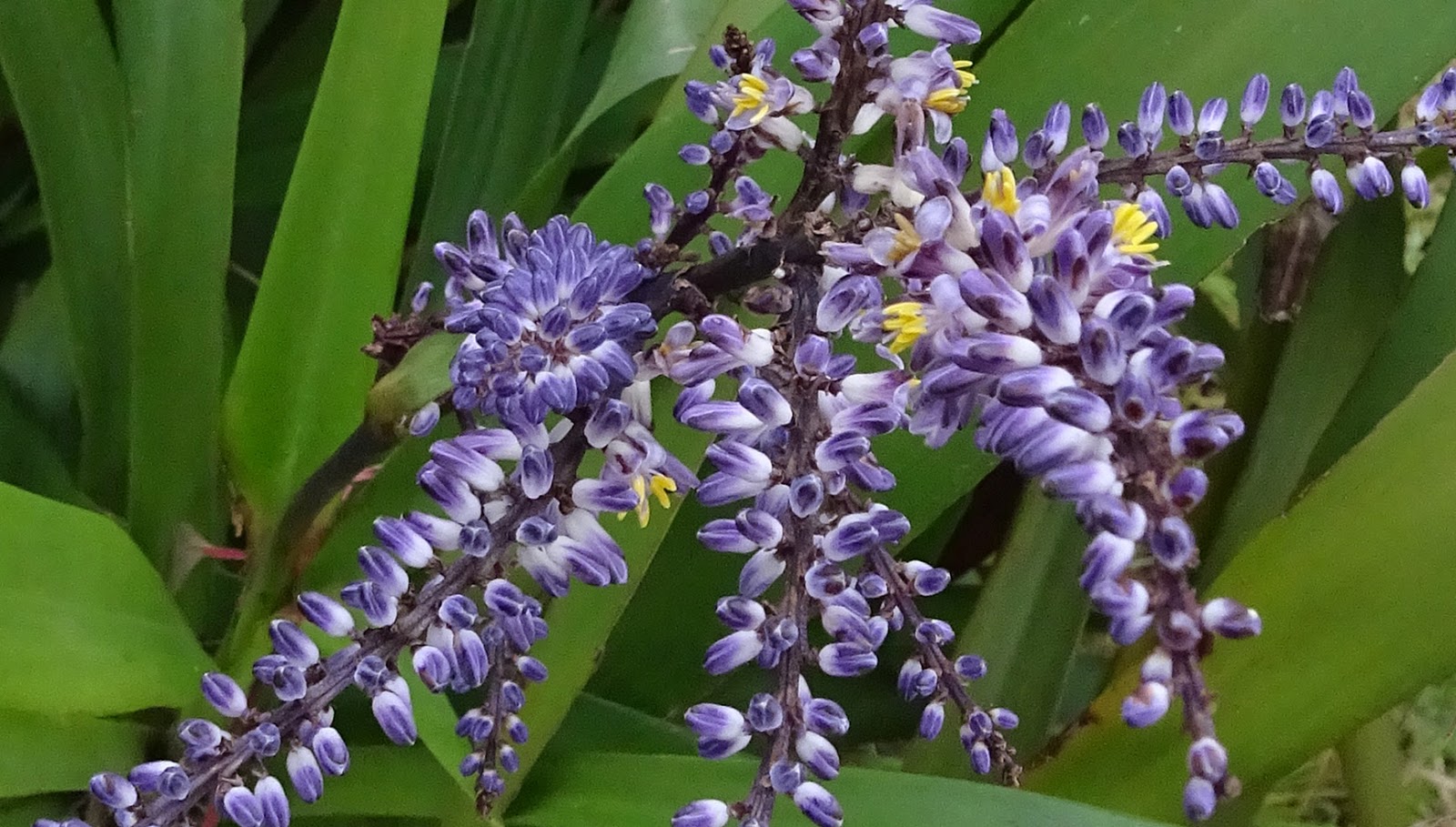
Cordyline is a genus of about 15 species of woody monocotyledonous flowering plants in family Asparagaceae, subfamily Lomandroideae. The subfamily has previously been treated as a separate family Laxmanniaceae, or Lomandraceae. Other authors have placed the genus in the Agavaceae (now Agavoideae). Cordyline is native to the western Pacific Ocean region, from New Zealand, eastern Australia, southeastern Asia and Polynesia, with one species found in western South America. The name Cordyline comes from the Greek word kordyle, meaning "club," a reference to the enlarged underground stems or rhizomes.
This post is part of the Floral Friday Fotos meme.
Doryanthes excelsa, in the Asparagaceae family, known as Gymea Lily, is a flowering plant indigenous to the coastal areas of New South Wales near Sydney.The plant has sword-like leaves more than a meter long. It flowers in spring and summer, sending up a flower spike up to 6 m high, which at its apex bears a large cluster of bright red flowers, each 10 cm across.The name "Gymea Lily" is derived from a local Eora dialect. Doryanthes means spear-flower in Greek, and excelsa is Latin for exceptional. The Sydney suburbs of Gymea and Gymea Bay are named after the lily.
The genus Doryanthes was first described in 1802 by the Portuguese priest, statesman, philosopher and botanist José Francisco Correia de Serra (1750–1823), a close friend of Sir Joseph Banks. Doryanthes excelsa has also inspired the naming of Doryanthes, the journal of history and heritage for Southern Sydney founded by Dharawal historian Les Bursill.
Honey-eaters love the nectar of these large, crimson flowers on stems 2–3 m tall. Aboriginal people in the Lake Macquarie district of NSW were observed in 1836 roasting the stems, having cut them when half a meter high and as thick as a person's arm. They also roasted the roots which they made into a sort of cake to be eaten cold.
This post is part of the Our Beautiful World meme,
and also part of the My Sunday Photo meme,
and also part of the Photo Sunday meme,
and also part of the Floral Friday Fotos meme.
Lachenalia aloides (opal flower) is a species of flowering plant in the family Asparagaceae, native to the Western Cape of South Africa. It is a bulbous perennial growing to 15–28 cm tall by 5 cm broad, with strap-shaped spotted leaves and fleshy stems bearing pendent tubular yellow flowers, red at the tips, in winter and spring.
The Latin aloides means "aloe-like"; though L. aloides, despite its similarity, does not belong to the same family of plants as aloes. Numerous cultivars have been bred for garden use. They require a sheltered, frost-free position or under glass. Some cultivars have gained the Royal Horticultural Society's Award of Garden Merit.
This post is part of the Floral Friday Fotos meme.
Liriope muscari is a species of low, herbaceous flowering plants from East Asia, in the Asparagaceae family. Common names in English include big blue lilyturf, lilyturf, border grass, and monkey grass. It is a perennial with grass-like evergreen foliage and lilac-purple flowers which produce single-seeded berries on a spike in Autumn.
It is an understory plant in China, Japan, and Korea occurring in shady forests at elevations of 100–1,400 m. It is a tufted, grass-like perennial which typically grows 30–45 cm tall and features clumps of strap-like, arching, glossy, dark green leaves to 1.5 cm. Clumps slowly expand by short stolons to a width of about 30 cm, but plants do not spread aggressively. Roots are fibrous, often with terminal tubers.
The small, showy flowers occur on erect spikes with tiered whorls of dense, white to violet-purple flowers rising above the leaves in late summer. Flowers resemble those of grape hyacinth (Muscari), which is the origin of the species name. Flowers develop into blackish berries which often persist into winter. There is considerable variation in leaf colour and size among a number of recognised cultivars. Distinguishing species in the genus Liriope is difficult at best, and mistaken identity occurs even in commercial nurseries.
Being an easy plant to grow, it is one of the most popular ground covers in temperate to subtropical climate, and is commonly used in landscaping as border plants and ground cover. L. muscari has gained the Royal Horticultural Society's Award of Garden Merit.
The species is easily grown in average, medium, well-drained soils in full sun to part shade. Ideal conditions are moist, fertile soils with partial shade. However, lilyturf tolerates a wide range of light and soil conditions. Lilyturf is also tolerant of heat, humidity, and drought. The evergreen foliage often turns brown in late winter; old foliage can be cut back or mowed at a high setting before new shoots appear early spring. Lilyturf is suitable for USDA Hardiness Zones 6 to 10. It might be grown in zone 5 in sheltered locations or if protected during severe winter weather.
This post is part of the Floral Friday Fotos meme,
and also part of the Friday Greens meme.
Hyacinthoides hispanica (syn. Endymion hispanicus or Scilla hispanica), the Spanish bluebell, is a spring-flowering bulbous perennial native to the Iberian Peninsula. It is one of around 11 species in the genus Hyacinthoides, others including the common bluebell (Hyacinthoides non-scripta) in northwestern Europe, and the Italian bluebell (Hyacinthoides italica) further east in the Mediterranean region. It is distinguished from the common bluebell by its paler, larger blue flowers, more erect flower stem (raceme), broader leaves, blue anthers (where the common bluebell has creamy-white ones) and little or no scent compared to the strong fragrant scent of the northern species. The Spanish bluebell is also cultivated as a garden plant, and several named cultivars exist with flowers in various shades of white, pink and blue.
This post is part of the Floral Friday Fotos meme,
and also part of the Friday Greens meme.
Lachenalia aloides (opal flower; Cape cowslip) is a species of flowering plant in the family Asparagaceae, native to the Western Cape of South Africa. It is a bulbous perennial growing to 15–28 cm tall by 5 cm broad, with strap-shaped spotted leaves and fleshy stems bearing pendent tubular yellow flowers, red at the tips, in winter and spring.
The Latin aloides literally means "aloe-like"; though L. aloides, despite its similarity, does not belong to the same family of plants as aloes. Numerous cultivars have been bred for garden use. They require a sheltered, frost-free position or under glass. Some cultivars have gained the Royal Horticultural Society's Award of Garden Merit.
This post is part of the Floral Friday Fotos meme.
Ornithogalum is a genus of perennial plants mostly native to southern Europe and southern Africa belonging to the family Asparagaceae. There are some species native to other areas such as the Caucasus. Growing from a bulb, species have linear basal leaves and a slender stalk, up to 30 cm or more tall, bearing clusters of typically white star-shaped flowers, often striped with green. The common name of the genus, Star-of-Bethlehem, is based on its star-shaped flowers, after the Star of Bethlehem that appeared in the Biblical account of the birth of Jesus.
The cultivar illustrated here is Ornithogalum thyrsoides 'Chesapeake Snowflake'. It is derived from a Southern African species and is a large, robust and showy flower. It makes an excellent cut flower with a vase life of up to two weeks.
This post is part of the Floral Friday Fotos meme.
Eucomis is a genus of flowering plants in the family Asparagaceae, subfamily Scilloideae. Most species of this genus are commonly referred to as pineapple flowers or pineapple lilies. They are bulbous perennials with basal rosettes of leaves with stout stems covered in star-shaped flowers, similar to those of the pineapple - hence the common names.
The name Eucomis is of Greek origin, eu- meaning "pleasing" and kome "hair of the head", thus referring to the tuft of leaf-like bracts that crown the inflorescence of the species in this genus. There are ten species native to South Africa, Botswana, Lesotho, Swaziland, Zimbabwe and Malawi. Eucomis can be found in grassland, forest, swamps and on river banks, but are absent from the drier regions.
This post is part of the Floral Friday Fotos meme.