Wednesday, 18 April 2012

ALONNISOS ISLAND, GREECE

Alonnisos (Greek: Αλόννησος) is a Greek island in the Aegean Sea. After Skiathos and Skopelos it is the third member of the Northern Sporades. It is 3 km E of the island of Skopelos. Alonnisos is also the name of a village on the island, as well as the municipality that encompasses the island and the village. The village of Alonnisos is located on the southern part of the island. It is locally known as Chora. The main port of the island is located in the southeast and is called Patitiri. There is ferry and hydrofoil service from Patitiri to Volos, Agios Konstantinos, and Thessaloniki on the mainland and to the islands of Skiathos, Skopelos and Skyros.

Agriculture is widespread on Alonnisos, predominantly mixed farming and vineyards. The main products are almonds, grapes, figs and olives. Spruce trees are abundant on the island. While fishing is a popular profession on the island, tourism is now the main industry. The island and the village were heavily damaged in the 1965 earthquake. Many inhabitants returned not to the village of Alonnisos, but to Patitiri. The old village has been restored in recent years, with rebuilt houses now utilised for tourism. The beaches around the island consist of pebbles. The ecosystem in the north side of the island is in good condition. The Mediterranean Monk Seal (Monachus monachus) is common around the island, and in 1992 the Alonnisos Marine Park was created to protect these seals and other animals.

This post is part of the Watery Wednesday meme,
and also of the Water World Wednesday meme,
and also of the Nature Footsteps Waters meme,
and also of the Outdoor Wednesday meme.
The ferry in the distance is arriving from Agios Konstantinos on the mainland. The boats in the foreground are still used extensively by the local fishermen

A lovely pebbly beach with crystal clear waters 
The gorgeous blue colour of the Aegean Sea
The local pottery is used to great advantage as planters
A steep, stepped street, along which one doesn't hear much traffic noise!
Lovely views of the sea can be had from most parts of the island
A lovely cluster of houses n a hillside. Housing traditionally consists of closely constructed houses with stone walls, which, until 1965, were centered around the capital. A small fortress protected against enemies and pirates
As the island is quite hilly, the steps take you from neighbourhood to neighbourhood
Every house has many flowers and fruit trees in its yard
The crystal clear water allows view of the pebbly bottom of the sea where one may see a lone sea urchin

Tuesday, 17 April 2012

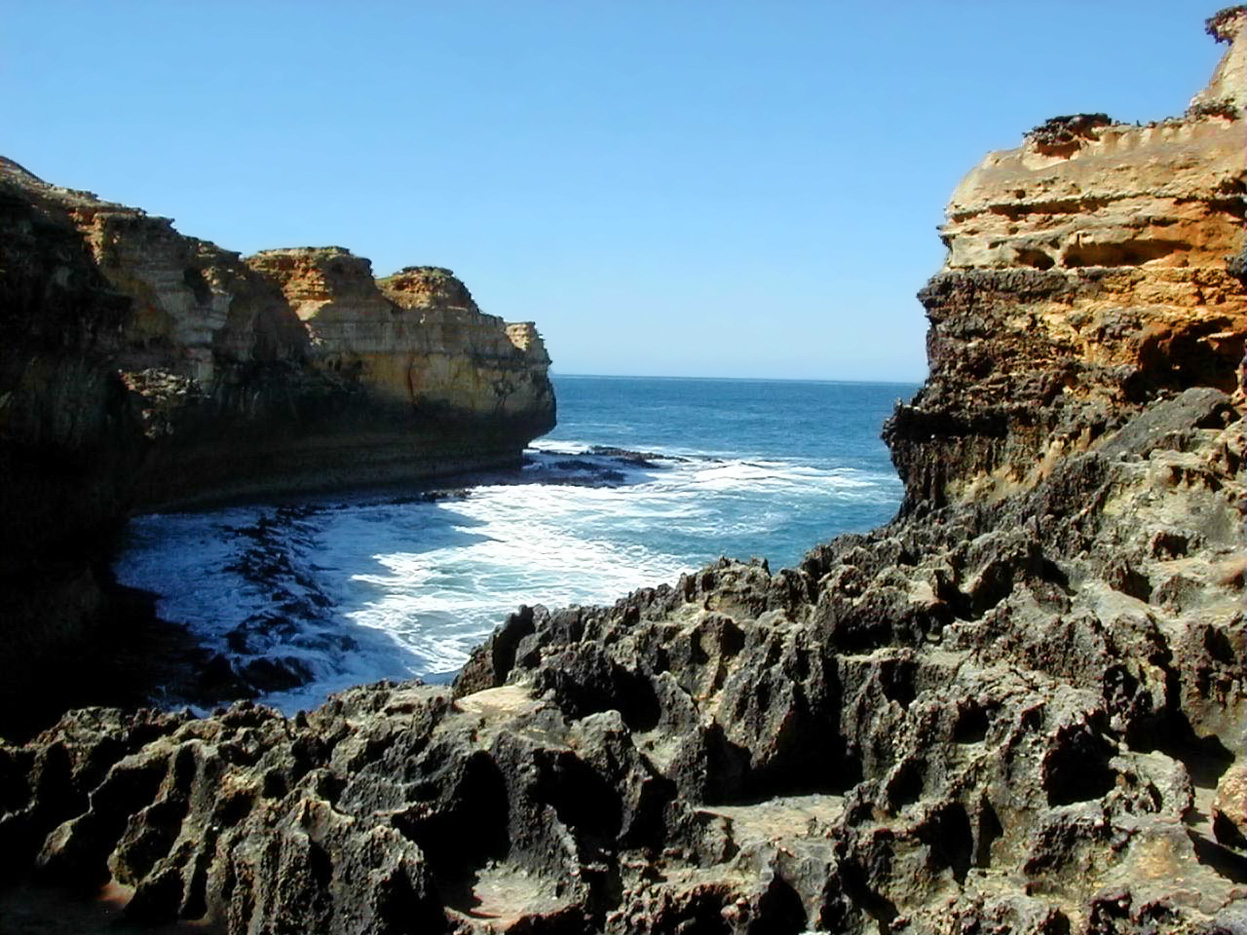
12 APOSTLES, VICTORIA, AUSTRALIA

The Great Ocean Road is an Australian National Heritage listed 243-kilometre stretch of road along the south-eastern coast of Australia between the Victorian cities of Torquay and Warrnambool. The road was built by returned soldiers between 1919 and 1932, and is the world's largest war memorial; dedicated to casualties of World War I. It is an important tourist attraction in the region, which winds through varying terrain alongside the coast, and provides access to several prominent landmarks; including the nationally significant Twelve Apostles rock formations.

The Twelve Apostles is a collection of miocene limestone rock stacks jutting from the water in Port Campbell National Park, between Princetown and Peterborough on the Great Ocean Road. The apostles were formed by erosion: The harsh weather conditions from the Southern Ocean gradually eroded the soft limestone to form caves in the cliffs, which then became arches, which in turn collapsed; leaving rock stacks up to 45 metres high. The site was known as the Sow and Piglets until 1922 (Muttonbird Island, near Loch Ard Gorge, was the Sow, and the smaller rock stacks the Piglets); after which it was renamed to The Apostles for tourism purposes. The formation eventually became known as the Twelve Apostles, despite only ever having nine stacks.

This post is part of the Our World Tuesday meme.


Monday, 16 April 2012

TEKKA CENTRE, SINGAPORE

The Tekka Centre in Singapore's Little India Quarter, is a multi-use building complex comprising a wet market, food centre and shops, located in the northern corner of Bukit Timah Road and Serangoon Road, Singapore. The original market was built in 1915, and was located across the street between Hastings Road and Sungei Road. When it was torn down in 1982 and relocated at its present site, the new multi-use complex was named Zhujiao Centre, the pinyin version of Tek Kia.

Today, Tekka Center remains a landmark in Little India, where different ethnic communities congregate. There are Chinese stallholders who speak Tamil, and vice versa. Shops sell traditional Indian costumes and inexpensive casual clothes. Some of the more notable shops include those selling Taoist and Buddhist paraphernalia, hardware shops, and tailors who can alter clothes in minutes. On the ground floor is a hawker centre with stalls which sell Indian vegetarian meals, served on banana leaves or on stainless steel platters, besides Chinese vegetarian, North Indian and Malay food.

At the wet market which is on the same level, stalls sell fresh seafood, especially crabs from Sri Lanka, and vegetables. There are also many Chinese stalls selling vegetables that are specially flown in from India. In terms of accessibility, the centre is served by the adjacent Little India MRT Station.

This post is part of the Mellow Yellow Monday meme.


Sunday, 15 April 2012

GREEK EASTER IN SHEPPARTON

Many Orthodox Christians in Australia celebrate Easter (Pascha) according to the Easter date in the Julian calendar, usually later than the Western Church Easter, which is calculated according to the Gregorian calendar. Easter is the most important event in the Orthodox church calendar. The Easter Sunday church liturgies are joyous as they celebrate Jesus Christ’s resurrection, according to Christian belief, as well as commemorating a spiritual victory.

Many Orthodox Christians in Australia fast during Lent prior to Easter. Easter Sunday is a time for families and friends to get together for a festive meal, where meat and dairy products can be eaten again. Lamb and tsourekia (or tsoureki), which is a type of Easter bread, are popular Easter dishes in many Greek Orthodox communities in Australia. Many people leave the city and go in the countryside to celebrate Easter and spit roast the lamb over an open bed of charcoal.

Here are some of early (2000) digital photos from my archive, showing some shots of the Easter we celebrated in Shepparton, Victoria, a city located on the floodplain of the Goulburn River in the north east of Victoria, Australia, approximately 181 kilometres north-east of Melbourne. It is the fifth largest city in Victoria with an estimated population of 48,926. It began as a sheep station and river crossing before undergoing a major transformation as a railway town. Today it is an agricultural and manufacturing centre and the centre of the Goulburn Valley irrigation system, one of the largest centres of irrigation in Australia. It is a major regional service city and is the civic administration centre for the City of Greater Shepparton.

There are quite few Greeks there and the parish church of St George, although small had a wonderful resurrection liturgy on the midnight of Easter Saturday. On Easter Sunday it was wonderful to roast the lamb on the shores of the river.

This post is part of the Scenic Sunday meme,
and also of Psalm Sundayhosted by Louis and Robert.


The following hymn is sung at the resurrection in Orthodox churches at the midnight liturgy. 
Usually even non-religious Greeks will attend this glorious liturgy and just before midnight, will observe all the lights being put out in the church except for a lone holy flame burning in the holy of holies. From this ever-burning light the priest will light his Paschal candle and go out into the church and call out: “Come take the light!” The faithful light their own Paschal candles from this and soon the whole congregation that spills out into the surrounds of the church carry aloft their lit candles waiting for the priest to chant the resurrection message, while firecrackers and fireworks are let off:

Χριστός Ανέστη εκ νεκρών,
θανάτω θάνατον πατήσας
και τοις εν τοις μνήμασιν,
ζωήν χαρισάμενος
.

Christ is risen from dead,
On death treading victorious,
And to those in the grave
Giving the gift of life.


Saturday, 14 April 2012

PERTH MALL

One of the quirky statues in the Perth Mall.

This post is part of the Weekly Topshots meme hosted by Madge.


Friday, 13 April 2012

THE OUTBACK, AUSTRALIA

The Outback is the vast, remote, arid area of Australia; the term colloquially can refer to any lands outside the main urban areas. The term "the outback" is generally used to refer to locations that are comparatively more remote than those areas named "the bush".

Owing to the low and erratic rainfall over most of the outback, combined with soils which are usually not very fertile, inland Australia is relatively sparsely settled. More than 90 percent of Australians live in urban areas on the coast. However the outback and the history of its exploration and settlement provides Australians with a culturally valued backdrop, and stories of swagmen, squatters, and bushrangers are central to the national ethos. The song Waltzing Matilda, which is about a swagman and squatters, is probably Australia's best internationally known and most well-loved song (see below).

Aboriginal communities in outback regions have not been displaced as they have been in areas of intensive agriculture and large cities, in coastal areas. For this reason a significant proportion of Australia's indigenous population lives in the Outback, in areas such as the Anangu Pitjantjatjara Yankunytjatjara lands in northern South Australia.  The total population of Outback Australia declined from 700,000 in 1996 to 690,000 in 2006. The photo below was taken in the Woomera of South Australia, as we were driving from Adelaide to Darwin (distance of 3,030 km), which we did in 2002.


This is a post linking to Sylvia's Skywatch Friday meme.


Thursday, 12 April 2012

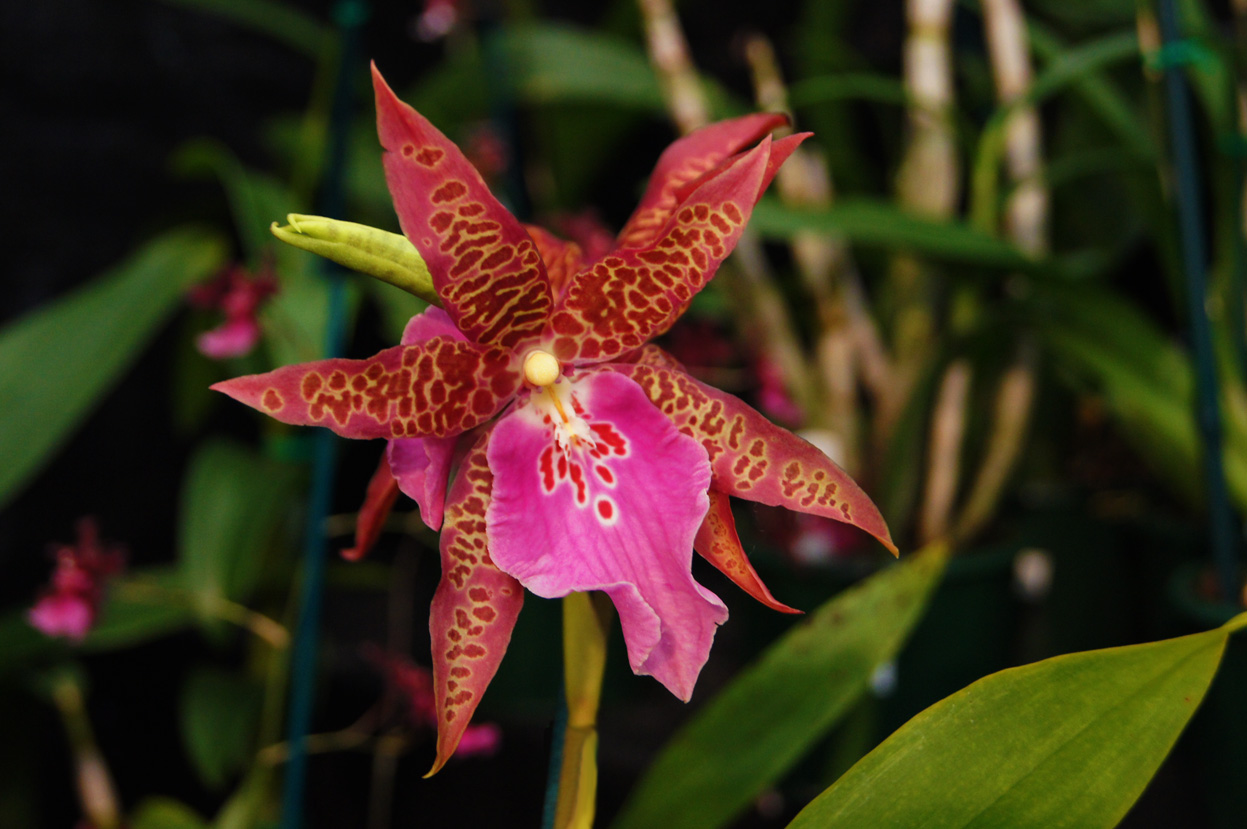
BEALLARA ORCHID

× Beallara, abbreviated Bllra. in the horticultural trade, is the nothogenus for intergeneric hybrids between the orchid genera Brassia, Cochlioda, Miltonia and Odontoglossum (Brs. x Cda. x Milt. x Odm.). This plant has a branched stem that grows to about 150 centimetres in height. The leaves are elongated and lanceolate, reaching about 60 centimetres of length. The flowers are numerous, about 14 to 16, and last long, between 20 to 30 days. It has fleshy large pseudobulbs. These orchids are commonly cultivated in greenhouses for ornamental purposes, resulting in a huge variety of cultivars of different colours.

The cultivar illustrated here is Beallara Purple Passion.

This post is part of the Floral Friday Fotos meme.

Wednesday, 11 April 2012

KATHERINE GORGE, NORTHERN TERRITORY, AUSTRALIA

Nitmiluk National Park is in the Northern Territory of Australia, 244 km southeast of Darwin, around a series of gorges on the Katherine River and Edith Falls. Previously named Katherine Gorge National Park, its northern edge borders Kakadu National Park. The gorges and the surrounding landscape have great ceremonial significance to the local Jawoyn people, who are custodians of Nitmiluk National Park. In Jawoyn, Nitmiluk means "place of the cicada dreaming".

Katherine Gorge, a deep gorge carved through ancient sandstone by the Katherine River, is the central attraction of the park. Katherine Gorge is made up of thirteen gorges, with rapids and falls, and follow the Katherine River, which begins in Kakadu. During the Dry Season, roughly from April to October, the Katherine Gorge waters are placid in most spots and ideal for swimming and canoeing. There may be freshwater crocodiles in most parts of the river, as they nest along the banks, but they are harmless to humans. Saltwater crocodiles regularly enter the river during the wet season, when the water levels are very high, and are subsequently removed and returned to the lower levels at the onset of the dry season. Thus, swimming in the Wet Season is prohibited, as crocodiles don't respond to swimmers' questioning them if they are fresh or saltwater ones. Cruises of various lengths go as far as the fifth gorge.

This post is part of the Water World Wednesday meme,
and also of the Nature Footsteps Waters meme,
and also fo the Outdoor Wednesday meme.
Katherine Gorge
I think you'll agree Katherine Gorge is "gorge-ous" :-)
One of the flat bottomed cruise boats on the Katherine River


Freshwater Crocodiles are widely distributed along the river year-round. During the Wet Season, rises in water levels may allow Saltwater Crocodiles to enter the gorge, where they are caught and relocated to lower levels when the dry season begins. Birds that can be seen include Ospreys, Red-tailed Black Cockatoos, Great Bowerbirds, White-gaped Honeyeaters and Red-winged Parrots. Part of the Yinberrie Hills Important Bird Area, identified as such by BirdLife International because of its importance for endangered Gouldian Finches, lies in the park

We visited in March 2002 during the Dry Season and this is a freshwater crocodile


The town of Katherine, located in Northern Territory, Australia. It is situated 320 kilometres southeast of Darwin in the "Top End" of Australia. It is the fourth largest settlement in the Territory after the capital Darwin, Palmerston and Alice Springs. Katherine had an urban population of 5,849 on the 2006 Census night. Set in promising grazing and future agricultural country, the town's main economic source has often been gold, but this has lessened after the closing of the mine at Mount Todd. There is increasing tourism and the RAAF Base Tindal 17 km southeast of town is also contributing to the economy. The town has several churches, sporting clubs, parks, a well-kept golf course, and a showground
Katherine main street
Heading towards Adelaide River, one encounters this local Pub, the Adelaide River Inn. The Inn welcomes locals, visitors and travellers alike. The Inn, The Pub or "303 Bar" as it has synonymously become known, forms a large part of the Adelaide River Resort Complex. Situated directly behind the BP Service Station the Inn is surrounded by lush tropical gardens, shady trees and well manicured lawns. It is centrally located to many tourist attractions in and around Adelaide River Township and its surrounds
The 303 Bar is your typical Local Country Pub and is brimming with character and history.  On offer is decent range of the coldest tap and bottled beers around, some boutique beers, wines and spirits for your choosing. Although there is no cocktail list there are some cocktail and shooters available upon request (provided you ask nicely). At the bar you will find locals enjoying a quiet drink, memorabilia of every kind and on the walls you will find pictures and reminders of days gone by which forms part of Adelaide Rivers so very rich history
One local residing at the Bar who is not so talkative is "Charlie" the Buffalo. Charlie, made famous by Mick Dundee (Paul Hogan) whilst being hypnotised to the ground on the movie Crocodile Dundee passed away in 2000 and now stands proudly on the bar