Friday, 29 December 2017

SUMMER SERENITY

At the Edward Hunter Heritage Bush Reserve in Moe, Victoria. Perfect weather on a Summery Christmas day, Downunder!

This post is part of the Skywatch Friday meme,
and also part of the Friday Photo Journal meme.

Thursday, 28 December 2017

RAFFLESIA

Rafflesia arnoldii is a species of flowering plant in the parasitic genus Rafflesia. It is noted for producing the largest individual flower on earth. It has a very strong and horrible odour of decaying flesh, earning it the nickname "carrion flower". It is endemic to the rainforests of Sumatra and possibly Borneo.

Although there are some plants with larger flowering organs like the titan arum (Amorphophallus titanum) and talipot palm (Corypha umbraculifera), those are technically clusters of many flowers. Rafflesia arnoldii (Indonesian: Padma raksasa), also called Kerubut (Devil's Betelnut Box) is one of the three national flowers in Indonesia, the other two being the white jasmine and moon orchid. It was officially recognised as a national "rare flower" (Indonesian: Puspa langka) in Presidential Decree No. 4 in 1993.

The flower of Rafflesia arnoldii grows to a diameter of around one meter and weighs up to 11 kilograms. These flowers emerge from very large, cabbage-like, maroon or magenta buds typically about 30 cm wide, but the largest (and the largest flower bud ever recorded) found at Mount Sago, Sumatra in May 1956 was 43 cm.  It lives as a parasite on several vines of the genus Tetrastigma, which grow only in primary (undisturbed) rainforests.

Rafflesia lacks any observable leaves, stems or even roots, yet is still considered a vascular plant. Similar to fungi, individuals grow as thread-like strands of tissue completely embedded within and in intimate contact with surrounding host cells from which nutrients and water are obtained. This plant produces no leaves, stems or roots and does not have chlorophyll. It can only be seen outside the host plant when it is ready to reproduce. Perhaps the only part of Rafflesia that is identifiable as distinctly plant-like are the flowers, though even these are unusual since they attain massive proportions, have a reddish-brown coloration, and stink of rotting flesh. This scent attracts insects such as flies which then pollinate the rare plant.

This post is part of the Floral Friday Fotos meme.


Wednesday, 27 December 2017

'Y' IS FOR YOLK

yolk | jəʊk |noun The yellow internal part of a bird's egg, which is surrounded by the white, and which is rich in protein and fat, and nourishes the developing embryo.[mass noun] Zoology - The part corresponding to the yolk in the ovum or larva of all egg-laying vertebrates and many invertebrates. Old English geol(o)ca, from geolu ‘yellow’.This post is part of the Wordless Wednesday meme,and also part fo the ABC Wednesday meme.

Tuesday, 26 December 2017

DONEGAL CASTLE

Donegal Castle (Irish: Caisleán Dhún na nGall) is a castle situated in the centre of Donegal Town in County Donegal in Ulster, Ireland. For most of the last two centuries, the majority of the buildings lay in ruins but the castle was almost fully restored in the early 1990s. The castle consists of a 15th-century rectangular keep (right) with a later Jacobean style wing (left).

The complex is sited on a bend in the River Eske, near the mouth of Donegal Bay, and is surrounded by a 17th-century boundary wall. There is a small gatehouse at its entrance mirroring the design of the keep. Most of the stonework was constructed from locally sourced limestone with some sandstone. The castle was the stronghold of the O'Donnell clan, Lords of Tír Conaill and one of the most powerful Gaelic families in Ireland from the 5th to the 16th centuries.

This post is part of the Our World Tuesday meme,
and also part of the Travel Tuesday meme,
and also part of the Wordless Wednesday meme.

Sunday, 24 December 2017

MY SUNDAY BEST MEME #46 - MERRY CHRISTMAS

Welcome to the meme, "My Sunday Best", which is a photographic and creative meme that allows you to showcase your talents in imaging. Every Sunday, you can post here showing an image you have created using your camera, (and/or) image processing software, and/or painting and drawing in the conventional way and have scanned in.

The rules are simple:
1) Create your image and post it up on your blog;
2) Put the "My Sunday Best" logo image link somewhere on your post so people can click and come by here;
3) Leave a comment here once you have posted;
4) Visit other posters' blogs and be amazed with their creativity!

Please do not use this meme to advertise your goods or services. This is a creative meme and any inappropriate links or comments shall be removed immediately!
This post is part of the My Sunday Photo meme.

MERRY CHRISTMAS TO YOU AND YOUR FAMILY!

Saturday, 23 December 2017

BLACK & WHITE BIRDS

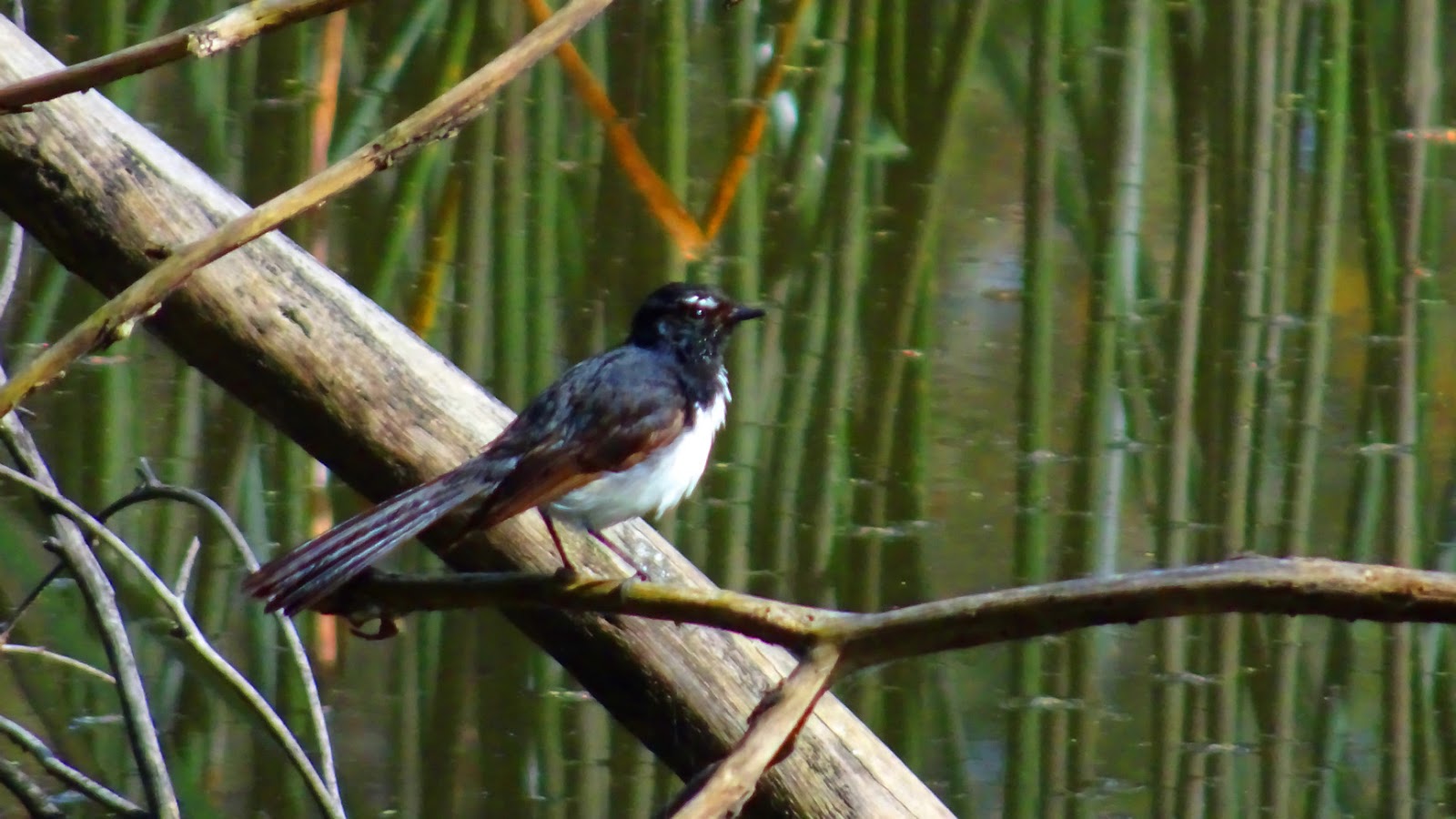
These birds are all common in the Darebin Parklands in suburban Melbourne. It was only as I was looking at the photos that I realised they were all dressed in fashionable black and white...

This post is part of the Saturday Critters meme,
and also part of the Camera Critters meme,
and also part of the I'd Rather Be Birdin' meme.
The pied currawong (Strepera graculina) is a medium-sized black passerine bird native to eastern Australia and Lord Howe Island. One of three currawong species in the genus Strepera, it is closely related to the butcherbirds and Australian magpie of the family Artamidae. Six subspecies are recognised. 

The willie (or willy) wagtail (Rhipidura leucophrys) is a passerine bird native to Australia, New Guinea, the Solomon Islands, the Bismarck Archipelago, and Eastern Indonesia. It is a common and familiar bird throughout much of its range, living in most habitats apart from thick forest.

The Australian white ibis (Threskiornis moluccus) is a wading bird of the ibis family, Threskiornithidae. It is widespread across much of Australia

The Eurasian Coot (Fulica atra family Rallidae), with its sooty-black plumage and gleaming white bill and frontal shield covering its forehead, is a familiar bird across Europe and Asia as well as Australia. It is often seen running across the water’s surface or swimming in huge flocks on large wetlands, but they equally often occur on small ponds. They require submerged aquatic vegetation or mats of floating waterweed, among which they forage, diving below the surface for up to 20 seconds, or plucking the stems of emergent shoots.

The magpie-lark (Grallina cyanoleuca) is a conspicuous Australian bird of small to medium size, also known as the mudlark in Victoria and Western Australia, the Murray magpie in South Australia, and as the peewee in New South Wales and Queensland

The Australian magpie (Cracticus tibicen) is a medium-sized black and white passerine bird native to Australia and southern New Guinea

On the right is the the little pied cormorant, little shag or kawaupaka (Microcarbo melanoleucos) is a common Australasian waterbird, found around the coasts, islands, estuaries, and inland waters of Australia, New Guinea, New Zealand, Malaysia, and Indonesia. On the left is a noisy miner (Manorina melanocephala), which is a bird in the honeyeater family, Meliphagidae, and is endemic to eastern and south-eastern Australia
The Grey Butcherbird (Cracticus torquatus) is a widely distributed species endemic to Australia. The grey butcherbird occurs in a range of different habitats including arid, semi-arid and temperate zones. The grey butcherbird is found across southern Australia, but is absent from the deserts of central Australia and the monsoon tropics of northern Australia.

Friday, 22 December 2017

MIDSUMMER SKY

A beautiful warm, sunny and fine day for the Summer Solstice. And so the year begins its decline as we mark the longest day and shortest night...

This post is part of the Skywatch Friday meme,
and also part of the Friday Photo Journal meme,
and also part of the Weekend Green meme.

Thursday, 21 December 2017

PHILADELPHUS

Philadelphus, (the mock-orange) is a genus of about 60 species of shrubs from 1 to 6 m tall, native to North America, Central America, Asia and (locally) in southeast Europe. They are named "mock-orange" in reference to their flowers, which in wild species look somewhat similar to those of oranges and lemons (Citrus) at first glance, and smell of orange flowers and jasmine (Jasminum).

Philadelphus is named after an ancient Greek king of Egypt, Ptolemy II Philadelphus and the name literally means ‘loving one's brother’ (hence Philadelphia, 'City of brotherly love'). Most Philadelphus are deciduous but a few species from the south of the genus' range are evergreen. The leaves are opposite, simple, with serrated margins, from 1 to 14 cm long. The flowers are white, with four petals and sepals, 1–4 cm diameter, and commonly (but not in all species) sweetly scented. The fruit is a small capsule, containing numerous small seeds. The bark is thin and flaky, finely shredding in longitudinal strips.

For a long time, Philadelphus coronarius was the only mock-orange of gardens, though some adventurous Americans grew the native P. inodorus that Mark Catesby had discovered growing on the banks of the Savannah River; it appeared in Lady Skipwith's garden lists and George Washington ordered some from Bartram in 1792. Mock-oranges are popular shrubs in parks and gardens, grown for their reliable display of late spring flowers; the scented species are particularly valued. In addition to the species, there are numerous garden origin hybrids and cultivars available, selected for doubleness and large flowers, with some compromise as to scent.

This blossom seemed apt today as in Melbourne we have had an incident where a car driven by a mentally disturbed drug addict ploughed into a crowd of people in a busy central thoroughfare in the City and injured seriously 19 people. This floral offering in sympathy for all affected and in thanks to our emergency services and personnel who responded in a timely and effective fashion.

This post is part of the Floral Friday Fotos meme.


Wednesday, 20 December 2017

'X' IS FOR XEROPHYTE

xerophyte | ˈzɪərə(ʊ)fʌɪt, ˈzɛrə(ʊ)fʌɪt | noun Botany: A plant which needs very little water to grow.
DERIVATIVES xerophytic | ˌzɪərə(ʊ)ˈfɪtɪk | adjective

This post is part of the Outdoor Wednesday meme,
and also part of the Wordless Wednesday meme,
and also part of the ABC Wednesday meme.