Showing posts with label Rubiaceae. Show all posts

Thursday, 8 February 2018

PENTAS

Pentas is a genus of flowering plants in the Rubiaceae family. The genus is found in tropical and southern Africa, the Comoros, Madagascar, and the Arabian Peninsula. The plants have hairy green leaves and clusters of flowers in shades of red, white, pink, and purple. Pentas are attractive to butterflies and hummingbirds. Some species are commonly cultivated and can be grown in pots and baskets. Species such as Pentas lanceolata can withstand full sunlight and need little to no care, growing even in locations that are dry and hot.

Growing into a shrub anywhere from about 50-80cm tall, pentas have dark green, pleated leaves, and bear numerous heads containing dozens of small, star-shaped flowers. The nectar-rich flowers are very attractive to bees and butterflies, so you will have the added bonus of enjoying watching these visitors to your garden. The flowers are also good for cutting, lasting a week or more in a vase. Pentas flower almost year round, and thrive in full sun or part shade. A thoroughly neglected pentas may look a bit shabby but it will come back beautifully after a hard prune.

The hybrid called Starcluster has huge flowers on tall, sturdy stems. They are fabulous in pots or in garden beds, and are available in red, lavender, white and rose. They are well branched and compact in habit, and have been bred to perform well in hot summer conditions.

This post is part of the Floral Friday Fotos meme.


Friday, 4 November 2016

MIRROR BUSH - TAUPATA

Coprosma repens is a species of flowering shrub or small tree of the genus Coprosma, in the family Rubiaceae, native to New Zealand. Common names include tree bedstraw, taupata, mirror bush, looking-glass bush, New Zealand laurel and shiny leaf.

The habit of this species varies markedly with its situation. In exposed situations, such as cliffs, it assumes a prostrate habit, while in more sheltered areas it can grow as a small tree up to 8 metres in height. It has thick and very glossy leaves which vary considerably in size, depending on exposure to the elements. The leaf margins are recurved, occasionally to the extent that the leaf may be cylindrical in cross-section. The shiny leaves aids its survival near coastal locations. Flowers are produced in spring and summer, the male flowers appearing in dense, compound clusters, the female flowers in smaller clusters. Female plants produce orange-red ovoid drupes which are around 8 mm in diameter and 10 mm in length.

The species is native to the North Island, South Island, Kermadec Islands and Three Kings Islands in New Zealand. In Australia it has become naturalised in coastal areas of Victoria, New South Wales, South Australia and Tasmania, to the extent that it is now classified as an environmental weed. It is the bane of our garden as the neighbours have  a hedge and I am constantly uprooting seedlings from our garden beds...

This post is part of the Floral Friday Fotos meme,
and also part of the Friday Greens meme.
Glossy "mirror" leaves

Male flowers

Female flowers

Thursday, 24 December 2015

GARDENIA

Gardenia is a genus of flowering plants in the coffee family, Rubiaceae, native to the tropical and subtropical regions of Africa, southern Asia, Australasia and Oceania. The genus was named by Carl Linnaeus and John Ellis after Dr. Alexander Garden (1730-1791), a Scottish-born American naturalist.

They are evergreen shrubs and small trees growing to 1–15 metres tall. The leaves are opposite or in whorls of three or four, 5–50 centimetres long and 3–25 centimetres broad, dark green and glossy with a leathery texture. The flowers are solitary or in small clusters, white, or pale yellow, with a tubular-based corolla with 5-12 lobes (petals) from 5–12 centimetres diameter. Flowering is from about mid-spring to mid-summer, and many species are strongly scented.

Gardenia jasminoides, shown below, originated in Asia and is most commonly found growing wild in Vietnam, Southern China, Taiwan, Japan, Myanmar, and India. With its shiny green leaves and heavily fragrant white summer flowers, it is widely used in gardens in warm temperate and subtropical climates, and as a houseplant in temperate regions. It has been in cultivation in China for at least a thousand years, and was introduced to English gardens in the mid 18th century. Many varieties have been bred for horticulture, with low growing, and large-and long-flowering forms.

This post is part of the Floral Friday Fotos meme.

Thursday, 8 October 2015

MUSSAENDA

Mussaenda is a genus of flowering plants in the Rubiaceae family. They are native to the African and Asian tropics and subtropics. Several species are cultivated as ornamental plants. It contains some 194 species.

The cultivar seen here is Mussaenda philippica 'Queen Sirikit' and it is growing in the Singapore Botanical Gardens. Queen Sirikit is the Queen of Thailand. It was named to commemorate her first visit to the Philippines in the 1970's.

This Mussaenda is a tropical shrub or sub-shrub that will grow to 3 metres tall in tropical areas, but more likely will reach 1 metre tall in containers. Clusters (corymbs) of small, tubular flowers with five spreading lobes bloom in summer, however it is the large and colourful, ovate, leaf-like sepals (to 10 cm long) that provide the real ornamental display. Some individual flowers in each cluster will develop a single enlarged sepal. Elliptic to ovate, bright green leaves (to 20 cm long). Other hybrids typically feature flowers in red and/or yellow with showy sepals of white, bright red or pink.

This post is part of the Floral Friday Fotos meme.


Thursday, 13 November 2014

TREE GARDENIA

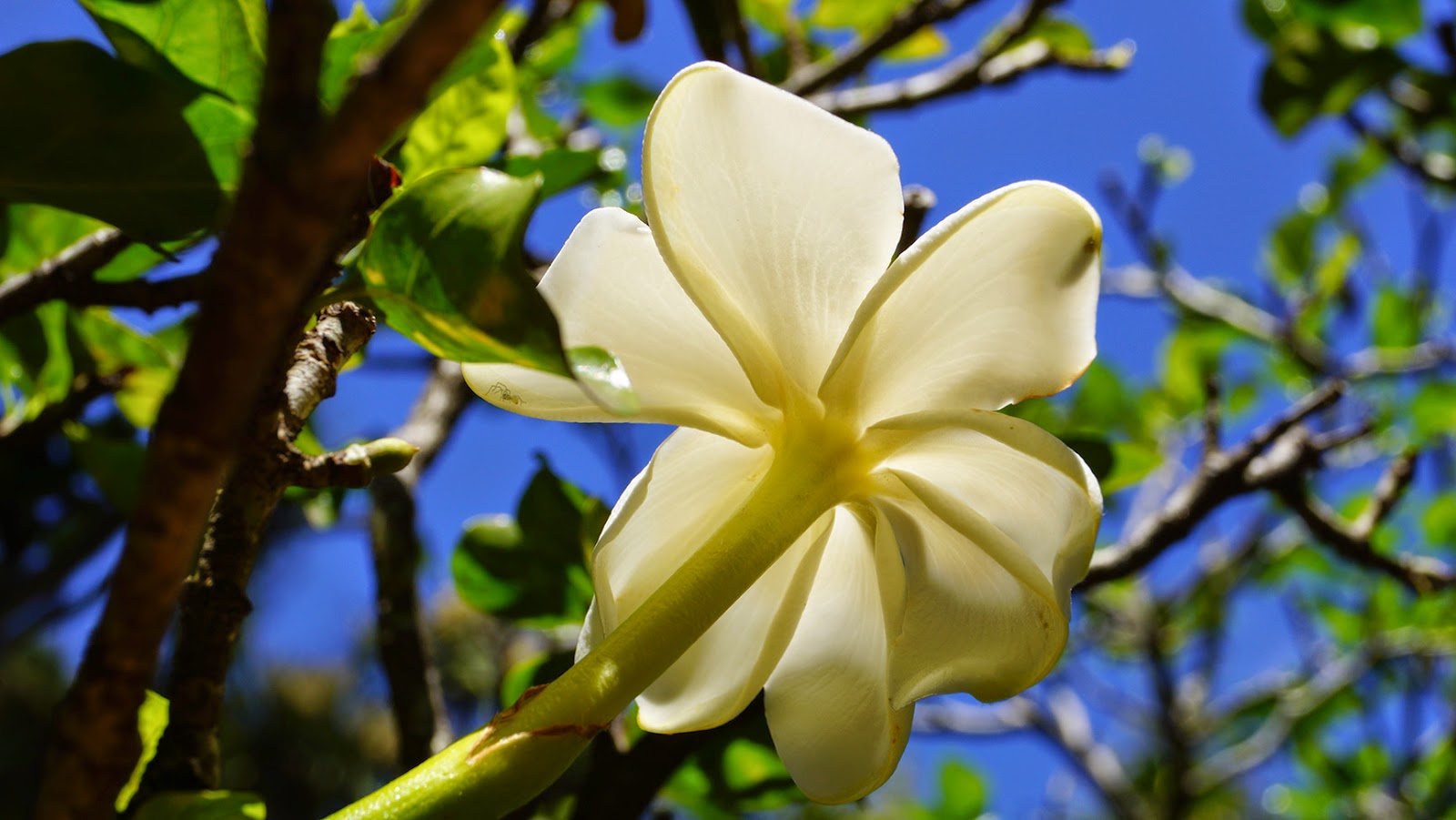
Gardenia thunbergia is a sturdy large shrub or small tree endemic to the Southern and Eastern regions of South Africa and neighbouring territories such as Swaziland. It grows largely in forest or on forest margins, occurring in the Eastern Cape, Natal and Transkei in South Africa.

It is densely twiggy and rigid with smooth light-grey bark, and is horticulturally valuable, being easy to grow as a strong hedge, but more usually as a specimen plant, striking in appearance and long-lived. The abundant and extremely fragrant flowers are about 70mm in diameter with long tubes only accessible to the proboscides of nocturnal hawkmoths.

The leaves are smooth, shiny, whorled and entire, and clustered at the ends of branchlets. The fruit is oval, hard, woody and fibrous, about 80mm long and about 40mm in diameter, light-grey with small raised white spots and if not eaten by large browsers or elephant, will remain on the tree for years.

Its common names include Forest Gardenia, Mutarara (in the Shona language), Tree Gardenia, White Gardenia and Wild Gardenia. In Afrikaans it is variously known as Buffelsbol ("buffalo ball), Stompdoring ("blunt thorn"), or Wildekatjiepiering ("wild gardenia").

This post is part of the Floral Friday Fotos meme.


Thursday, 10 April 2014

IXORA - 'PRINCE OF ORANGE'

Ixora is a genus of flowering plants in the Rubiaceae family. It consists of tropical evergreen trees and shrubs and holds around 500 species. Though native to the tropical and subtropical areas throughout the world, its centre of diversity is in Tropical Asia. Ixora also grows commonly in subtropical climates in the United States, such as Florida. It is commonly known as West Indian Jasmine. Other common names include: rangan, kheme, ponna, chann tanea, techi, pan, santan, jarum-jarum, Jungle flame, Jungle geranium, and many more.

The plants possess leathery leaves, ranging from 3 to 6 inches in length, and produce large clusters of tiny flowers in the summer. Members of Ixora prefer acidic soil, and are suitable choices for bonsai. It is also a popular choice for hedges in parts of South East Asia, like in Thailand. In tropical climates they flower year round.

The variety illustrated here is Ixora chinensis 'Prince of Orange'. It is an evergreen shrub with erect, densely packed branches and long pointed, yellow to green foliage and rounded heads of tubular, opening to star shaped, bright orange to scarlet flowers from spring to autumn. This is a beautiful plant, showy and elegant all in one. It is frost tender and likes humidity so can do well in a glasshouse. It should be grown in well-drained but moist, humus-rich soils with plenty of mulch. Scale insects can be a problem, but respond to treatment. Remove dead flowerheads, water well in hot conditions. The roots are used in Asian medicine to relieve some stomach problems.


This post is part of the Floral Friday Fotos meme.


Sunday, 28 July 2013

LUCULIA

Luculia gratissima has rose pink flowers with a strong perfume, which is often described as being between a gardenia and a vanilla fragrance. The generic name, Luculia, is the Latinised form of the Nepalese name, Luculi Swa. The specific name, gratissima, is Latin for 'most pleasing'. Luculias are evergreen shrubs with rounded, often irregular growth habits. In the wild they are said to reach 6m but in cultivation they are usually around the 3-4m mark. In winter scented, pink flowers appear on the ends of the stems, in large clusters up to 20cm across.

Luculias grow well in a semi-shaded position (or a spot with protection from hot afternoon summer sun). A free-draining coarse soil with added organic material is best. They like a cool root zone, so keep the plant mulched. Do not let the soil dry out. Luculias resent root disturbance and don't like to be transplanted. During prolonged periods of heavy rain, spraying the foliage with a phosphorus acid product may help prevent root rot. Shoots that have been damaged by frost can be cut back to a pair of healthy leaves or buds in late winter to early spring, when the chance of frost is past. A light prune to remove spent flowers at this time will also help to shape the plant and keep it bushy. Luculias benefit from the occasional application of a small amount of lime, except in areas which have alkaline soils.

This post is part of the Pink Saturday meme,
and also part of the I Heart Macros meme.


Friday, 31 May 2013

IXORA COCCINEA

Ixora coccinea (or jungle geranium, flame of the woods, and jungle flame) is a species of flowering plant in the Rubiaceae family. It is a common flowering shrub native to Southern India and Sri Lanka. It has become one of the most popular flowering shrubs in subtropical gardens and landscapes. Its name derives from an Indian deity.

I. coccinea is a dense, multi-branched evergreen shrub, commonly 1.2–2 m in height, but capable of reaching up to 3.6 m high. It has a rounded form, with a spread that may exceed its height. The glossy, leathery, oblong leaves are about 10 cm long, with entire margins, and are carried in opposite pairs or whorled on the stems. Small tubular, scarlet flowers in dense rounded clusters 5–13 cm across are produced almost all year long.

This post is part of the Floral Friday Fotos meme.