Saturday, 23 January 2016

SATURDAY SILHOUETTES #31

Welcome to the Saturday Silhouettes meme! This is a weekly meme that looks at SILHOUETTES in photography.

SILHOUETTE |ˌsɪlʊˈɛt| noun: The dark shape and outline of someone or something visible in restricted light against a brighter background.
ORIGIN - late 18th century: Named (although the reason remains uncertain) after Étienne de Silhouette (1709–67), French author and politician.
This post also a part of the Skywatch Friday meme.

Please add your silhouette shot below, using the Linky tool:

Friday, 22 January 2016

TROPICAL

Lush greenery in Singapore, dominated by the "bird's-nest fern". Bird's-nest fern is a common name applied to several related species of epiphytic ferns in the genus Asplenium. They grow in a tight, nest-like clump with a lingulate leaf rosette and are usually epiphytic, growing in trees. Bird's-nest Fern may also be seen growing on rocks and they will grow in the ground, too. This is Asplenium nidus, native to tropical southeastern Asia, eastern Australia, Hawaii, Polynesia, Christmas Island, India, and eastern Africa.

This post is part of the Friday Greens meme.

Thursday, 21 January 2016

GARDEN PANSIES

The garden pansy is a type of large-flowered hybrid plant cultivated as a garden flower. It is derived by hybridisation from several species in the section Melanium ("the pansies") of the genus Viola, particularly Viola tricolor, a wildflower of Europe and western Asia known as heartsease. Some of these hybrids are referred to as Viola × wittrockiana Gams ex Nauenb. & Buttler. For simplicity, the older name Viola tricolor var. hortensis is often used.

The garden pansy flower is 3-10 cm in diameter and has two slightly overlapping upper petals, two side petals, and a single bottom petal with a slight beard emanating from the flower's centre. These petals are usually white or yellow, purplish, or blue. The plant may grow to 20 cm in height, and prefers sun to varying degrees and well-draining soils.

The name "pansy" is derived from the French word pensée, "thought", and was imported into Late Middle English as a name of Viola in the mid-15th century, as the flower was regarded as a symbol of remembrance. The name "love in idleness" was meant to imply the image of a lover who has little or no other employment than to think of his beloved. The name "heart’s-ease" came from St. Euphrasia, whose name in Greek signifies cheerfulness of mind. The woman, who refused marriage and took the veil, was considered a pattern of humility, hence the name "humble violet"

This post is part of the Floral Friday Fotos meme.

Wednesday, 20 January 2016

A WALK IN UDAIPUR

Udaipur, also known as the City of Lakes, is a city, a Municipal Council and the administrative headquarters of the Udaipur district in the state of Rajasthan in western India. It is located 403 kilometres southwest of the state capital, Jaipur, 248 km west of Kota, and 250 km northeast from Ahmedabad.

Udaipur is the historic capital of the kingdom of Mewar in the former Rajputana Agency. The Guhils (Sisodia) clan ruled the Mewar and its capital was shifted from Chittorgarh to Udaipur after founding city of Udaipur by Maharana Uday Singh. The Mewar province became part of Rajasthan after India became independent.

Apart from its history, culture, and scenic locations, it is also known for its Rajput-era palaces. The Lake Palace, for instance, covers an entire island in the Pichola Lake. Many of the palaces have been converted into luxury hotels. It is often called the "Venice of the East", and is also nicknamed the "Lake City". Lake Pichola, Fateh Sagar Lake, Udai Sagar and Swaroop Sagar in this city are considered some of the most beautiful lakes in the state.

This post is part of the Wednesday Waters meme,
and also part of the Waterworld Wednesday meme,
and also part of the Outdoor Wednesday meme,
and also part of the Wordless Wednesday meme,
and also part of the Travel Tuesday meme.


Tuesday, 19 January 2016

BIBLIOTHECA ALEXANDRINA

The Royal Library of Alexandria, or Ancient Library of Alexandria, in Alexandria, Egypt, was one of the largest and most significant libraries of the ancient world. It flourished under the patronage of the Ptolemaic dynasty and functioned as a major center of scholarship from its construction in the 3rd century BC until the Roman conquest of Egypt in 30 BC. With collections of works, lecture halls, meeting rooms, and gardens, the library was part of a larger research institution called the Museum of Alexandria, where many of the most famous thinkers of the ancient world studied.

The library was conceived and opened either during the reign of Ptolemy I Soter (323-283 BC) or during the reign of his son Ptolemy II (283-246 BC). As a symbol of the wealth and power of Egypt, it employed many scribes to borrow books from around the known world, copy them, and return them. Most of the books were kept as papyrus scrolls, and though it is unknown how many such scrolls were housed at any given time, their combined value was incalculable.

The library is famous for having been burned, resulting in the loss of many scrolls and books, and has become a symbol of the destruction of cultural knowledge. Ancient sources differ widely on who is responsible for the destruction and when it occurred. Although there is a mythology of the burning of the Library at Alexandria, the library may have suffered several fires or acts of destruction over many years. Possible occasions for the partial or complete destruction of the Library of Alexandria include a fire set by Julius Caesar in 48 BC, an attack by Aurelian in the 270s AD, the decree of Coptic Pope Theophilus in 391, and the Muslim conquest of Egypt in 642. After the main library was fully destroyed, ancient scholars used a "daughter library" in a temple known as the Serapeum, located in another part of the city. According to Socrates of Constantinople, Coptic Pope Theophilus destroyed the Serapeum in 391 AD.

The idea of reviving the old library dates back to 1974, when a committee set up by Alexandria University selected a plot of land for its new library, between the campus and the seafront, close to where the ancient library once stood. The notion of recreating the ancient library was adopted by other individuals and agencies. One leading supporter of the project was former Egyptian President Hosni Mubarak; UNESCO was also quick to embrace the concept of endowing the Mediterranean region with a centre of cultural and scientific excellence.

An architectural design competition was organised by UNESCO in 1988 to choose a design worthy of the site and its heritage. The competition was won by Snøhetta, a Norwegian architectural office, from among more than 1,400 entries. The first pledges were made for funding the project at a conference held in 1990 in Aswan: USD $65 million, mostly from the Arab states. Construction work began in 1995 and, after some USD $220 million had been spent, the complex was officially inaugurated on 16 October 2002.

The Bibliotheca Alexandrina is trilingual, containing books in Arabic, English, and French. In 2010, the library received a donation of 500,000 books from the National Library of France, Bibliothèque nationale de France (BnF). The gift makes the Bibliotheca Alexandrina the sixth-largest Francophone library in the world. The BA also is now the largest depository of French books in the Arab world, surpassing those of Tunisia, Algeria and Morocco, in addition to being the main French library in Africa.

The dimensions of the project are vast: the library has shelf space for eight million books, with the main reading room covering 70,000 square metres on eleven cascading levels. The complex also houses a conference centre; specialised libraries for maps, multimedia, the blind and visually impaired, young people, and for children; four museums; four art galleries for temporary exhibitions; 15 permanent exhibitions; a planetarium; and a manuscript restoration laboratory. The library's architecture is equally striking. The main reading room stands beneath a 32-meter-high glass-panelled roof, tilted out toward the sea like a sundial, and measuring some 160 m in diameter. The walls are of grey Aswan granite, carved with characters from 120 different human scripts.

This post is part of Our World Tuesday meme,
and also part of the Ruby Tuesday meme,
and also part of the Trees & Bushes meme,
and also part of the Travel Tuesday meme,
and also part of the Wordless Wednesday meme.
Ancient Library of Alexandria - Putative reconstruction from ancientvine.com


Monday, 18 January 2016

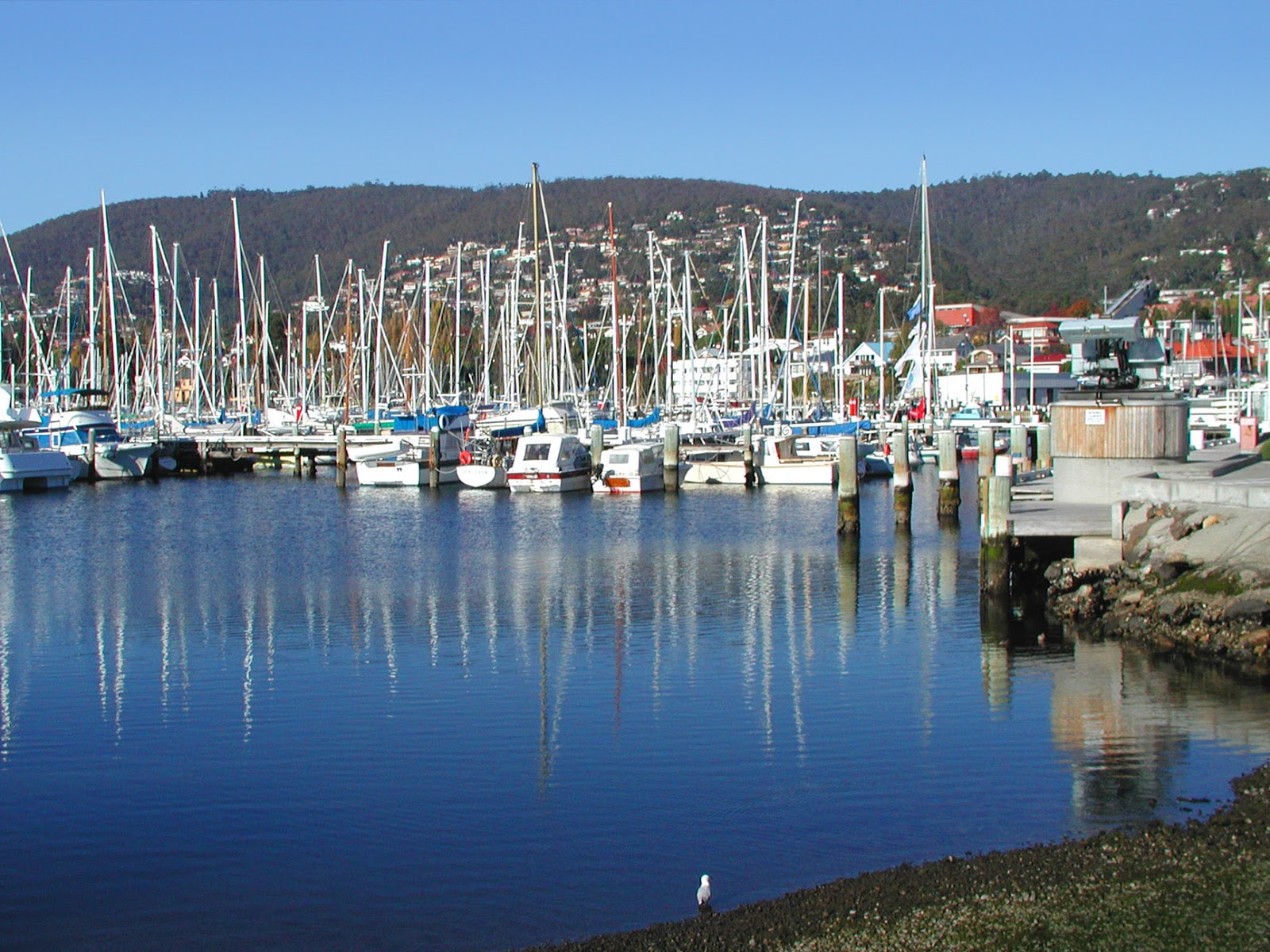
HOBART PROMENADE

Hobart is the state capital and most populous city of the Australian island state of Tasmania. Founded in 1804 as a penal colony, Hobart is Australia's second oldest capital city after Sydney. In 2009, the city had a greater area population of approximately 212,019. A resident of Hobart is known as a "Hobartian".

The city is located in the state's south-east on the estuary of the Derwent River. The skyline is dominated by Mount Wellington at 1,271 metres high. The city is the financial and administrative heart of Tasmania, also serving as the home port for both Australian and French Antarctic operations. Hobart was named Australia's 6th most sustainable city, by the Australian Conservation Foundation in 2010. For economic and social innovation, Hobart was the 11th placed in Australia in 2009, and listed as an innovation influencer city in the Innovation Cities Global Index scoring equal with Reykjavik, Katowice and Casablanca by 2thinknow.

Hobart supports a huge tourist industry. Visitors come to the city to explore its historic inner suburbs and nationally acclaimed restaurants and cafes, as well as its vibrant music and nightlife culture. Australia's first legal casino was the 17-storey Wrest Point Hotel Casino in Sandy Bay, opened in 1973. Tourists also come to visit the massive weekly market in Salamanca Place, as well as to use the city as a base from which to explore the rest of Tasmania.

This post is part of the Monday Mellow Yellows meme,
and also part of the Blue Monday meme,
and also part of the Through my Lens meme,
and also part of the Travel Tuesday meme.


Sunday, 17 January 2016

QUEENSCLIFF BEACH

Queenscliff is a small town on the Bellarine Peninsula in southern Victoria, Australia, south of Swan Bay at the entrance to Port Phillip. It is the administrative centre for the Borough of Queenscliffe. At the 2006 census, Queenscliff had a population of 1,416. Queenscliff is a former 1880s seaside resort now known for its Victorian era heritage and tourist industry and as one of the endpoints of the Searoad ferry to Sorrento on the Mornington Peninsula.

This post is part of the Weekend Reflections meme,
and also part of the Scenic Weekends meme.


Saturday, 16 January 2016

SATURDAY SILHOUETTES #30

Welcome to the Saturday Silhouettes meme! This is a weekly meme that looks at SILHOUETTES in photography.

SILHOUETTE |ˌsɪlʊˈɛt| noun: The dark shape and outline of someone or something visible in restricted light against a brighter background.
ORIGIN - late 18th century: Named (although the reason remains uncertain) after Étienne de Silhouette (1709–67), French author and politician.

This post also a part of the Skywatch Friday meme.

Please add your silhouette shot below, using the Linky tool:

Friday, 15 January 2016

GARDEN ROCKET

Garden rocket (also known as arugula, rucola and roquette) is one of the nutritious green-leafy vegetables of Mediterranean origin. It is a small, low growing annual herb featuring dandelion like succulent, elongated, lobular leaves with green-veins. It belongs within the Brassicaceae family similar to as mustard greens, cauliflower, kale, etc, and has the scientific name, Eruca sativa.

Rocket is a quick growing, cool season crop. It prefers well-drained, fertile soil, and full sunlight to flourish. It grows to about 1 metre in height with creamy-white edible flowers. Its leaves can be ready for harvest within 40 days of sowing the seed. Younger rocket leaves feature light green colour, and appear identical to that of spinach without lobulation. Additionally, young, tender leaves are less peppery and sweet in contrast to strong, spicy flavour of mature greens.

As all members of the Brassicaceae family, rocket leaves are rich sources of indoles, thiocyanates, sulforaphane, and iso­thiocyanates. Together, these compounds have been found to counter carcinogenic effects of oestrogen and thus may offer protection against prostate, breast, cervical, colon, ovarian cancers by virtue of their cancer-cell growth inhibition, cytotoxic effects on cancer cells. It is rich in folates, vitamins A, B complex, C and K, and contains copper and iron. In addition, it has small amounts of some other essential minerals and electrolytes such as calcium, iron, potassium, manganese, and phosphorus.

This post is part of the Friday Greens meme,
and also part of the Food Friday meme.

Thursday, 14 January 2016

IVY FLOWERS

Hedera helix (common ivy, English ivy, European ivy, or just ivy) is a species of flowering plant in the family Araliaceae, native to most of Europe and western Asia. A rampant, clinging evergreen vine, it is a familiar sight in gardens, waste spaces, on house walls, tree trunks and in wild areas across its native habitat. It is labeled as an invasive species in a number of areas where it has been introduced.

The flowers are produced from late summer until late autumn, individually small, in 3-to-5 cm-diameter umbels, greenish-yellow, and very rich in nectar, an important late autumn food source for bees and other insects. The fruit are purple-black to orange-yellow berries 6–8 mm in diameter, ripening in late winter, and are an important food for many birds, though somewhat poisonous to humans. One to five seeds are in each berry, which are dispersed after being eaten by birds.

This post is part of the Floral Friday Fotos meme,
and also part of the Friday Greens meme.