Showing posts with label Primulaceae. Show all posts

Thursday, 14 April 2022

CYCLAMEN

Cyclamen persicum, the Persian cyclamen, in the family Primulaceae, is a species of flowering herbaceous perennial plant growing from a tuber, native to rocky hillsides, shrubland, and woodland up to 1,200 m above sea level, from south-central Turkey to Israel and Jordan. It also grows in Algeria and Tunisia and on the Greek islands of Rhodes, Karpathos, and Crete, where it may have been introduced by monks. 

Cultivars of this species are the commonly seen florist's cyclamen. Wild plants have heart-shaped leaves, up to 14 cm usually green with lighter marbling on the upper surface. Flowers bloom from winter to spring (var. persicum) or in autumn (var. autumnale) and have 5 small sepals and 5 upswept petals, usually white to pale pink with a band of deep pink to magenta at the base. After pollination, the flower stem curls downwards slightly as the pod develops, but does not coil as in other cyclamens. Plants go dormant in summer.

Some cultivars (as the pink one on the left pictured) have a subtle, distinctive fragrance, which is quite unforgettable. Cyclamen persicum has a dark-brown tuberous root which is semi-poisonous. In some cultures, the tubers were used in making soap, as they generate a lather when mixed with water. The Bedouins of Mandate Palestine used to collect the root, and after grating it, would mix it with lime and sprinkle it over the surface of lakes or other large bodies of water known to contain fish. These poisonous mixtures would stun fish, which would then come to the surface and be collected by the fishermen. Such methods, as well as fishing with explosives, which came into use in the early 20th century, were banned by the British Mandate authorities.

This post is part of the Floral Friday Fotos meme.


Thursday, 27 August 2020

PRIMULA

Primula malacoides (ht to 30cm) is a pretty winter/spring annual that is easy to grow and will tolerate shade. It is a determined self-seeder: Even if not planted for years the seedlings pop up everywhere in autumn - and in winter and spring they look so pretty with their tiered layers of simple flowers of shades of pink, mauve or white.

This post is part of the Floral Friday Fotos meme.

Thursday, 22 August 2019

CYCLAMEN

Cyclamen persicum, the Persian cyclamen, in the family Primulaceae, is a species of flowering herbaceous perennial plant growing from a tuber, native to rocky hillsides, shrubland, and woodland up to 1,200 m above sea level, from south-central Turkey to Israel and Jordan. It also grows in Algeria and Tunisia and on the Greek islands of Rhodes, Karpathos, and Crete, where it may have been introduced by monks.

Cultivars of this species are the commonly seen florist's cyclamen. Wild plants have heart-shaped leaves, up to 14 cm usually green with lighter marbling on the upper surface. Flowers bloom from winter to spring (var. persicum) or in autumn (var. autumnale) and have 5 small sepals and 5 upswept petals, usually white to pale pink with a band of deep pink to magenta at the base. After pollination, the flower stem curls downwards slightly as the pod develops, but does not coil as in other cyclamens. Plants go dormant in summer.

Cyclamen persicum has a dark-brown tuberous root which is semi-poisonous. In some cultures, the tubers were used in making soap, as they generate a lather when mixed with water. The Bedouins of Mandate Palestine used to collect the root, and after grating it, would mix it with lime and sprinkle it over the surface of lakes or other large bodies of water known to contain fish. These poisonous mixtures would stun fish, which would then come to the surface and be collected by the fishermen. Such methods, as well as fishing with explosives, which came into use in the early 20th century, were banned by the British Mandate authorities.

This post is part of the Floral Friday Fotos meme.

Thursday, 20 November 2014

PRIMULA BEESIANA

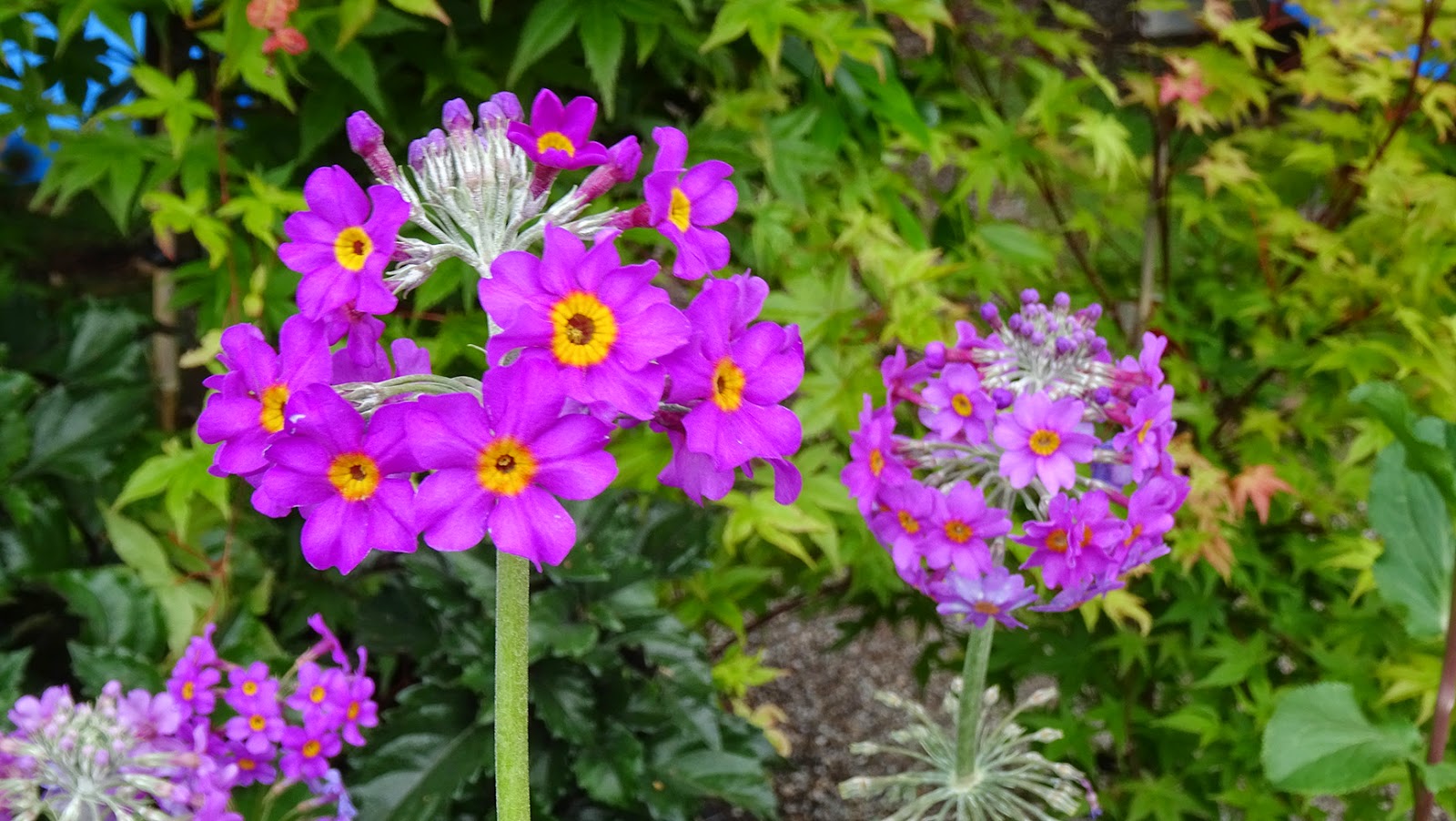
Primula beesiana, now treated as a subspecies of Primula bulleyana, is one of the species known as candelabra primroses. It is a tall Primula with purple-red flowers. Stems of Primula beesiana grow 50–60 cm high and flower in late spring or early summer. The flowers are fragrant and require diligent watering.

Primroses come in many shapes and sizes. The Candelabra group are grown for their colourful display of flowers arranged in tiers or layers on tall, upright stems. This species features heads of rose-purple flowers with a yellow eye. Foliage is light green, held in a low rosette at ground level. All Candelabra type Primrose prefer a rich soil that is constantly moist, and dislike any hint of summer drought. A stream bank or pond side setting is ideal. Allow plants to self-sow. Will tolerate full sun in cool summer regions.

This post is part of the Floral Friday Fotos meme.

Thursday, 11 July 2013

CYCLAMEN

Cyclamen is a genus of 23 species of perennials growing from tubers, valued for their flowers with upswept petals and variably patterned leaves. Cyclamen species are native to Europe and the Mediterranean Basin east to Iran, with one species in Somalia.It was traditionally classified in the family Primulaceae but recently has been reclassified in the family Myrsinaceae. In the APG III system (2009 onwards), Myrsinaceae was not recognised, but was sunk into Primulaceae, which in that system is circumscribed very broadly, as Myrsinoidea sub-family.

This post is part of the Floral Friday Fotos meme.