Thursday, 31 October 2019

CEANOTHUS

Ceanothus L. is a genus of about 50–60 species of shrubs or small trees in the family Rhamnaceae. Common names for members of this genus are California Lilac, Wild Lilac, and Soap Bush. Ceanothus comes from a Greek word meaning "spiny plant". The genus is confined to North America, with the centre of its distribution in California. Some species (e.g. C. americanus) are found in the eastern United States and southeast Canada, and others (e.g. C. coeruleus) extend as far south as Guatemala. Most are shrubs 0.5–3 m tall, but C. arboreus and C. thyrsiflorus, both from California, can be small trees up to 6–7 m tall.

The species illustrated here is Ceanothus thyrsiflorus (also known as blueblossom or blue blossom ceanothus), which is an evergreen shrub in the genus Ceanothus that is endemic to California. The term 'Californian lilac' is also applied to this and other varieties of Ceanothus, though it is not closely related to Syringa, the true lilac. In late spring and early summer, this bushy evergreen shrub is smothered in clusters of dark blue flowers among small, dark green, glossy leaves.

It looks great in the middle of a south or west-facing mixed border, or as a specimen at the edge of a terrace or path. It requires protection from cold, drying winds. Each year, after the plant has flowered, take out dead, diseased or damaged shoots and trim back the flowered shoots to the required shape. Apply a 5-7cm mulch of well-rotted organic matter around the base of the plant in spring.

This post is part of the Floral Friday Fotos meme.

Tuesday, 29 October 2019

RETHYMNO, GREECE

Rethymno (Greek: Ρέθυμνο) is a city of approximately 40,000 people in Greece, the capital of Rethymno regional unit on the island of Crete, a former Latin Catholic bishopric as Retimo and former Latin titular see. Rethymno was originally built during the Minoan civilisation (ancient Rhithymna and Arsinoe). The city was prominent enough to mint its own coins and maintain urban growth. One of these coins is today depicted as the crest of the town: Two dolphins in a circle.

This region as a whole is rich with ancient history, most notably through the Minoan civilisation centred at Kydonia east of Rethymno. Rethymno itself began a period of growth when the Venetian conquerors of the island decided to put an intermediate commercial station between Heraklion and Chania, acquiring its own bishop and nobility in the process. Today’s old town (palia poli) is almost entirely built by the Republic of Venice. It is one of the best-preserved old towns in Crete.

The town still maintains its old aristocratic appearance, with its buildings dating from the 16th century, arched doorways, stone staircases, Byzantine and Hellenic-Roman remains, the small Venetian harbour and narrow streets. The Venetian Loggia houses the information office of the Ministry of Culture and Sports. A Wine Festival is held there annually at the beginning of July. Another festival, in memory of the destruction of the Arkadi Monastery, is held on 7–8 November.

The city’s Venetian-era citadel, the Fortezza of Rethymno, is one of the best-preserved castles in Crete. Other monuments include the Neratze mosque (the Municipal Odeon arts centre), the Great Gate (Μεγάλη Πόρτα or Porta Guora), the Piazza Rimondi and the Loggia. The town was captured by the Ottoman Empire in 1646 during the Cretan War (1645–69) and they ruled it for almost three centuries. The town, called Resmo in Turkish, was the centre of a sanjak (administrative part of a province) during Ottoman rule.

During the Battle of Crete (20–30 May 1941), the Battle of Rethymno was fought between German paratroopers and the Second Australian Imperial Force and Hellenic Army. Although initially unsuccessful, the Germans won the battle after receiving reinforcements from Maleme in the Northwestern part of the island. Today the city’s main income is from tourism, many new facilities having been built in the past 20 years. Agriculture is also notable, especially for olive oil and other Mediterranean products.

This post is part of the Our World Tuesday meme,
and also part of the Ruby Tuesday meme,
and also part of the Travel Tuesday meme,
and also part of the Wordless Wednesday meme.

Sunday, 27 October 2019

MY SUNDAY BEST MEME #141 - MORNING TRAIN

Welcome to the meme, "My Sunday Best", which is a photographic and creative meme that allows you to showcase your talents in imaging. Every Sunday, you can post here showing an image you have created using your camera, (and/or) image processing software, and/or painting and drawing in the conventional way and have scanned in.

The rules are simple:
1) Create your image and post it up on your blog;
2) Put the "My Sunday Best" logo image link somewhere on your post so people can click and come by here;
3) Leave a comment here once you have posted;
4) Visit other posters' blogs and be amazed with their creativity!

Please do not use this meme to advertise your goods or services. This is a creative meme and any inappropriate links or comments shall be removed immediately!


The theme is of your own choosing, so post on any subject you desire.
Morning and waiting for the commuter train to go into the City for work...

Last week Lydia from Sydney, Australia shared some of her snaps and I fell in love with this photo, which is my favourite for the week. Please visit her blog for more of her images.

Thursday, 24 October 2019

HIBISCUS 'TROPICANA'

Hibiscus rosa-sinensis, known colloquially as Chinese hibiscus, China rose, Hawaiian hibiscus, and shoe flower, is a species of flowering plant in the Hibisceae tribe of the family Malvaceae, native to East Asia. It is widely grown as an ornamental plant throughout the tropics and subtropics.

As it does not tolerate temperatures below 10 °C, in temperate regions it is best grown under glass. However, plants in containers may be placed outside during the summer months or moved into shelter during the winter months. Numerous varieties, cultivars, and hybrids are available, with flower colours ranging from white through yellow and orange to scarlet and shades of pink, with both single and double sets of petals.

The cultivar 'Cooperi' has gained the Royal Horticultural Society's Award of Garden Merit. Illustrated here is a Flamenco™ Hibiscus 'Tropicana', featuring spectacular long-lasting (4-5 days) large flowers. These varieties have a compact, well branched habit that provides a neat frame for the lush dark green foliage and the many spectacular full blooms that appear continuously during the warmer months.

This post is part of the Floral Friday Fotos meme.

Wednesday, 23 October 2019

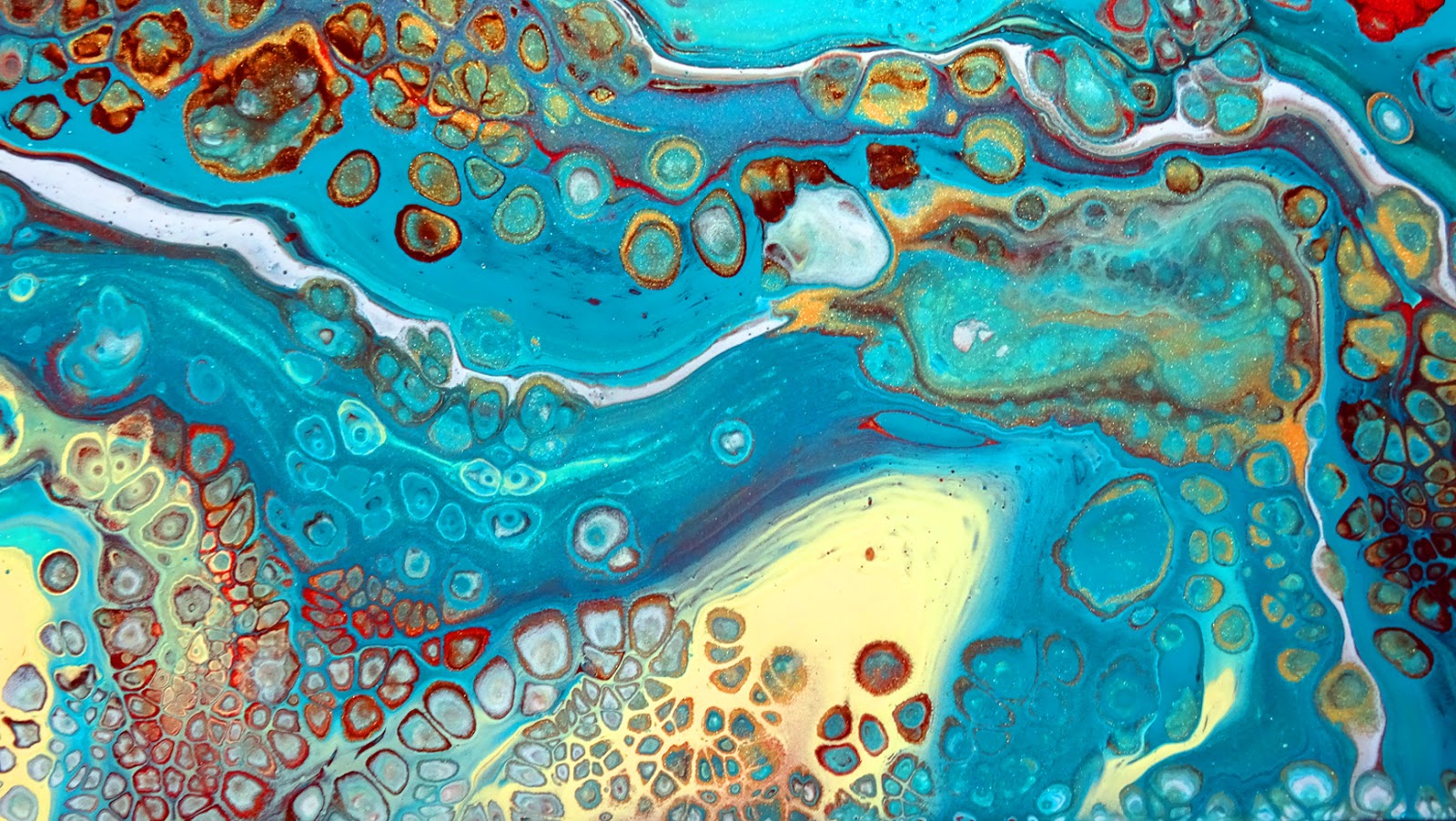
PAINT POUR ART

The last few years, a new form of abstract art has developed. This is a rather heuristic and serendipitous form of art where acrylic paints are mixed with a fluid medium, a few drops of silicone oil are added, the mixed paints are layered in a beaker and then poured on a canvas. The canvas is tilted so that it is completely covered by the paint and the painting is heated with a butane torch so that the silicone oil droplets laden with paint come to the top forming multi-coloured "cells".

Although one may try one's best to control the process, it is largely a matter of chance what patterns develop and how the paints interact and mix with one another. Until I tried it for myself I discounted it as a mechanistic and "easy" way to make art. However, as is often the case, trying my hand at it convinced me that there was indeed skill involved and the choice of colours, the mixing of paint, and close control of a number of variables that one can control, made the difference between a pleasing end-result or the formation of a picture seemingly besmirched with mud.

You may see a paint pour artist at work in this link. It is a fellow Australian, Julie Cutts, who lives in Queensland and produces excellent instructional videos on how she makes her paint pour art.

This post is part of the Wordless Wednesday meme,
and also part of the ABC Wednesday meme.


Tuesday, 22 October 2019

PERTH, AUSTRALIA

Perth is the capital and largest city of the Australian state of Western Australia (WA). It is the fourth most populous city in Australia, with an estimated population of 1.97 million (on 30 June 2013) living in Greater Perth. Part of the South West Land Division of Western Australia, the majority of the metropolitan area of Perth is located on the Swan Coastal Plain, a narrow strip between the Indian Ocean and the Darling Scarp, a low coastal escarpment. The first areas settled were on the Swan River, with the city’s central business district and port (Fremantle) both located on its shores.

Perth is formally divided into a number of local government areas, which themselves consist of a large number of suburbs, extending from Two Rocks in the north to Rockingham in the south, and east inland to The Lakes. Perth was originally founded by Captain James Stirling in 1829 as the administrative centre of the Swan River Colony, and gained city status in 1856 (currently vested in the smaller City of Perth). The city is named for Perth, Scotland, by influence of Sir George Murray, then British Secretary of State for War and the Colonies.

The city’s population increased substantially as a result of the Western Australian gold rushes in the late 19th century, largely as a result of emigration from the eastern colonies of Australia. During Australia's involvement in World War II, Fremantle served as a base for submarines operating in the Pacific Theatre, and a US Navy Catalina flying boat fleet was based at Matilda Bay. An influx of immigrants after the war, predominantly from Britain, Greece, Italy and Yugoslavia, led to rapid population growth. This was followed by a surge in economic activity flowing from several mining booms in the late 20th and early 21st centuries that saw Perth become the regional headquarters for a number of large mining operations located around the state.

This post is part of the Our World Tuesday meme,
and also part of the Ruby Tuesday meme,
and also part of the Travel Tuesday meme,
and also part of the Wordless Wednesday meme.

Sunday, 20 October 2019

MY SUNDAY BEST MEME #140 - CAFE

Welcome to the meme, "My Sunday Best", which is a photographic and creative meme that allows you to showcase your talents in imaging. Every Sunday, you can post here showing an image you have created using your camera, (and/or) image processing software, and/or painting and drawing in the conventional way and have scanned in.

The rules are simple:
1) Create your image and post it up on your blog;
2) Put the "My Sunday Best" logo image link somewhere on your post so people can click and come by here;
3) Leave a comment here once you have posted;
4) Visit other posters' blogs and be amazed with their creativity! Please do not use this meme to advertise your goods or services.

This is a creative meme and any inappropriate links or comments shall be removed immediately! The theme is of your own choosing, so post on any subject you desire.
Brunswick Street is a street in inner northern Melbourne, known for cafés, live music venues, quirky shops, street entertainment and alternative fashion boutiques. Brunswick Street runs north-south through the inner northern Melbourne suburbs of Fitzroy and Fitzroy North, from Victoria Parade at its southernmost end, crossing Alexandra Parade, and continuing until it reaches St Georges Road in Fitzroy North, near the Edinburgh Gardens; there, its former northward course is continued by a much smaller residential street named Brunswick Street North. Tram route 112 runs along the entire length of Brunswick Street for part of its journey.

Last week, Klara from Poland contributed some fine photos, the one below being my fave this week. Go to her blog for more wonderful photography!

Friday, 18 October 2019